PHYSICS OPTICS
 Call Kai
 Learn
 Practice Test
 Spaced Repetition
 Match
 Flashcards
 Knowt Play
1/51

Earn XP
Description and Tags
Y12- physics
52 Terms
What is refraction?
The change in direction of a wave when it passes from one medium to another, caused by a change in its speed.
What wave properties change when a wave is refracted?
The frequency remains constant, so the change in speed causes a change in wavelength.
IF the wave is approaching the interface between the 2 media at an angle then the change in speed causes a change in direction as well.
What is the law of reflection?
Angle of incidence = Angle of reflection
What wave properties change when a wave is reflected?
Only the direction
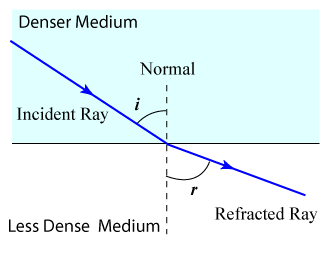
If light enters a material which is less optically dense…
It will speed up, its wavelength will increase and it will bend away from the normal.
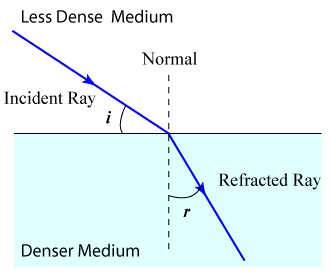
If light enters a material which is more optically dense…
It will slow down, its wavelength will decrease and it will bend towards the normal.
If light crosses a boundary while travelling along the normal…
It will carry on in a straight line but its wavelength and speed will still change.
When a wave refracts, there is always…
Partial reflection off the surface
What is the refractive index?
The refractive index of medium is the ratio between the speed of light in air (or a vacuum) and the speed in the other medium
or
The ratio of the sin of the angle of incidence in air to the sin of the angle of refraction in the given medium.
What are the equations to calculate the refractive index?
n = c/v
n = sinθ1 / sinθ2
Where
n= refractive index, c = 3×10⁸ , v = speed of medium, sinθ1 = sin of the angle of incidence in air and sinθ2 = sin of the angle of refraction in the medium.
A medium with a higher refractive light index is more…
Optically dense
The greater the refractive index of the material…
The lower the critical angle
What is Snell’s Law?
If the ray is travelling between any 2 media:
n1sinθ1 = n2sinθ2
Where θ1 is the angle of incidence in the first medium and θ2 is the angle of refraction in the second medium.
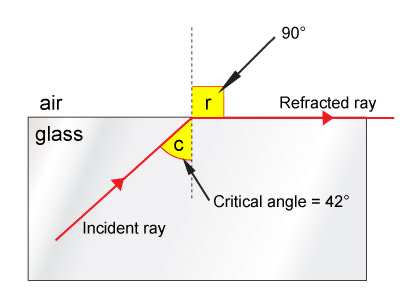
What happens at the critical angle?
The minimum angle of incidence where the angle of refraction is exactly 90 degrees and light is refracted along the boundary.
What causes total internal refection?
When all light is reflected and no refraction occurs.
Occurs when:
The angle of incidence is greater than the critical angle
Light travels in a medium with a higher refractive index strikes the boundary of a medium with a lower refractive index.
What is the equation we can obtain from Snell’s Law to find the critical angle of a material?
1) If the 2nd medium is air
2) If it isnt air
sin (C) = 1/n
sin (C) = n2/n1
Why do different colours refract by different amounts entering a prism?
n = c/v and v = fλ —> n = c/fλ
and n1sinθ1 = n2sinθ2
If medium 1 is air, n1 = 1 so,
sinθ1 = n2sinθ2
sinθ1 = c/fλ sinθ2
sinθ2 = fλ sinθ1 / c
sin of angle of refraction DP wavelength
Smaller wavelengths like violet will refract closer to normal inside the prism.
Why do different colours refract by different amounts exiting a prism?
Same process as entering, such end up with
sinθ1 = sinθ2 c / fλ
So angle refraction INV P wavelength
The shorter wavelengths will have a larger angle of refraction and will refract further away from the normal.
The angles of incidence are not all the same on emergence, so the dispersion effect is amplified.
What is polarisation?
The restriction of oscillations in a transverse wave to a single plane.
What does ‘plane polarised’ mean?
When all the oscillations occur in one single plane.
Why are electromagnetic waves unpolarised?
They oscillate in all directions perpendicular to the direction of travel.
How can we polarise unpolarised light?
We can pass it through a filter that will only transmit those waves that are polarised in a particular plane.
What happens if the second filter (analyser) is in the same/different plane to the first?
If its in the same plane- then the light passes through it unaffected.
However if the second Polaroid is slowly rotated, the intensity of the light transmitted through it drops. When the second filter has turned through 900, no light is transmitted and the intensity falls to 0.
What is used instead of a polarising filter for the polarisation of microwaves?
A metal grille
Outline why the intensity varies from a maximum value to zero. (microwaves)
When the metal grilles are aligned, maximum intensity is received. As one is rotated, the intensity is reduced until the second grille is aligned at 900 to the first, the intensity is zero.
Why does the metal sheet in the door of a microwave oven contain little holes, rather than a series of slits?
Holes will not allow for any orientation of plane polarised microwaves to get through.
What happens when unpolarised light reflects off a surface?
It becomes partially polarised (normally horizontal partial plane polarisation- horizontal component is the greatest).
Critical angle (C)
The minimum angle of incidence where the angle of refraction is exactly 90° and light is refracted along the boundary
Focal point
The point where parallel rays of light (to the principle axis) are focused/ appear to be focused from.
Focal length
The distance from the centre of the lens to its focal point. Negative for concave lenses
Converging lens
Causes parallel light rays to converge/ move closer together.

For a convex lens, a ray of light travelling parallel to the principle axis will refract…
Through the focal point
Diverging lens
Causes parallel light rays to diverge/ move apart.

For a concave lens, a ray of light travelling parallel to the principle axis will refract…
As if they are travelling from the focal point.
Images from diverging lenses
Virtual, diminished, upright
Power of a lens
A measure of the lens’ ability to bend light. Negative for concave lenses
P=
1/f
Power (D- dioptres) = 1/ Focal length (m)
What determines a powerful lense?
A shorter focal length which is caused by a fatter lens.
If light is refracted through two or more lenses consecutively, power =
The sum of the powers of the individual lenses
Real image
Light rays travel to/ through the object. Can be projected on a screen. On the other side of the lens to the object.
Virtual image
Light rays only appear to travel from the object. Can’t be projected onto a screen. On the same side of the lens as the object.
For a convex lens, a ray travelling parallel to the axis of the lens will go…
Through the focus
For a convex lens, a ray travelling through the centre of the lens will…
Carry on it a straight line
For a convex lens, a ray travelling through the focus will go…
Parallel to the axis
For a concave lens, a ray travelling parallel to the axis of the lens will…
Appear to come from the focus on the same side of the lens
For a concave lens, a ray travelling through the centre of the lens will…
Carry on it a straight line
For a concave lens, a ray travelling through the focus on the other side of the lens…
Emerged parallel to the axis
The lens equation
1/u + 1/v = 1/f = power
u = distance between object and lens
v = distance between lens and image
For a virtual image, v is…
Negative
For a graph of 1/v against 1/u, the gradient is…
-1
For a graph of 1/v against 1/u, the x and y-intercepts are…
1/f
Magnification
Image height/ object height
v / u