Week 6 Receptor theory
 Call Kai
 Learn
 Practice Test
 Spaced Repetition
 Match
 Flashcards
 Knowt Play
1/66

There's no tags or description
Looks like no tags are added yet.
67 Terms
receptor
specific macromolecular component of a cell with which a drug interacts to initiate its biochemical and physiologic effects
receptor defined by 2 properties
recognition (selective binding of a ligand)
transduction (conversion of binding into a cellular signal)
receptor binding
usually reversible and governed by chemical forces: ionic, hydrogen, hydrophobic, van der Waals; covalent binding gives long-lasting effects
Macromolecules that act as Drug Targets
Regulatory proteins, Enzymes, Transport proteins, Structural proteins, Nucleic acids
4 consequences of receptors
Quantitative relationships
Therapeutic selectivity
Agonists vs. antagonists
Drug discovery
affinity
how tightly a drug binds to its receptor
Kd
concentration occupying 50% of receptors
measures affinity
high affinity and zero efficacy
antagonist
efficacy
how much effect the bound drug produces
intrinsic activity: full agonist>partial agonist>antagonist
zero efficacy
antagonist
selectivity
how narrowly the drug acts on one receptor
always dose dependent
affinity (Kd) and efficacy
are independent
5 receptor superfamilies
Ligand-gated ion channels - milliseconds (fastest)
G protein-coupled receptors (GPCRs) - seconds
Enzyme-linked receptors - minutes
Cytokine receptors (JAK/STAT) - minutes
Intracellular/nuclear receptors - hours
Drug selectivity
drug's ability to bind preferentially to certain receptors over others, 3D structure of a receptor determines which drugs can bind to
Small changes in drug structure
can produce large changes in affinity, the basis of structure-activity relationships
Stereoselectivity
Receptors may bind one enantiomer more strongly than another
S-warfarin is more potent than R-warfarin
Receptor subtypes
allow medications to target specific receptors and produce more targeted effects, potentially reducing unwanted effects in other tissues
Receptor Regulation
can change due to disease or long-term drug exposure in expression, coupling, and localization
Expression
Number of receptors present
Coupling
How receptors communicate with intracellular signaling systems
Localization
Where receptors are located in the cell
Different beta-receptor subtypes
are located in different tissues and produce different effects when activated
b-1 heart, b-2 airway, b-3 adipose
propranolol nonselective block
blocks beta-1 and bet-2 so the blood pressure benefit arrives with airway risk
difference b/t B1 and B2 receptors
B1 receptor requires a catechol ring, where bulk at N-substituent is allowed for B2 activity and decreases B1 receptor activity
conversion of agonist to antagonist
changing a drugs chemical structure can change it from an agonist to an antagonist
β1 Receptor Antagonism
replacement of catechol ring with a para substituted phenyl ring provides antagonist activity
Occupancy Theory (A. V. Hill)
amount of drug binding to receptors depends on the drug's concentration
low Kd = high affinity

Occupancy Theory graph curve
sigmoidal (S-shaped) curve because drug concentration is plotted on a logarithmic scale
Receptor Occupancy Theory (A. J. Clark)
assumed drug response is directly proportional to receptor occupancy
sigmoidal curve
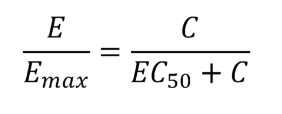
EC50
Drug concentration that produces 50% of the maximum effect
lower value=higher potency
Drug Effect graph (hyperbolic)
pharmacodynamics: how much effect does the drug produce
Emax, EC50, X-axis drug conc., Y-axis drug effect

Receptor Binding graph (hyperbolic)
Receptor Occupancy: How many receptors are occupied by the drug
Kd, Bmax, X-axis drug conc., Y axis receptor bound drug (B)

Both receptor binding and drug effect
increase as drug concentration increases, but eventually reach a maximum
Binding Equation
describes how much drug binds to receptors

Effect Equation
describes how much effect a drug produces

Concentration-response curves
Plotting effect against log concentration converts the hyperbola into a symmetric sigmoid curve
Concentration-response curves 0–20%
Drug effect is approximately proportional to concentration
Concentration-response curves 20–80%
Drug effect is approximately linear with the log of concentration
Concentration-response curves 80–100%
The system approaches maximum capacity, so additional drug produces little extra effect
doubling a dose
rarely doubles the effect, can add toxicity w/o adding benefit
Spare receptors
Receptors that do not need to be occupied for a drug to produce its maximum effect (Emax)
Kd is more then EC50
whenever spare receptors are present
effect curve lies to the left of the binding curve
Why Do Spare Receptors Exist
bc of signal amplification and Prolonged signaling
Signal amplification
Activating a small number of receptors can produce a large cellular response
Prolonged signaling
effect may continue even after the drug separates from its receptor, such as when enzymes remain activated
Clinical Consequence of spare receptors
Irreversible antagonists permanently inactivate receptors
Efficacy Spectrum
full agonist, partial agonist, neutral agonist, inverse agonist

Competitive (Reversible) Antagonism
Shifts the agonist concentration-response curve to the right without reducing Emax, assuming surmountable antagonism
effect depends on ratio of antagonist to
agonist
Irreversible antagonist
Can decrease Emax because functional receptors become unavailable
More agonist overcomes
competitive blockade, it does not overcome irreversible blockade
Recovery requires synthesis of new receptors
duration of irreversible antagonists outlasts
the drugs plasma half-life
partial agonist
Occupies all receptors yet cannot produce Emax bc it stabilizes an intermediate active receptor conformation
partial agonist w/ a full agonist
Acts as an antagonist, it competes for the same receptors and reduces the overall response
neutral antagonist w/ full agonist
Rightward shift only (competitive)
inverse agonist w/ full agonist
Blocks agonist and lowers basal tone
Irreversible antagonist w/ full agonist
decreases the maximum effect a drug can produce, depresses Emax
Antagonism That Does Not Involve the Receptor
Chemical Antagonism, Physiologic Antagonism, Allosteric Modulation
Chemical Antagonism
directly binds to another drug or substance and neutralizes or removes it
Physiologic Antagonism
Two agonists act on different receptors to produce opposite physiological effects
Allosteric Modulation
drug binds to a different site on the receptor than the agonist which changes the receptor's affinity or response to the agonist
Constitutive activity
When a receptor produces a signal even without a drug or agonist binding to it
Receptors naturally exist in two states
Ri (Inactive): Receptor is not producing a signal.
Ra (Active): Receptor produces a signal
baseline signaling
some receptors spontaneously switch into the active state
Increases signaling above baseline
Agonist
Does not change baseline signaling
Neutral Antagonist
Decreases signaling below baseline
Inverse Agonist, binds to Ri preferentially