Crime - Lecture 4
 Call Kai
 Learn
 Practice Test
 Spaced Repetition
 Match
 Flashcards
 Knowt Play
1/77

Earn XP
Description and Tags
Autonomic Nervous System correlates of ASB and violent behaviours
78 Terms
nervous system
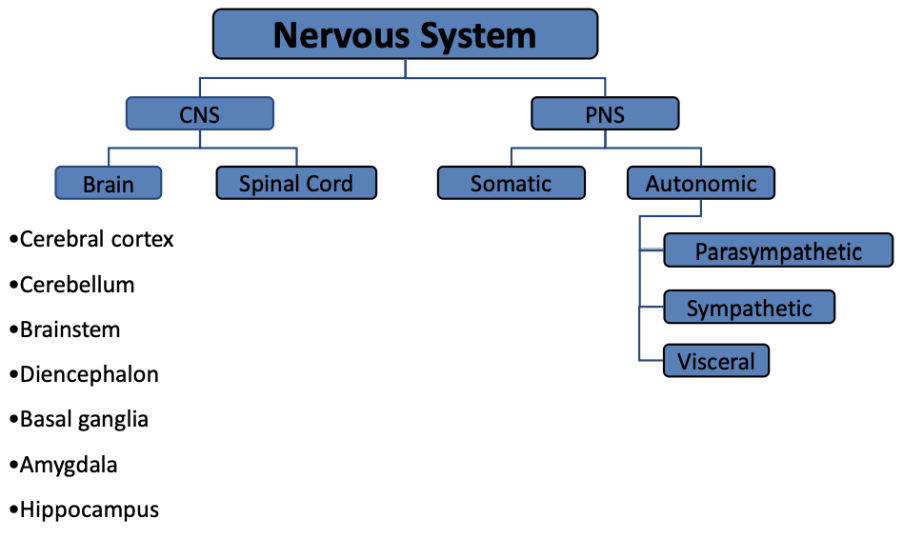
autonomic nervous system controls physiological arousal

low resting HR and ASB: theories - fearlessness theory (Raine, 1993)
hypothesises that low HR is a marker for low fear, which could disrupt early fear conditioning and in turn facilitate criminal acts that require a degree of fearlessness to complete
under this view, antisoical acts would be faciliated by a lack of fear regarding the antisocial context and potential punishment if apprehended
low resting HR and ASB: theories - sensation-seeking theory (quay, 1965)
rests on the premise that a low resting heart rate is a marker of low autonomic arousal, which is thought to be an unpleasant physiological state
as a result, individuals with low resting HRs seek stimulating behaviours, including antisocial behaviours, to increase their level of arousal to a more optimal level (e.g. fights)
in serial killers:
period of time after killing when they go under the radar and do not kill for a period of time
there’s tension that builds up
thats when they start to commit murders
low resting HR: antisocial children - davies & maliphant (1971)
12-16 yo english boarding school pupils
refractory (difficult) group (low resting HR) < non-refractory group
low resting HR: antisocial children - wadsworth (1976)
1,813 male English, Scottish and Welsh 11-year-old school children
official delinquent < non-delinquent
low resting HR: antisocial children - little (1978) school
english male and female school children aged 9-11
those defined as antisocial had lower resting HR compared to those identified as well-behaved
low resting HR: antisocial children - west and farrington (1977)
18-19 year old non-institutionalised english males
those with wither adult or juvenile offences were overrepresented in the group of youths with low pulse rate
low resting HR: antisocial children - venable (1983)
245 11-year-old children of criminal, schizophrenic and psychiatrically normal parents in copenhagen
children with criminal fathers (low resting HR) < children of non-criminals
low resting HR: antisocial children - ortiz and raine - meta-analysis
45 independent effect sizes obtained from 40 studies
studies conducted between 1971 and 2002
total of 5,868 children
the main method of analysis was comparing antisocial children and controls for resting HR at rest
a secondary meta-analysis was also conducted on heart rate during a stressor
significant overall effect sizes were found for both resting HR and heart rate during a stressor
results were not moderated by gender, age, method of recording, use of psychiatric control group, recruitment source, concurrent versus prospective nature of testing, and source of behavioural rating
low resting HR: twin and intergenerational evidence - baker et al.
genetic & environmental influencles to resting HR and the link to ASB
prospective longitudinal design (9&14)
demonstrated a genetic and environmental effect on low resting HR
present throughout development from age 9 to 14

low resting HR: twin and intergenerational evidence - venable
245 11-year-old children of criminal, schizophrenic and psychiatrically normal parents in copenhagen
children with criminal fathers < children of non-criminals
low resting HR and ASB: longtidunial evidence
suggests a causal association can be found using a prospective longitdunial design
selected samples of males

low resting HR and ASB: longtidunial evidence - limitations
often small sample size
many looked at young children/adolecents
the follow up period was quite short
low resting HR and ASB: longtidunial evidence - population-based study (latvala et al.)
population study (representative of the general population)
used swedish national resident number
age 18 had to do military service
medical exam: HR was measured
follow up period (nearly 36 years)
low resting HR associated with increased criminality and exposure to assault in adulthood
low resting HR predictive of a high rate of crime (apart from sexual)

low resting HR and ASB: longtidunial evidence - murray et al.
found an association between low resting HR and subsequent crime
used wrist monitor to measure HR at age 11, 15 and 18 years
looked at violent and non-violent crime at age 18
low resting HR predicted violent and non-violent crime
only cross-sectionally associated with crime in females

low resting HR and ASB: potential confounds
could social factors explain this relationship by increasing the risk for both low resting HR and ASB
farrington (1997) showed that out of 48 individual and environmental predictors of violence, only low resting HR and poor concentration were independently related to violence
low resting HR at age 18 was significantly associated with self-reported violence at age 18 and teacher-reported aggression at age 14
the relationship was found irrespective of several potential conflicting confounds (e.g. personality, poor concentration, education, family factors, and SES)
only resting HR and poor concentration were independently associated with violence
prospective longitudinal study - following men for several decades
gao et al. - role of associative learning in childhood socialisation
children learn to avoid antisocial actions by pairing rule-breaking cues and subsequent socialising punishments, developing conditioned anticipatory fear that deter future misconduct
gao et al. - anticipatory fear hypothesis of ASB
individuals who fail to acquire anticipatory fear or anxiety to warning cues lack the internal emotional brake (conscience) needed to suppress prohibited criminal acts
gao et al. - key neural substrates implicated in fear conditioning and aversive learning
the amygdala and the ventral prefrontal cortex (including the orbitofrontal cortex)
gao et al. - core hypothesis
poor autonomic fear conditioning at age 3 relfects early amygdala-prefrontal dysfunction amd prospectively predicts criminal offeding in adulthood
gao et al. - cohort name and baseline sample size
the mauritius joint child health project, consisting of n=1,795 children initially tested at age 3
gao et al. - psychophysiological modality used to index fear conditioning at age 3
electrodermal responses/skin conductance responding (SCR), relfecting autonomic sympathetic nervous system activity
gao et al. - CS+, CS-, and UCS parameters in the age 3 classical conditioning task
CS+ was a tone paired with an aversive 90-dB loud noise (UCS)
CS- was an unreinfornced tone presented without noise
gao et al. - unconditioned stimulus (UCS) characteristics
an unpleasant, loud 90-dB noise lasting 4.5 seconds
gao et al. - follow-up age and source of criminal outcome data
ppts were reassessed 20 years later at age 23 using official nationwide court conviction records in mauritius
gao et al. - offender group composition and offence criteria at age 23
n = 137 individuals (131 males, 6 females) convicted of property, violent, crug, or serious driving offences (petty offences excluded)
gao et al. - case-control matching ratio and total comparison group size
a 1:2 mathced design where each of the 137 offenders was matched with two non-offender controls, yielding n=274 comparison subjects
gao et al. - confounding variables controlled via matching
gender, age, ethnicity, and a 9-point childhood social adversity index measured at age 3
gao et al. - electrodermal conditioning response of the comparison group (n = 274)
robust differential conditioning: significantly greater skin conductance responses to the CS+ relative to the CS-
gao et al. - electrodermal response of the future offender group (n = 137)
differential conditioning failure: no significant difference in skin conductance between the CS+ and CS-
gao et al. - theoretical significance of matching for childhood social adversity
demonstrated that the poor conditioning deficit in future criminals was independent of early socioeconomic, environmental, or family deprivation
gao et al. - neurodevelopmental precursor concept established
autonomic fear conditioning deficits at age 3 precede criminality by 20 years, serving as an early neurobiological marker rather than a byproduct of offedning
gao et al. - double dissociation of amugdala vs hippocampal damage in fear conditioning (bechara et al., 1995)
amygdala lesions abolish autonomic conditioned fear (SCR) while sparing declarative memory
hippocampal lesions spare fear conditioning but impair declarative recall
gao et al. - role of the insular cortex in emotional processing and conditioning
the insula supports interoception (awareness of bodily/visceral changes) and integrates autonomic arousal into conscious feeling states
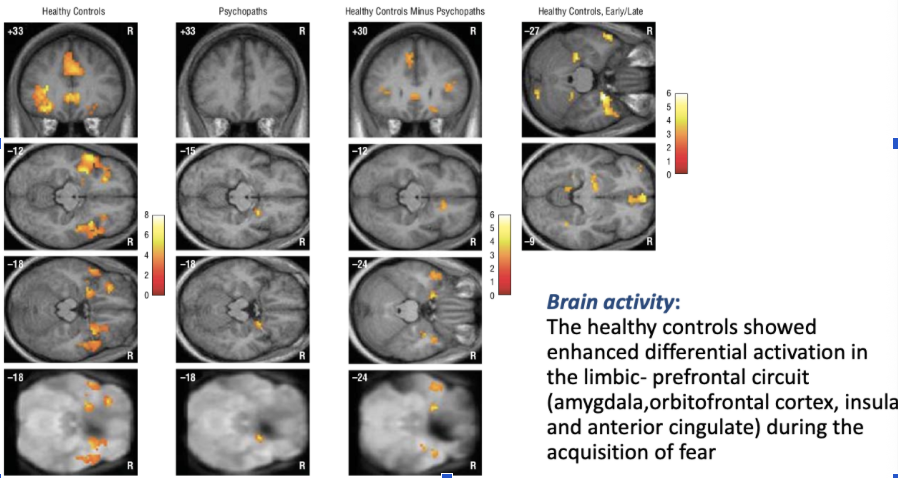
gao et al. - fmri findings during fear acquisition in psychopathy (birbaumer et al.) he
healthy controls showed enhanced activation in the front-limbic circuit (amygdala, OFC, insula, anterior cingulate), whereas individuals with psychopathy exhibited deficient activation
gao et al. - fear conditioning findings in youths with CD (fairchild et al.)
both early-onset and adolescence-onset CD youths (male and female) showed impaired electrodermal fear conditioning and blunted startle modulation
gao et al. - early intervention implications
enrichment programs in early childhood focusing on nutrition, physical health, and cognitive stimulation can enhance brain development and potentially reduce adult criminality
gao et al. - the multifactorial caveat emphasised
adult crime cannot be deterministically predicted by a single biological marker
it arises from complex interactions among neurobiology, genetics, parenting, and social environments
gao et al. - latency window for conditioned responses
skin conductance responses occuring within specific latency windows (e.g. 1-3 seconds and 11-13 seconds after CS onset, prior to UCS presentation)
gao et al. - comparison of UCR between offenders and controls
offenders reacted normally to the loud noise itself (UCR), proving their deficit was specific to associative anticipation (CR) rather than sensory deafness or somatic paralysis
gao et al. - low resting HR vs poor fear conditioning as ANS markers for ASB
low resting HR relfects tonic autonomic hypoarousal and sensation-seeking/fearlessness, whereas poor electrodermal fear conditioning reflects phasic deficits in associative punishment learning
fagan et al. - primary research question
does autonomic nervous system activity mediate the link between childhood social adversity and antisocial behaviour, and does this indirect pathway differ by sex?
fagan et al. - sample and setting
339 community children aged 7-10 years from Brooklyn, New York
fagan et al. - three cardiovascular measures and their ANS functions
resting HR: overall cardian activity
HR variability: parasympathetic vagal tone
pre-ejection period: sympathetic cardiac drive
fagan et al. - key mediation finding in boys
resting HR was a significant mediator
early social adversity lowered resting HR, which in turn predicted greater ASB
fagan et al. - key findings in girls
social adversity directly predicted antisocial behaviour without any medication by cardiovascular measures
fagan et al. - role of isolated autonomic branches (HRV and PEP)
neither HRV nor PEP mediated the relationship on their own, demonstrating that low resting HR reflects complex autonomic co-regulation rather than simple sympathetic under-arousal
fagan et al. - three theoretical frameworks tested
sensation-seeking/under-arousal theory
misconduct elevates unpleasant low arousal
fearlessnear theory
low fear impairs punishment learning
blunted stress hypothesis
chronic stress suppresses physiological reactivity
fagan et al. - practical intervention proposed
providing structured, prosocial opportunities that safely elevate physiological arousal (such as competitive sports or vigourous physical activities) for low-HR boys
fagan et al. - primary methodological limitation
cross-sectional design, which prevents confirming true causal temporal ordering between adversity, physiology, and behaviour
fagan et al. - assessment of ASB
caregiver ratings across multiple clinical scales (CBCL, APSD, ICU, DISC-IV) combined into a single factor measuring aggression, rule-breaking, callousness, and conduct problems
raine et al. (1995) - high resting HR as a protective factor for ASB
collected data from males at age 15 (resting HR) and criminal behaviour at age 30
desistors had significantly higher electrodermal arousal and higher electrodermal orienting than the criminal group
risk factor of low resting HR
also collected skin conductance
electrodes measure how electricity travels to tissue
how sweat glands function
SNS activity - not under our control
not everyone feels fear to the same extent as others
blair et al. - skin conductance: fear conditioning and conscience
speculate skin conductance response can be something people learn
acquired through repeated exposure to certain things in early ages
lorber et al. - learning fear conditioning, so using skin conductance
different measures of ANS functionality were paired with different types of offending
dampening of ANS associated with psychopathic traits
was not unanimous across all features of criminal behaviour
skin conductance
higher skin conductance related to higher aggressive behaviour
may be reactive aggression that causes higher skin conductance
association of poor childhood fear conditioning and adult crime
skin conductance response
tried to match ppts characteristics such that criminal offenders were similar to the comparison group
repeated exposure to a stimulus; becomes a conditioned response
classical conditioning
measure response to an UCS
CS+ → warning cue before unpleasant stimulus
criminals do not respond as strongly to stimulus
reduced fear response
CS- → skin conductance is the same for both groups

bechara et al. - amygdala fear conditioning - double dissociation
amygdala and hippocamus intact
for the CS+ task, they experience an increase in response
the patient with bilateral amygdala damage failed to fear-condition to aversive stimuli but could nevertheless report the facts about the conditioning experience
in contrast, another patient with hippocampal damage successfully acquired a conditoned fear response but had no explicit memory of the conditioning procedure (declarative issues)
indicating that fear conditioning depends on the amygdala
patient with damage in both struggled with both conditioning and declarative

the insular cortex or insula
cerebral cortex structure located deep within the lateral fissure between the temporal lobe and the frontal lobe
the insula rather than the hippocampus may be the crucial region involved in the perception of bodily changes (i.e. interoception ability)
insula is involved in a range of emotional processes, including:
recognition
experience
empathy
interoception: ability to feel your inner body
insula and interoception - critchley et al.
measured someone’s HR
able to instantly present info on a screen
asked “is this info correct with how you feel?”
sometimes manipulated the information
measured how accurate people were with their own physiological understanding of their bodiies
better detection was associated with increased activity and greater grey matter volume in right anterior insula

insula and interoception - birbanner et al. - methods
one of the faces was associated and conditioned to relate to pain
swapped between the two images
CS+ → stimulus is displayed, and another stimulus follows
CS- → stimulus is displayed, but is not followed
asked ppts whether they felt pain
valence: the spectrum of what we perceive as positive and negative
e.g. how positive the experience was
arousal: how strongly your nervous system is activated
habituation: get used to the environment
AC1: early learning, AC2: late learning
ext: how quickly you recover from the pain
insula and interoception - birbanner et al. - results (overall)
healthy controls and psychopaths both felt pain in CS+
both reliably said no pain in CS-
valence
significant difference in AC2
psychopaths do not experience a difference in valence in CS+/-
healthy controls feel more negative in CS+
arousal
healthy controls did not recover as quickly after CS+
based on self-report (psychopaths do not want to seem like psychopaths)
skin conductance rates (SCRs)
healthy controls responded more highly to CS+
psychopaths did not respond much differently between the two
can report they feel the pain, but their body does not show

insula and interoception - birbanner et al. - results (brain)
healthy controls show a lot of activity in certain areas of the brain
limbic and frontal structures are very active
for psychopaths, this is not shown
it is the composition of info that travels across the brain that is affected, not just one area
fairchild et al. - fear conditioning and startle reflex (males)
HC = healthy controls
AO-CD = adolescent-onset CD
EO-CD = early-onset CD
healthy controls
no skin conductance response in the acquisiton phase
there is in the CS+ phase
AO-CD & EO-CD
SNS does not respond to the CS+ condition
both groups have the same problems

fairchild et al. - fear conditioning and startle reflex (females)
looked into females
control and CD
controls
response to CS+, but not to CS-
cannot see this in females with CD
universal across sexes
CD and skin conductance response are correlated
looked into whether skin conductance response to CS+ was unique
ppts with CD had lower skin conductance response to pain across different types of stimuli than controls

measurement of the startle reflex
elicited with a brief burst of white noise (“startle probe”) presented over headphones
eyeblink response is indexed by recording electrical activity in the orbicularis oculi muscle
can measure HR, breathing, and muscle contraction
blink at a slower rate when you’re calmer then when stressed

grillion & patrick - advantages of the startle reflex
the startle reflex is a ubiquitous, cross-species response to abrupt and intense stimulation
the neurobiological substrates of startle and fairly well-delineated, allowing for greater hypothesis testing and generalisability of the results
as an automatic/relfexive (<50 ms) subcortical measure, it is less influenced by intentional control
in contrast to other measures indexing autonomic responding (e.g. HR or electrodermal measures), it indexes aversive emotional activation (i.e. valence) independently of arousal and experimental task demands

no physiological measure to measure valence
a lot og psychological traits stimulate the SNS
measurements, e.g. skin conductance, don’t tell us if it is positive or negative
blink/startle reflex does
threatening information
largely increases eye blinks
for both medium and high intensity

emotion manipulation
pleasanmat, neutral and unpleasant pictures from the International Affective Picture System (IAPS)

major dependent measure
startle reflex response
response matching hypothesis
startle reflex is a defensive response
the magnitude of the reflex is INCREASED when the organism if fearful (fear-potentiated startle; FPS)
the magntiude of the reflex is DECREASED when the organism is “feeling good”
pleasant images paired with negative stimuli, same with neural and unpleasant images

neural circuits mediating fear-potentiated startle reflex
processed by receiving information received from the outside (eyes)
information is processed in the pons in the brain stem
specifically in the cochlear nucleus
then to the cortex back to the muscles to process the blink response

fear-potentiated startle reflex and the amygdala
information goes through the root neurons (pons)
processed in specific areas of the pons
then back to motor neruons to generate the blink
the amygdala steps in before the motor neurons to determine when the detected information is dangerous, something to be fearful of
if the amygdala is impaired, the ability to detect fearful information is diminished

psychopathy and the low fear hypothesis - blair et al.
there is a considerable body of evidence that suggests that individuals with psychopathy are impaired in the processing of fear-related stimuli (amygdala)
psychopaths typically show impaired:
aversive conditioning
autonomic responses to anticipated threat
passive avoidance learning
the augmentation of the startle reflex to visual threat primes
patrick et al. - psychopathy and the fear-enhanced startle reflex - PCL-R
two types of psychopaths
PCL-R measures those two types/factors
factor 1 - typical pyschopath
emotionally, regulated, cool and collected, doesn’t show many emotions
neurologically acquired
factor 2 - just antisocial
typically bullies
react with aggression, emotionally disregulated, cannot control themselves
acquired psychopathy
do not have the typical amygdala impairments, just adverse childhood experiences
patrick et al. - psychopathy and the fear-enhanced startle reflex - methods
study sample: 54 male prisoners (sexual offenders) assessed using the PCL-R
mean age = 30.9
participants were shown slides of three types:
pleasant (e.g. erotic scenes)
neutral (e.g. plants)
unpleasant (e.g. mutilated bodies)
a loud tone was played during the slide presentation to induce a startle response in the participants
patrick et al. - psychopathy and the fear-enhanced startle reflex - factor separation results
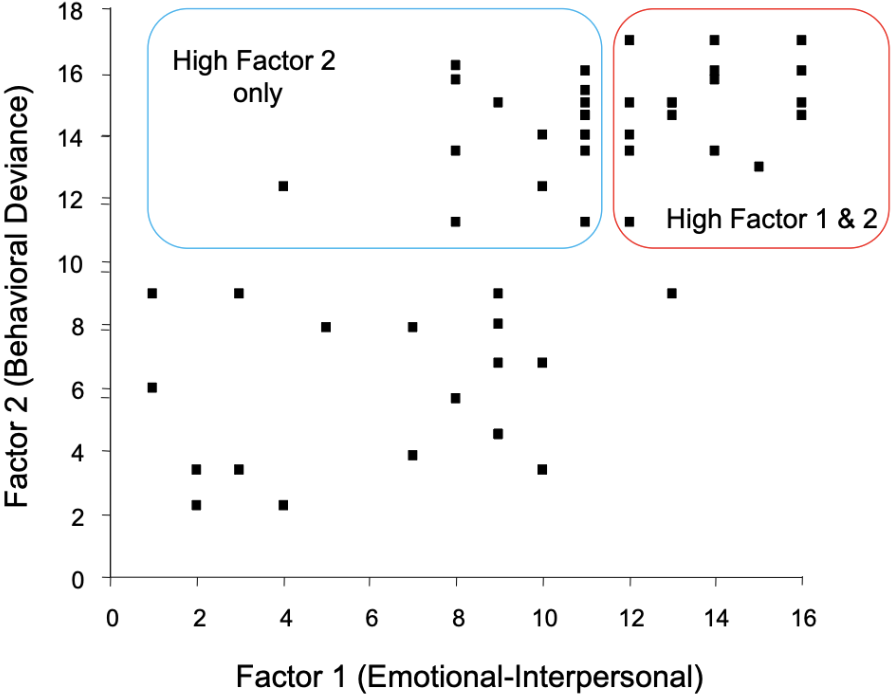
found everyone who scored highly on factor 2 and separated them from those with factor 1&2
usually if someone has factor 1, they also have factor 2
patrick et al. - psychopathy and the fear-enhanced startle reflex - overall results
high factor 2
blink rate on the rise from pleasant to unpleasant images
hight factor 1 & 2
low blink rate for both pleasant and unpleasant images
increased rate in the neutral
provides further evidence for the distinction between factor 1 & 2 in psychopathy

fairchild et al. - startle reflex modulation in youths with CD
males with adolescent-onset do not differ hugely from early onset on the fear-potentiated startle reflex
differ for control groups
is not a specific pattern for the different types of valence (positive, sad, etc.)
same happens for females
blink rate is reduced across the different valence for CD

lecture summary
antisocial and violent behaviour in youths and adults has been associated with abnormal ANS functioning
low resting HR, low skin conductance, low FP startle reflex
fearlessness, sensation-seeking, and low conscious development have been proposed as mechanisms in major theories
meta-analystic and prospective longitudinal evidence
neuroimaging and lesion studies point to abnormalities within the amygdala and the insular cortex
there does not seem to be sex differences in youths with CD