Exam 3-Lesson 5 Protein Transport and Folding
 Call Kai
 Learn
 Practice Test
 Spaced Repetition
 Match
 Flashcards
 Knowt Play
1/62

There's no tags or description
Looks like no tags are added yet.
63 Terms
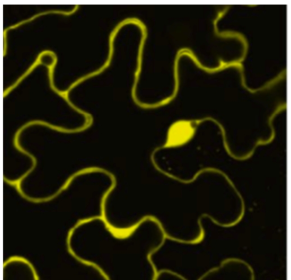
epidermal cell of tobacoo plants
giant central vacuole that pushes nucleus to edge of cell
Colocalization Experiment with Plasma Membrane marker
checks whether two things sit in the same place inside a cell.
label your protein of interest with one fluorescent color and a known reference structure with another, image both, and see how much the two signals overlap.
Signal Peptide
15-20 amino acids found at N-Terminus of newly made protein
shipping label, directs proteins were to go
HDEL Sequence
four-amino-acid tag, His-Asp-Glu-Leu, at the very C-terminus (the end) of a protein
ER retention signal (keeps soluble proteins in Endoplasmic Reticulum)

How are molecules transported between cytosol and nucleus?
nuclear pores!
small subunits (30-60 kDa) go through pores, ex: RNA & ribosomal subunits go nucleus → cytosol
Ribosomal subunit proteins/other proteins cytosol → nucleus
each pore involved in 1,000 translocations per second
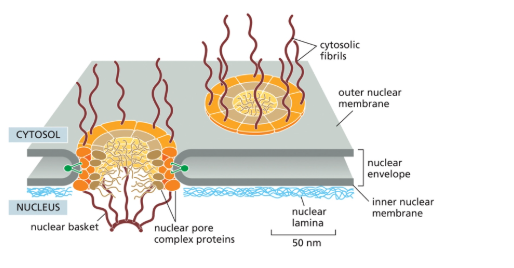
Nuclear Basket and Cytosolic fibrils
proteins
nuclear basket faces nucloplasm
Nuclear lamina
signature to animal cells
Why do plants not have nuclear lamina?
do not have intermediate filaments (which make up nuclear lamina)

nuclear pore with TEM
Nuclear Importins
protein used to get proteins into nucleus
Nuclear localization signal (NLS) recognized by nuclear import receptor (AKA importin)
Nuclear Exportins
proteins that bring proteins from nucleus to cytosol
binds nuclear export signals (NES)
What is in the center of the nuclear pore complex?
proteins binding loosely in gel-like structure (Phe- Gly nucleoporins [FG Nup])
FG Nup
Fenoalynine Glycine Nucleoporins
loose gel-like structure of proteins
important for allowing proteins to pass through nuclear pore
Ras
used in signaling protein for cell proliferation
part of MAPKKK pathway
Ran-GTP cycle
allows proteins to be imported and exported out of nucleus
Ran
small GTPase, binds GTP or GDP
Binds GTP when inside nucleus
Binds GDP while in the cytosol
Ran-GTP Cycle
Ran GAP (GTPas activating protein) facilitates GTP hydrolysis (in cytosol)
Ran-GEF (Guanine nucleotide exchange factor) exchanges GDP for GTP in Ran, only in nucleus
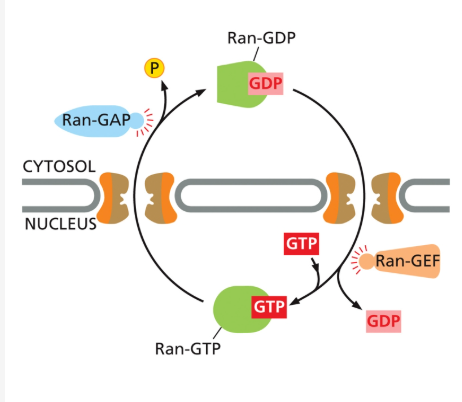
How do Ran-GAP and Ran-GEF stay in cytosol and nucleus respectively?
Nuclear import signal and nuclear export signal (different signal sequences for different proteins)
How does Ran GDP import stuff into the nucleus?

How is Ran GTP involved in export out of the nucleus?

How are proteins transported throughout the cell?
Nuclear Pores- proteins transported in folded form
Across membranes- proteins transported in unfolded form & refolded after transport (same as bacteria- or accomplished by protein translocators)
Vesicles- proteins transported in folded form
Protein translocator
protein complex that moves proteins into/across membranes
Signal Peptidase
cleaves off signal peptide in protein
Where is the protein signal sequence located?
N-terminus
(5’ end of mRNA)
What form are proteins usually transported in?
unfolded
translocation through both membranes occurs simultaneously if protein is destined for matrix
Where are most proteins for mitochondria located?
synthesized by ribosomes in cytosol bc most mitochondrial proteins are encoded for in the nucleus
If proteins are transported unfolded, how are they not degraded?
chaperone proteins bind to aid in transport
How are proteins translocated into chloroplasts?
extra step b/c of thylakoid membranes
1st N-terminal signal peptide cleaved and 2nd signal peptide binds
directs proteins into thylakoid via 4 different pathways
How are proteins without an ER signal sequence synthesized?
by cytosolic ribosomes
Signal Recognition Particle (SRP)
signal (zip code) to guide proteins to correct location
Think postal worker while signal sequence is mailing address
(technically protein + RNA)- this helps protein be flexible
Polyribosomes
many ribosomes reading the same mRNA sequence at once
What is cotranslational translocation?
protein moved across membrane (or inserted in membrane) while still being synthesized
How are soluble proteins translocated into ER lumen?
soluble= in cytosol
cotranslational translocation
signal peptidase cleaves off ER signal sequence (by N-terminus), then degraded while mature protein folds & released into ER lumen
how does SRP use GTP for cotranslational translocation?
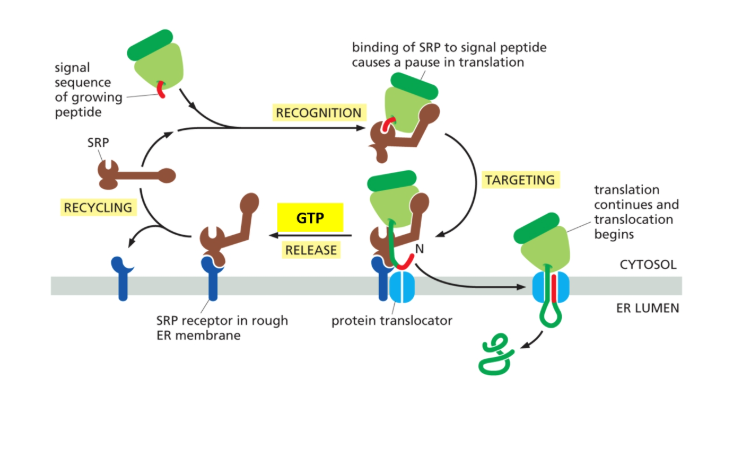
which form of energy is used for translation?
GTP
Sec 61
the core, universally conserved protein-conducting channel (translocon) in the endoplasmic reticulum (ER) membrane of eukaryotic cells that mediates cotranslational translocation.
Same in bacteria, archaea, eukaryotes
how is post-translational translocation different in bacteria & eukaryotes

Are start and stop transfer sequences hydrophobic or hydrophilic?
hydrophobic so they stay in membrane
What charge are the residues GENERALLY in the cytosol?
positive
What charge are the residues of the ER lumen GENERALLY?
negative
Microsomes
mini ERs
Contains all proteins that would be found in the ER (ex: SRP receptors)
Amino-acyl tRNA
Charged tRNA (has amino acid bonded to it)
Where must GFP be put on a type 1 protein
C terminus, otherwise it interferes with protein folding
ends up in cytosolic end
Type 1 Protein

Type 2 Protein

Type 3 Protein

The ER lumen is topilogically equivalent to…
outside of the cell
Type 4 Protein
multiple passes of protein

GPI-anchored proteins (Glycosylphosphatidylinositol)
similar to soluble ER proteins
start transfer sequence @ n-terminus
sit on outside of cell surface (anchored to membrane but not actually in-membrane)
receptors for different molecules

How does adding detergent and protease affect the protein?
kills/unfolds all the protein
What does the endomembrane system consist of?

What does it mean that vesicles and membranes maintain their orientation?
non-cytosolic side always faces lumen of compartment or outside of the cell
What is COP1?
Coatomer Protein 1
vesicular transport between golgi cisternae and from golgi back to ER

What isi COP 2?
ER to golgi
How does clathrin work with endocytosis?

How do SNARES, tethering proteins, and Rab work?

Lysosomes
only present in animal cells
Acidic vacuoles in plants and fungi
Acidic pH, optimal for hydrolases, maintined by active H"+ pumping into lysosomal lumen
would denature proteins in cell if it broke
If a protein is glycosylated, what can you conclude about its location?
anywhere in endomembrane system
N-linked glycosylation
carb chain linked to asparagine residue by ER
aids in protein folding and function
Are antibodies glycosylated?
Yes! Any eukaryotic organism can be used to make antibodies
What is Endo H?
Endoglycosidase H
Recombinant glycosidase (basically specific molecular scissors)
cleaves off high-mannose oligosaccharides from N-linked glycoproteins

What is Endo D?
cleaves in ER lumen and golgi
