Ap Bio Unit 4
 Call Kai
 Learn
 Practice Test
 Spaced Repetition
 Match
 Flashcards
 Knowt Play
1/31

There's no tags or description
Looks like no tags are added yet.
32 Terms
How Animal Cells Communicate
Through direct contact, secreting local regulators, and long distance
Autocrine Signaling
Cells sends the signal to itself
Juxtacrine Signaling
Cells communicate with adjacent cells through direct contact
Paracrine Signaling
Cells communicate to nearby cells by releasing chemical messengers
Endocrine Signaling
Cells communicated to cells far away by releasing chemical messengers that are carried to the target cell
3 Stages of Cells Signaling
Reception, transduction, and response
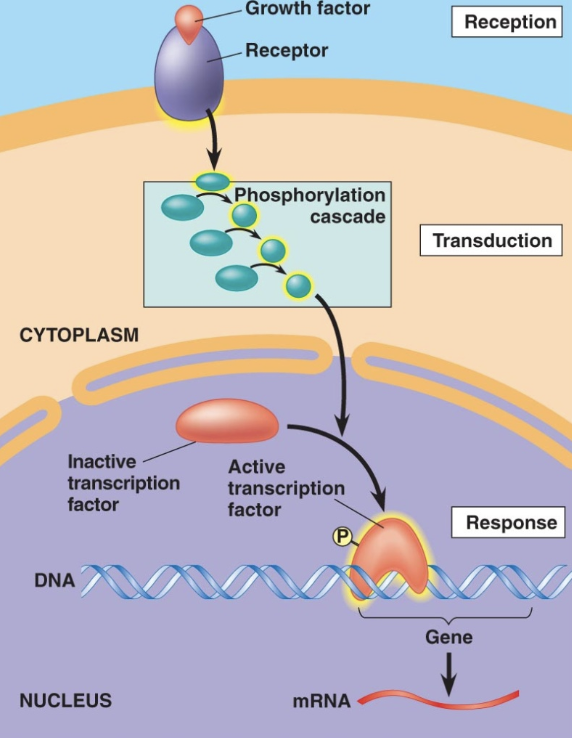
Reception
This is the detection of a signal molecule. Binding between a ligand and receptor is highly specific. Ligands bind to receptor protein → protein changes shape → initiates transduction signal

Plasma Membrane Receptor
H20 soluble ligands
Intracellular Receptors (Cytoplasm, Nucleus)
Small or hydrophobic ligand molecules (testosterone or nitric oxide)
G-Protein Coupled Receptors
G proteins bind the energy-rich GTP (similar to ATP). G proteins are all very similar in structure. GCPR systems are extremely widespread and diverse in their functions

Receptor Tyrosine Kinase
Membrane receptors that transfer phosphate groups from ATP to another protein. Can trigger multiple signal transduction pathways at one

Ligand Gated Ion Channel
Acts as a gate that opens and closes when the receptor changes shape. When a signal molecule binds as a ligand to the receptor, the gate allows specific ions, such as Na+ or Ca2+ through a channel in the receptor

Transduction
Molecular interactions relay signals from receptors to target molecules in the cell. It’s a multistep pathway and can amplify a signal (by activating multiple copies of the next component in the pathway). It provides more opportunities for coordination and regulation. At each step in a pathway, the signal is transducer into a different form, commonly a conformational change in a protein
Transduction-Phosphorylation
A series of protein kinases add a phosphate to the next one in line, activating it. Phosphate enzymes then remove the phosphates

Transduction-Secondary Messengers
Small molecules/ions that relay signals received by receptors to proteins (cAMP, Calcium)

Response
The same signal molecules can trigger different responses. Many responses can come from 1 signal and that signal can also trigger an activator or inhibitor. The signal can also trigger multiple receptors and different responses. This regulates protein synthesis by turning on/off genes in the nucleus (gene expression) and regulates the activity of proteins in the cytoplasm,
Stopping the Response
When the ligand detaches from the receptor
Apoptosis
The cell is dismantled and digested. This is triggered by signals that activate a cascade of suicide proteins (cascade)
Pathogens
Viruses, bacteria, fungi, protists
Innate Immunity
This is not specific and is the recognition of invading pathogens, rapid response, and using soluble antimicrobial proteins
Adaptive (Acquired) Immunity
Characterized by genetic rearrangements that generate a diverse set of molecules to recognize and invader. A slower response but highly specific
Skin
This is a part of innate immunity and contains many normal flora (good bacteria)
3 Kinds of Defending Leukocytes (White Blood Cells)
This is another part of innate immunity that includes macrophages, neutrophils, and natural killer cells
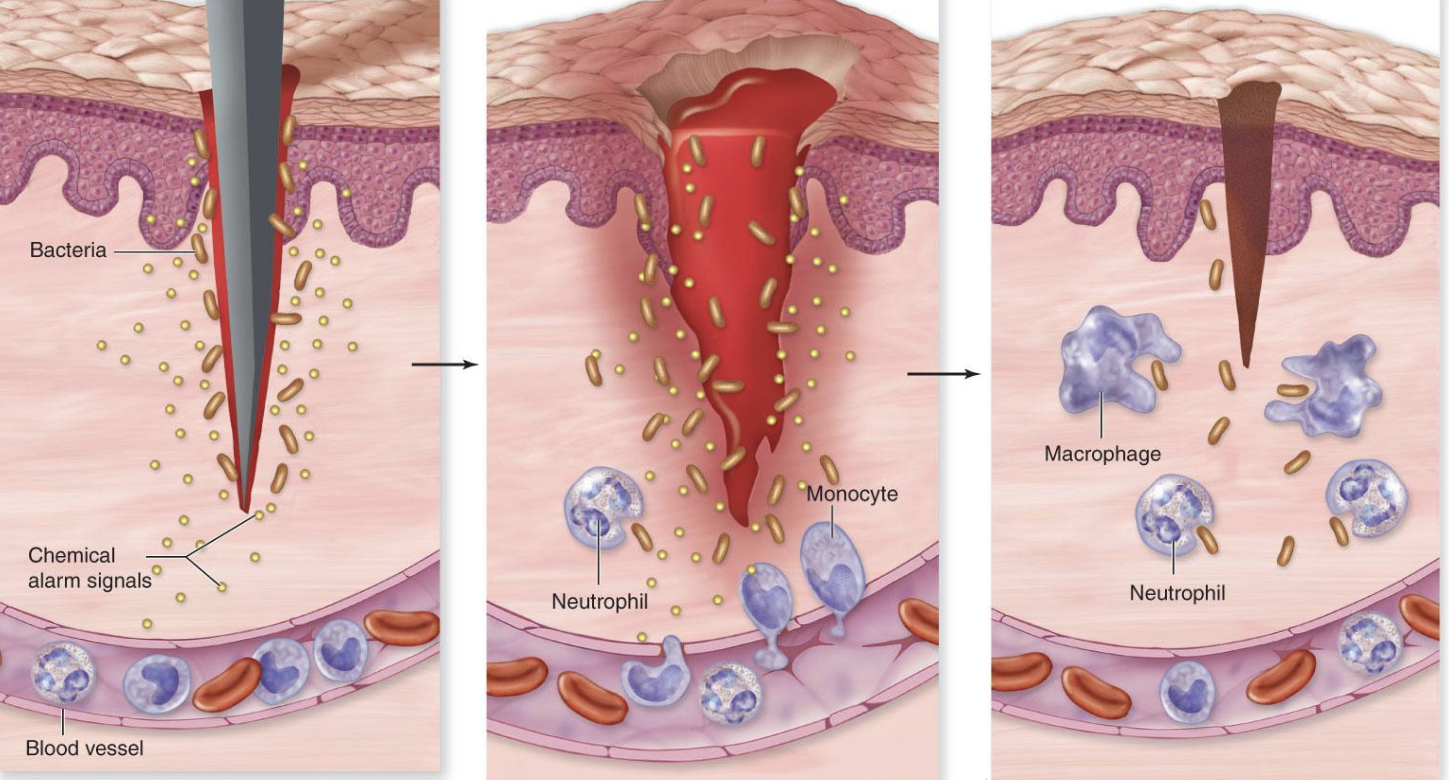
Macrophages
These are white blood cells that kill microorganisms through phagocytosis. Monocytes mature into these
Neutrophils
These are the most abundant circulating leukocyte and also use phagocytosis
Natural Killer Cells
These are white blood cells that don’t attack invading cells directly and induce apoptosis
Phagocytosis
A cellular process in which a cell uses its plasma membrane to engulf and digest large solid particles
Inflammatory Response
This is a part of innate immunity and involves several body systems. Inured cells release chemical alarms, inducing histamine and prostaglandins. It causes nearly blood vessels to dilate and increase in permeability and promote phagocyte accumulation
Fever
This is a part of innate immunity and a higher temperature helps defense
Compliment System
This is a part of innate immunity and about 30 proteins are circulating in blood plasma. It attacks bacterial and fungal cells which forms a membrane attack complex, perforates the target cell, and leads to apoptosis where the cell swells and bursts
Active Immunity
Results from the activation of an individuals own lymphocytes. Pathogen infection of vaccination
Passive Immunity
Results from obtaining another indiiduals’s