Section 3 Cue Cards
 Call Kai
 Learn
 Practice Test
 Spaced Repetition
 Match
 Flashcards
 Knowt Play
1/44

Earn XP
Description and Tags
Vocabulary practice flashcards covering membrane structure, selective permeability, passive and active transport mechanisms, and bulk transport processes based on lecture materials.
45 Terms
Selective Permeability
A characteristic of cell membranes that allows them to regulate cellular intake and excretion by permitting certain molecules or ions to pass while excluding others.
Properties of molecules that pass easily through the lipid bilayer
Nonpolar and hydrophobic (e.g., hydrocarbons, CO<em>2, and O</em>2)
Lipid bilayer limits passage of what molecules
Polar hydrophilic molecules and ions such as sugars and H2O
Transport proteins
Membrane proteins that enable hydrophilic ions and polar molecules to pass across the lipid bilayer.
Channel Proteins
Transport proteins that contain a hydrophilic channel, allowing specific polar molecules or ions to pass through the hydrophobic lipid bilayer by diffusion.
Carrier Proteins
Transport proteins that bind to specific target molecules and undergo a change in shape to translocate the solute across the membrane.
Aquaporin
A specialized channel protein in the plasma membrane that specifically facilitates the rapid passage of water molecules (H2O).

What is this process?
Diffusion
Diffusion
The spontaneous movement of a substance down its concentration gradient from an area of higher concentration to an area of lower concentration without energy input.
Concentration Gradient
A region along which the density or concentration of a chemical substance increases or decreases.
Passive Transport
The diffusion of a substance across a biological membrane down its concentration gradient without any expenditure of energy by the cell.
Osmosis
The diffusion of free water across a selectively permeable membrane from a region of higher free water concentration to lower free water concentration.
Tonicity
The ability of a surrounding solution to cause a cell to gain or lose water, which depends on the relative concentrations of non-penetrating solutes.
Isotonic Solution
A solution surrounding a cell that has an equal concentration of non-penetrating solutes as the cell's cytoplasm, resulting in no net water movement.
Hypertonic Solution
A solution surrounding a cell that has a higher concentration of non-penetrating solutes than the cell, causing water to leave the cell.
Hypotonic Solution
A solution surrounding a cell that has a lower concentration of non-penetrating solutes than the cell, causing water to enter the cell.
Osmoregulation
The active process by which a cell or organism regulates solute concentrations and water balance to maintain homeostasis.
Contractile Vacuole
An organelle in freshwater unicellular organisms like Paramecium that collects fluid from cytoplasmic canals and contracts to expel excess water out of the cell.
Plasmolysis
A process in plant or walled cells placed in a hypertonic solution where cytoplasm shrivels and the plasma membrane pulls away from the cell wall.

What does this cell respresent?
An animal cell in a hypotonic solution becoming lysed

What does this cell represent?
An animal cell in an isotonic solution, normal ideal state

What does this cell represent?
An animal cell in a hypertonic solution, becoming shrivelled

What does this cell represent?
Plant cell in a hypotonic solution, turgid, normal ideal form

What does this cell represent?
A plant cell in a isotonic solution, flacid

What does this cell represent?
A plant cell in a hypertonic solution, plasmolyzed
Facilitated Diffusion
A form of passive transport that speeds up the passage of hydrophilic molecules or ions across a membrane using specific channel or carrier proteins.

What is this process?
Facilitated Diffusion
Active Transport
The energy-requiring movement of a solute across a membrane against its concentration gradient, carried out by specific carrier proteins.

What is this process?
Active Transport
Sodium-Potassium Pump
A primary active transport carrier protein that hydrolyzes ATP to pump three Na+ ions out of the cell and two K+ ions into the cell against their concentration gradients.
Membrane Potential
The voltage difference across a cell's plasma membrane created by an unequal distribution of cations and anions, typically resulting in a negative interior charge.
Electrochemical Gradient
The combined dual drive of a concentration gradient (chemical force) and membrane potential (electrical force) governing ion diffusion across a membrane.
Electrogenic Pump
A membrane transport protein that generates voltage across a membrane by transferring net electrical charge during active transport.
Proton Pump
The primary electrogenic pump in plants, fungi, and bacteria that uses ATP hydrolysis to actively transport hydrogen ions (H+) out of the cell.
Cotransport
A mechanism of active transport in which the downhill diffusion of one solute is coupled to the uphill movement of a second solute against its concentration gradient.
Cotransporter
A carrier protein that couples the diffusion of one solute down its concentration gradient with the movement of another solute against its concentration gradient.
Vesicle
A small, membrane-enclosed sac that packages and transports liquid, proteins, polysaccharides, or other large particles within a cell or across the plasma membrane.
Exocytosis
The bulk transport mechanism by which cells secrete biological molecules outside the cell through the fusion of intracellular vesicles with the plasma membrane.
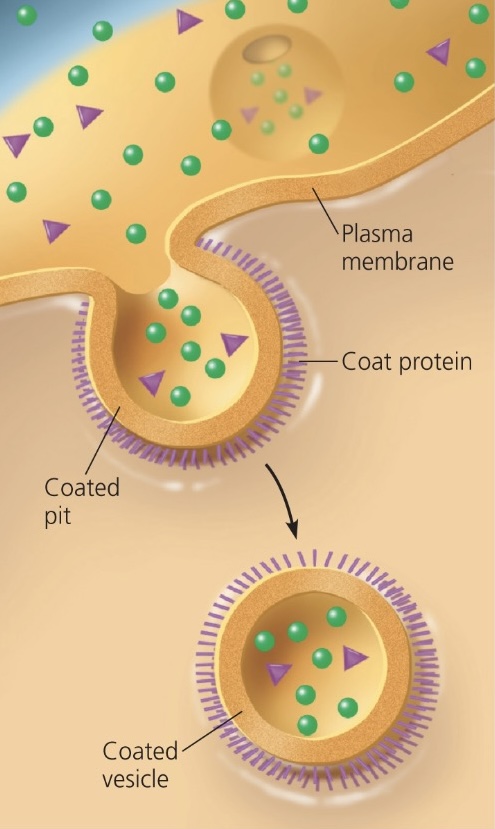
What is this process?
Pinocytosis

What is this process?
Phagocytosis

What is this process?
Receptor mediated endocytosis
Endocytosis
The bulk transport process through which a cell takes in biological molecules and particulate matter by forming new vesicles or vacuoles from the plasma membrane.
Phagocytosis
A form of endocytosis ('cellular eating') in which a cell engulfs large particles or organisms by extending pseudopodia around them and packaging them into a food vacuole.
Pinocytosis
A form of endocytosis ('cellular drinking') where droplets of extracellular fluid are nonspecifically gulped into small vesicles formed by infoldings of the plasma membrane.
Receptor-Mediated Endocytosis
A specialized endocytosis process where cell-surface receptor proteins bind specific target molecules, clustering in coated pits to internalize concentrated solutes in vesicles.