made by ai : Fixed Prosthodontics II - Post and Core
 Call Kai
 Learn
Learn Practice Test
 Spaced Repetition
 Match
Match Flashcards
 Knowt Play
1/14

There's no tags or description
Looks like no tags are added yet.
Name | Mastery | Learn | Test | Matching | Spaced | Call with Kai | Chat |
|---|
No analytics yet
Send a link to your students to track their progress
15 Terms
Coronal Tooth Structure Loss & Survival
Teeth with
10-Year Survival: Crown vs. Direct Restoration
Endodontically treated teeth restored with crowns have 91% survival vs 76% for direct restorations.

Purpose of a Core
Replaces missing coronal structure to provide retention and resistance for the final crown.
Indication for a Post
Indicated when there is inadequate coronal structure to retain a core. (Does NOT reinforce the root).

Required Apical Gutta-Percha Seal
At least 4 to 5 mm of apical gutta-percha must be retained.
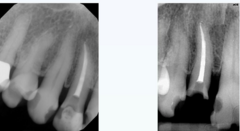
Ideal Post Length Ratio
Equal to the length of the clinical crown (1:1 ratio) to minimize failure and leverage forces.
Ferrule Dimensions
Minimum 1.5 mm vertical height and 1 mm dentin thickness circumferentially (360°).
Methods to Increase Ferrule Height
Crown lengthening, forced orthodontic eruption, or subgingival margin placement.
Advantages of Cast Post and Core
Custom-fit to root configuration and adaptable to large or irregularly shaped canals.
Indications for Prefabricated Posts
Multi-rooted teeth with relatively circular canal cross-sections.
Strength Order of Core Materials
Amalgam > Composite Resin > Silver-modified Glass Ionomer Cement.
Eugenol Effect on Resin Cements
Eugenol poisons the catalyst and inhibits free-radical polymerization of resin cements.
NaOCl Impact on Bonding
Leaves residual oxygen and oxidizing byproducts that inhibit resin polymerization.
Role of Clearfil DC Activator / Sodium Ascorbate
Neutralizes residual oxidants from NaOCl prior to resin bonding.

Function of 10-MDP Monomer
Provides ionic bonding with calcium in hydroxyapatite via its phosphoric-acid ester group.