Forensics Unit 4: Trace Evidence
 Call Kai
 Learn
 Practice Test
 Spaced Repetition
 Match
 Flashcards
 Knowt Play
1/12

There's no tags or description
Looks like no tags are added yet.
13 Terms
Hair morphology
Refers to the structure and characteristics of hair, including its shape, color, and diameter, which can provide important information in forensic investigations.
Cuticle
The outermost layer of the hair shaft, consists of overlapping scale-like cells that protect the inner layers and contribute to the hair's overall structure and properties.
Cortex
The middle layer of the hair shaft, contains pigment granules that give hair its color and contribute to its strength and elasticity.
Medulla
The central core of the hair shaft, which can vary in shape, size, and presence among different hair types. It plays a role in the identification of species and can provide additional forensic information.
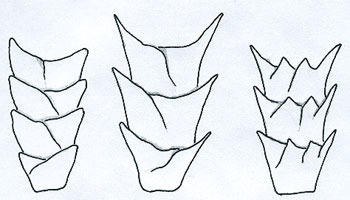
Coronal Cuticle
A type of cuticle pattern characterized by crown-like scales that overlap, found in some species of animals and used in forensic hair analysis.

Spinous Cuticle
A type of cuticle pattern characterized by petal-like scales that protrude from the hair shaft, commonly found in some species of animals.
Imbricate Cuticle
A type of cuticle pattern characterized by flattened, scale-like structures that lie close to the surface of the hair shaft, commonly found in humans and some other mammals.
Absent Medulla
A condition where the medulla, the central core of the hair shaft, is not present, commonly seen in human hair and certain animal species, impacts forensic hair comparisons.
Fragmental Medulla
A type of medulla pattern where the central core is composed of irregular, fragmented areas rather than being continuous, often observed in various animal hairs.
Interrupted Medulla
A type of medulla pattern characterized by visible gaps in the central core, often alternating with empty spaces, commonly found in various animal hairs.
Continuous Medulla
A type of medulla pattern where the central core appears as a solid line without any interruptions or gaps, commonly observed in some animal hairs.
Hair Examination
The process of analyzing hair samples to determine characteristics such as color, texture, and medulla patterns, which can help in identifying species or individuals.
Hair Preservation
The method of collecting and storing hair samples to prevent contamination or degradation, ensuring their integrity for forensic analysis.