thermal physiology I
 Call Kai
 Learn
 Practice Test
 Spaced Repetition
 Match
 Flashcards
 Knowt Play
1/43

There's no tags or description
Looks like no tags are added yet.
44 Terms
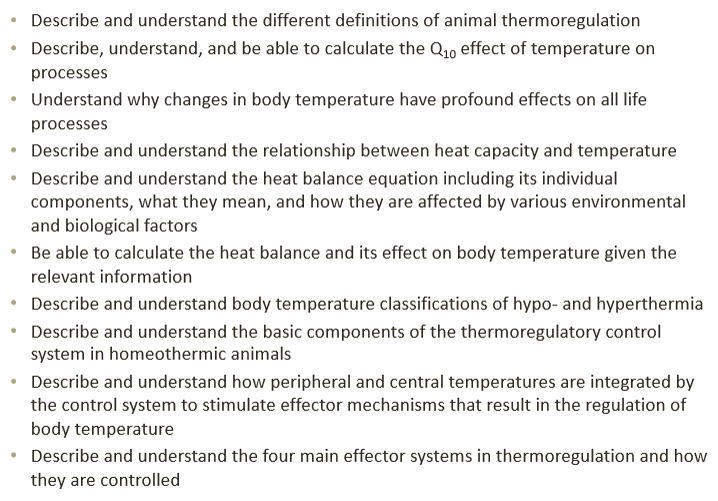
thermoconformer
body temperature same as that of environment
thermoregulator
regulatory system maintains optimal body temperature despite environment
humans are thermo(?)
regulators
poikilothermic vs homeothermic
cold blooded vs warm blooded
poikilothermic → body temperature changes and fluctuates along with the temperature of its surrounding environment
homeothermic → body temperature kept stable regardless of changes in the surrounding environment
what is the Q10 temperature coefficient
the ratio of any function at two temperatures 10 degrees apart (control vs 10 degrees celsius temp increase/decrease)
relationship between body temp and function
the Q10 for most biological processes is between what two numbers?
2 and 3
for example if you measure the metabolic rate of a snake and then measure it again at 10 degrees lower (body temp)
it'll decrease by a factor of between two and three
what is the calculation for Q10?

with increasing temperature reaction rate (?)
increases → energy of substrate closer to activation energy
temperature is defined by heat (?): how much energy does it take to warm something?
heat capacity → not the same for all objects/organisms
for example, it takes 0.001j to heat normal air by 1 degree celsius
on the other hand it takes 3.5j to heat animal tissue by 1 degree celsius

heat balance equation
S = heat storage
+ or - four mechanism of heat transfer
subtract heat loss from external work

if heat gain is equal to heat loss your body temp is:
stable
if heat gain is more than heat loss your body temp will:
increase
if heat loss is more than heat gain your body temp will:
decrease
hypothermia occurs under (?) degrees celsius
36
hyperthermia occurs over (?) degrees celsius
38
heat balance is maintained by four heat loss mechanisms:
conduction
convection
radiation
evaporation
conduction
Transfer of heat via direct contact
Depends on temperature difference
And thermal conductivity of the object
Picking up a block of metal will feel much colder than picking up a block of wood at the same temperature due to the higher thermal conductivity of the metal
You're losing more heat to the metal -> cold touch
convection
transfer of heat via a moving fluid
natural vs forced convection
natural → air gains heat from your skin and rises
forced → air movement created externally (from unnatural forces)
i.e. wind speed
radiation
Transfer of heat by electromagnetic radiation
Depends on the 4th power of the temperature difference and the emissivity of the obejcts
anything warmer than (?) degrees kelvin emits radiation
0
objects emit radiation depending on their (?) temperature
surface
Sun emits light primarily in the (a) spectrum whereas humans emit 'light' in the (b) spectrum
(a) visible (and infrared)
(b) infrared
the surface temperature of the sun is much higher than that of biological objects on earth
sun emits light at higher energy → shorter wavelength
biological objects emit light at lower energy → longer wavelength
evaporation
Transfer of heat via evaporation
Rate of evaporation depends on humidity of environment
skin thermoreceptors (list 2)
Warm thermoreceptors
Increase firing rate with an increase in temperature
Cold thermoreceptors
Increase firing rate with a decrease in temperature
the detection range of warm and cold skin thermoreceptors overlap at (?) body temperature
normal
hypothalamic thermoreceptors
located in the hypothalamus
include both warm and cold thermoreceptors
detect changes in core body temp and brain temp
afferent information from thermoreceptors is integrated in the (?)
hypothalamus
what are the three main physiological effector mechanisms?
control of skin blood flow
sweating
shivering
rate of blood flow in the cold will (?)
decrease
cold response is driven by sympathetic (a) neurons
heat response is driven by sympathetic (b) neurons
(a) adrenergic
(b) cholinergic
what are AVAs?
arteriovenous anastomoses
short circuits between arteries and veins so blood can flow between them (low resistance) without having to pass through a capillary bed
eccrine vs apocrine sweat glands
Eccrine sweat glands
Glands on the general body surface
Thermoregulatory driven sweating
Apocrine sweat glands
Glands in the armpit and pubis
Emotionally driven sweating
sweat (?) varies between sedentary and acclimated individuals
rate
sweating
sweat glands secretes protein free filtrate
travels up through duct → absorption of ions
sweat pools on surface of skin → evaporated → heat loss
the (?) nervous system is responsible for activation of sweating and vasoconstriction/vasodilation of periphery
autonomic
parasympathetic vs sympathetic pre and postganglionic neurons
Parasympathetic
Preganglionic neurons are cholinergic
Postganglionic neurons are cholinergic
Sympathetic
Preganglionic neurons are cholinergic
Postganglionic neurons are adrenergic

sudomotor neurons
Sympathetic neurons → pre and post ganglionic neurons are cholinergic
Activate sweat glands
Activate vasodilation for heat loss

name the two major neurotransmitters of the autonomic nervous system
Acetylcholine
Neurotransmitter that activates sweating
Released between cholinergic pre and post ganglionic neurons in sudomotor neurons
Leads to sweating
Noradrenaline
Released between adrenergic post ganglionic neuron and smooth muscle cells that lead to vasoconstriction in the skin

acclimation vs acclimatisation
Acclimation
Adaptations within a lifetime to an experimentally induced stressor (due to artificial environment)
Acclimatisation
Adaptations within a lifetime to a naturally induced stressor (due to nature of environment)
three changes to sweating from heat acclimatisation:
Sweat capacity increases from 1L/hr to 2-3L/hr via acclimatisation to heat
Sweat contains less electrolytes
Plasma volume increases due to increase of vasodilation in skin
reduction in sweat volume and electrolyte loss in sweat is mediated by what hormone?
aldosterone
if the heat balance equation is equal to 0:
heat produced by metabolic reactions should equal heat loss mechanisms
summary
thermoconformer (poikilothermic) vs thermoregulator (homeothermic)
Q10 → ratio of any funtion at two temperatures 10 degrees celsius apart
describes rate of change in biological process with increase in temp
Q10 is usually between 2 and 3
the temperature of something is determined by its heat capacity → i.e. air requires 0.001j to heat to 1 degree celsius
heat balance equation: S = M +- Cond +- Conv +- Rad +- E - W
metabolic heat production → main source of heat gained by the body
conduction → transfer of heat via direct contact
depends on temperature difference and thermal conductivity between two objects
convection → transfer of heat via moving fluid (natural vs forced)
i.e. heat loss via air that comes in contact with skin vs from artificial wind generated by fan
radiation → transfer of heat via electromagnetic radiation
everything warmer than 0 kelvin emits radiation → objects emit radiation based on surface temp
evaporation → transfer of heat via evaporation
hypothermia → body temp below 36
hyperthermia → body temp above 38
skin thermoreceptors detect temp changes in periphery
central thermoreceptors detect temp changes in brain/body
hypothalamus is the control centre for thermoregulation → interprets afferent signal from thermoreceptors
efferent signal sent out to effectors
control of skin blood flow → vasodilation/vasoconstriction
sweating → evaporative heat loss → impaired by humidity
eccrine (thermoregulatory) vs apocrine (emotional) sweating
shivering
behavioural changes
acclimation vs acclimatisation