earth & space term 1
 Call Kai
 Learn
 Practice Test
 Spaced Repetition
 Match
 Flashcards
 Knowt Play
1/34

There's no tags or description
Looks like no tags are added yet.
35 Terms
Big Bang Theory
the theory that the universe expanded from an extremely small, hot, and dense state around 13.7 billion years ago.
since then, the universe has become less dense and cooler.
Who was Edwin Hubble (1929)?
analysed red shift from distant galaxies
concluded that the further away a galaxy is from Earth, the greater its velocity (Hubble’s law)
Singularity
A point of infinite density and gravity where space and time are compressed.
Red Shift
stretching of light from galaxies moving away, showing the universe is expanding.
wavelength increases/stretches → shifts towards red end of spectrum
Cosmic microwave background radiation
Faint background radiation left over from the early universe, supporting the Big Bang Theory.
Star
A massive ball of hot gas that produces energy through nuclear fusion.
Nuclear fusion
The process where hydrogen atoms fuse into helium, releasing energy in a star's core.
Nebula
A cloud of gas and dust where stars are formed, mostly made of hydrogen.
Protostar
A young star that is heating up (due to pressure from gravity). It eventually gets hot enough for nuclear fusion to begin.
Main sequence star
A stable star that fuses hydrogen into helium in its core (longest stage of a star's life).
Red giant
A star that expands and cools after hydrogen in its core runs out, causing it to glow red.
Supergiant
A massive star that expands after running out of hydrogen and fuses heavier elements until its core collapses, leading to a supernova.
Planetary nebula
The outer layers of a red giant that are expelled into space, forming a glowing shell of gas.
White dwarf
The hot, dense core left after a red giant sheds its outer layers (the planetary nebula), which slowly cools over time.
Supernova
A massive, bright explosion of a collapsing supergiant that produces heavy elements.
Neutron star
An extremely dense remnant of a supernova made mostly of neutrons.
Black hole
An extremely dense object with gravity so strong not even light can escape.
HR Diagram
graph comparing temperature and luminosity
used to classify stars, shows life stage of a star
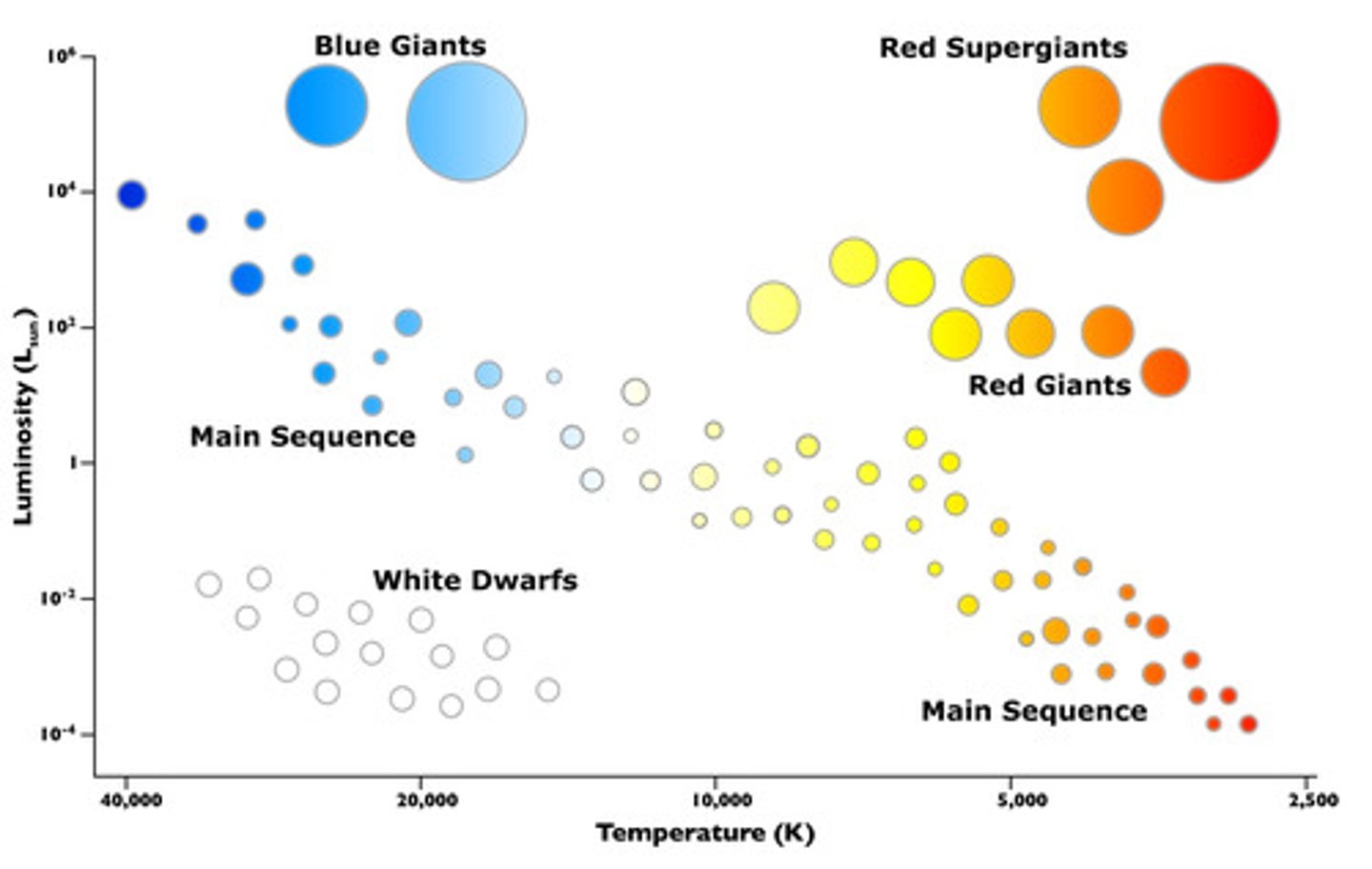
Temperature
A measure of how hot a star's surface is, shown by its colour (blue = hotter, red = cooler).
Luminosity
The total amount of energy a star releases per second (how bright it actually is).
Mass (of a star)
The amount of matter in a star, which determines its life cycle and how it will end.
Solar System
formed 4.6 billion years ago
the sun is at the centre
planets orbit it due to gravity
Nebular Theory
the solar system formed from a nebula that collapsed under gravity.
as the cloud collapsed, it spun faster due to conservation of angular momentum and flattened into a disk.
formed a rotating, flattened disk (protoplanetary disk) with the Sun at the centre.
Evidence for Nebular Theory
Planets orbit same direction
Sun has most of the mass
Young stars observed with disks
Accretion
The process where particles collide and stick together under gravity, forming larger bodies over time.
Planetesimals & Protoplanets
planetesimals are small rocky or icy bodies that formed early in the solar system.
they combine over time to form a large body called a protoplanet
Space probe
An unmanned spacecraft sent to collect data from space, sent back to Earth.
Rover
A robotic vehicle designed to explore the surface of planets or moons.
Telescope
An instrument that collects and focuses light to observe distant objects in space.
Satelite
An object that orbits a planet (e.g. Earth) to collect data, allow communication, or monitor conditions.
How are stars and galaxies formed?
Gravity pulls gas and dust together
Matter clumps and collapses
Forms stars and galaxies over time
Life cycle of a Star
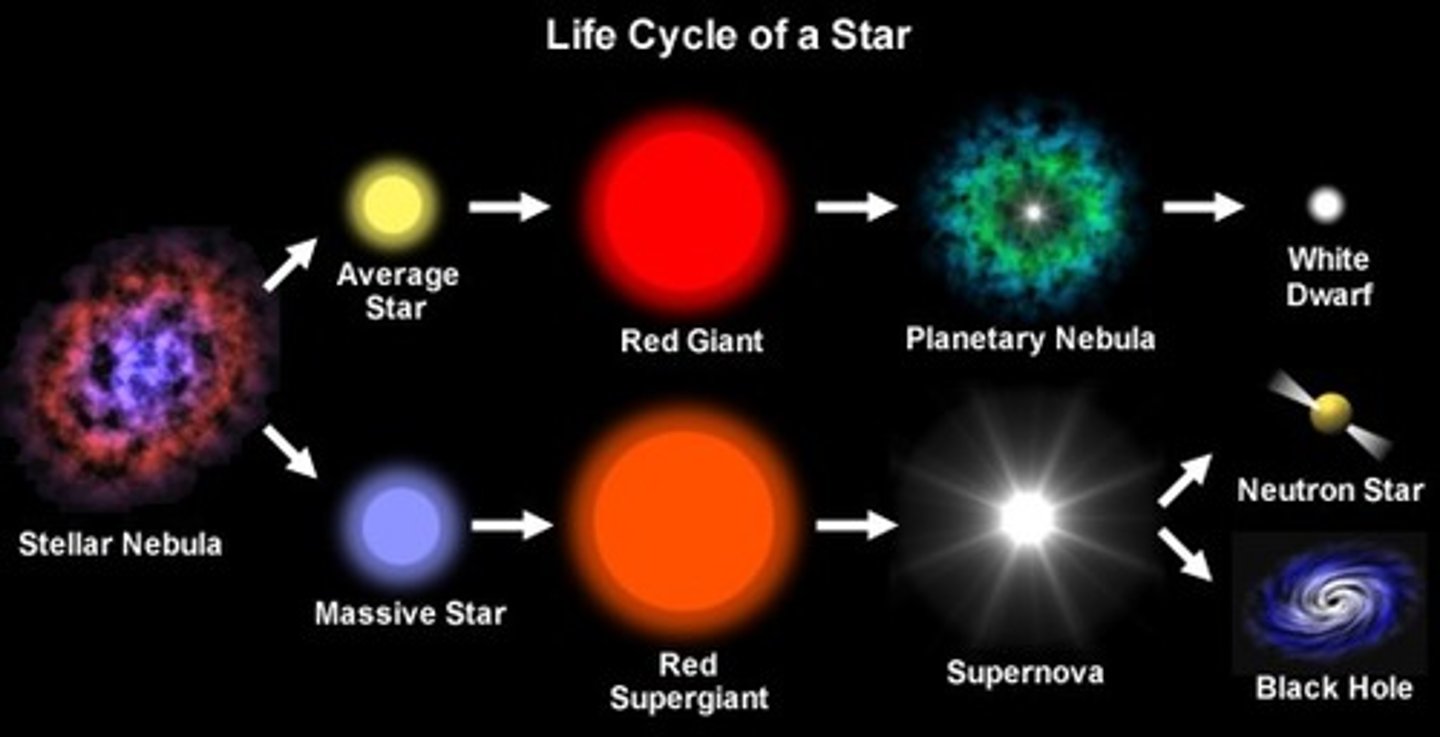
The Sun
A medium-mass, main-sequence star that will become a red giant then a white dwarf.
Terrestrial vs gas giant planets
Terrestrial planets:
Small and rocky
Solid surface
Closer to the Sun
Gas giants:
Large and mostly gas
Thick atmospheres
Further from the Sun
Oceans: summarise the issue, space technology used, how it helps
Issue: Marine ecosystems are threatened by pollution, climate change, and overfishing.
Technology: Satellites and satellite tagging devices.
How it helps: Satellites track animal migration, monitor ocean temperatures and coral bleaching, and provide data that helps governments create marine protected areas and manage fishing sustainably.