ACC 301 Exam 1: Chapter 7
 Call Kai
 Learn
Learn Practice Test
 Spaced Repetition
 Match
Match Flashcards
 Knowt Play
1/122

There's no tags or description
Looks like no tags are added yet.
Name | Mastery | Learn | Test | Matching | Spaced | Call with Kai | Chat |
|---|
No analytics yet
Send a link to your students to track their progress
123 Terms
If a company uses the periodic inventory system, what is the impact on the current ratio of including goods in transit f.o.b shipping point in purchases, but not ending inventory?
Understate the current ratio
What a perpetual inventory system is used,
No purchase account is used
Cost of Goods Sold account is debited when goods are sold
Two entries are required to record a sale
Goods in transit which are shipped f.o.b shipping point should be
Included in the inventory of the buyer
Goods in transit which are shipped f.o.b destination should be
Included in the inventory of the seller
What should be included in a company’s inventory at the balance sheet date?
Goods sold to a customer and shipped f.o.b destination
Valuation of inventories requires the determination of all of the following except
The costs of goods held on consignment from other companies
The accountant for the Pryor Sales Company is preparing the income statement for 2025 and the balance sheet at December 31, 2025. Pryor uses the periodic inventory system. The January 1, 2025 merchandise inventory balance will be reported
Only in the cost of goods sold section of the income statement
The failure to record a purchase of merchandise on account even though the goods are properly included in the physical inventory results in
An understatement of liabilities and overstatement of owner’s equity
Green Co. received merchandise on consignment. As of January 31, Green included the goods in inventory, but did not record the receipt of the goods as a purchase. The effect of this on its financial statements for January 31 would be
Net income, current assets, and retained earnings were overstated
What is the effect of a $49500 overstatement of last year’s inventory on the current year’s ending retained earnings balance?
No effect
Inventoriable costs include all of the following except
Selling costs of a sales department
What inventory costing method closely approximates the current cost for each of the following
Ending Inventory: FIFO; Cost of Goods Sold: LIFO
Tanner Corporation’s inventory on its balance sheet was lower using first-in, first-out than it would have been using last-in, first-out. Assuming no beginning inventory, in what direction did the cost of purchases move during the period?
Down
The acquisition cost of a certain raw material changes frequently. The book value of the inventory of this material at year-end will be the same if perpetual records are kept, as it would be under a periodic inventory method, only if the book value is computed under the
FIFO method
What is not considered an advantage of LIO when prices are rising?
The inventory will be overstated
Waterway Corporation uses the perpetual inventory and the gross method. On March 1, it purchased $90,000 of inventory, terms 2/10, n/30. On March 3, Waterway returned goods that cost $7,000. On March 9, Waterway paid the supplier. On March 9, Waterway’s entry to record the payment to the supplier should credit
Inventory for $1660
Waterway Inc. took a physical inventory at the end of the year and determined that $778,000 of goods were on hand. In addition, Waterway determined that $62,000 of goods were in transit. The goods were shipped f.o.b shipping point and were received two days after the inventory count. Waterway also had $88,500 of goods out on consignment. What amount should Waterway report as inventory at the end of the year?
$928,500

$14550 overstated

$0

$2301000

$3360
Coronado Company has 510 units of “Tank” in its inventory at $5 each. It purchased, for $2770, 320 more units of “Tank”. Coronado then sold 415 units at a selling price of $11 each, resulting in a gross profit of $1905. The cost flow assumption used by Coronado
Is weighted-average
$1,200,000

$410400

$1258459
In a period of rising prices, the inventory method produces the lowest ending inventory is the:
LIFO periodic method
What cost flow assumption would be most appropriate when a relatively small number of costly, easily distinguishable items are sold?
Specific identification
What is the correct concerning LIFO liquidations
LIFO liquidations often distort net income and may result in substantial tax payments
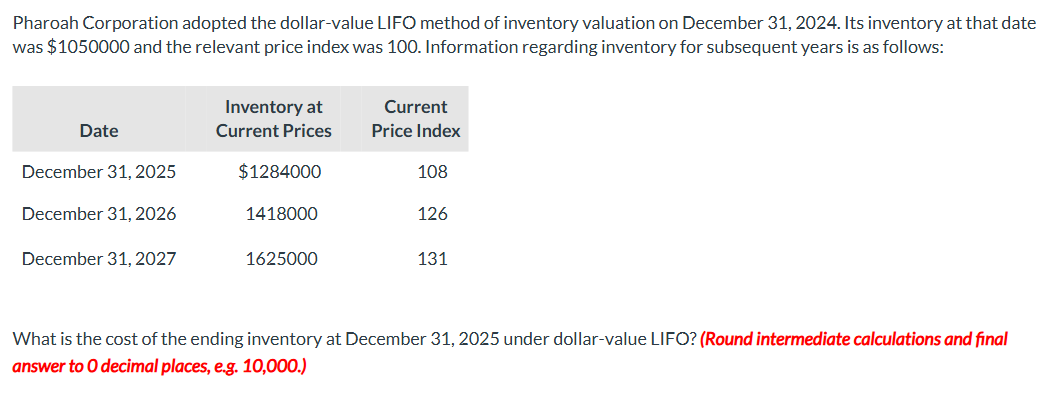
Under dollar-value LIFO, each layer in ending inventory at LIFO cost is calculated by
First expressing the year at base-year prices and then extending it to current LIFO cost by multiplying by the year’s price index

$19200 overstated
What are the four inventory cost flow assumptions?
Specific identification
Average-cost
FIFO
LIFO
What is specific identification?
A method that identifies the actual cost of each specific item sold and each item remaining in inventory.
When is specific identification most appropriate?
When there are a relatively small number of high-cost, easily distinguishable items, such as jewelry, automobiles, special orders, and custom manufacturing.
Disadvantage(s) of specific identification
It can allow management to manipulate net income by choosing which specific-cost items are sold.
Costs such as shipping, storage, and discounts may have to be allocated somewhat arbitrarily.
What does the average-cost method do?
It assigns inventory costs based on the average cost of similar goods available for sale.
What average-cost method is used with a periodic inventory system?
Weighted-average cost.
What average-cost method is used with a perpetual inventory system?
Moving-average cost.
What is the weighted-average cost formula?
Total cost of goods available ÷ Total units available
What are two advantages of average-cost methods?
They are simple to apply and objective, and they are less susceptible to income manipulation than some other methods.
First-In, First-Out (FIFO)
The first goods purchased are the first goods sold.
Under FIFO, what costs generally remain in ending inventory?
The most recent purchase costs.
When inventory costs are rising, does FIFO produce higher or lower COGS than LIFO?
Lower COGS.
When inventory costs are rising, does FIFO produce higher or lower ending inventory than LIFO?
Higher ending inventory.
When inventory costs are rising, which method produces the highest net income?
FIFO
Why does FIFO produce higher income when costs are rising?
It assigns the older, cheaper costs to COGS, resulting in lower COGS and higher gross profit.
Last-In, First-Out (LIFO)
The last goods purchased are the first goods sold.
Under LIFO, what costs generally remain in ending inventory?
Older Costs
When inventory costs are rising, which method produces the highest COGS?
LIFO
When inventory costs are rising, which method produces the lowest net income?
LIFO
Why does LIFO produce lower income when costs are rising?
It assigns the newer, more expensive costs to COGS, increasing COGS and reducing gross profit.
When inventory costs are rising, rank ending inventory from lowest to highest.
LIFO < Average < FIFO
When inventory costs are rising, rank net income from lowest to highest.
LIFO < Average < FIFO
When inventory costs are rising, which method produces the lowest income taxes?
LIFO, because it produces the highest COGS and therefore the lowest taxable income.
If inventory costs are declining, what happens to the FIFO/LIFO income relationship?
It reverses. FIFO produces lower net income and LIFO produces higher net income.
What is a periodic inventory system?
Inventory and COGS are determined at the end of the accounting period.
What is a perpetual inventory system?
Inventory records are continuously updated after purchases and sa
Does FIFO produce the same COGS and ending inventory under periodic and perpetual systems?
Yes
Does LIFO necessarily produce the same results under periodic and perpetual systems?
No
Why can LIFO produce different results under periodic and perpetual systems?
Perpetual LIFO assigns costs based on the inventory layers available when each sale occurs, while periodic LIFO considers the period's total purchases and sales at the end.
What is the formula for COGS?
Cost of Goods Available for Sale−Ending Inventory
What happens to gross profit when COGS increases?
Gross profit decreases.
What happens to income taxes when taxable income decreases?
Income taxes decrease
Why does FIFO produce higher income than LIFO when costs are rising?
FIFO has lower COGS, which produces higher gross profit and net income.
What is an "inventory profit" or "paper profit"?
The apparent profit created when older, lower inventory costs are matched against current selling prices, particularly under FIFO during rising prices.
What is the LIFO reserve?
The difference between inventory measured under FIFO and LIFO
What account is used to record the LIFO reserve?
Allowance to Reduce Inventory to LIFO.
Why might a company use FIFO internally but LIFO externally?
FIFO or average-cost may be easier or more useful for internal pricing, management, bonuses, and interim reporting, while LIFO may provide tax benefits.
What is the formula for the LIFO reserve?
LIFO Reserve=FIFO Inventory−LIFO Inventory
What is the journal entry when the LIFO reserve increases by $30,000?
Debit: Cost of Goods Sold $30,000
Credit: Allowance to Reduce Inventory to LIFO $30,000
What is the LIFO conformity rule?
If a company uses LIFO for tax purposes, it must also use LIFO for financial reporting purposes.
Does IFRS permit LIFO?
No. IFRS does not permit LIFO.
What is one advantage of FIFO regarding the physical flow of goods?
FIFO often mirrors the actual physical flow because businesses frequently sell older goods first.
What is LIFO's major advantage when inventory costs are rising?
Lower income taxes and improved cash flow because COGS is higher.
What is FIFO's advantage for the balance sheet?
Ending inventory reflects more recent/current costs.
What issadvantage of LIFO for the balance sheet?
Ending inventory may contain very old costs, making reported inventory potentially less representative of current costs.
Once a company selects an inventory costing method, what should it do?
Apply the method consistently unless circumstances justify a change, which should be properly explained and disclosed.
What is inventory?
Assets held for sale in the ordinary course of business or goods that will be used or consumed in producing goods for sale.
Why is it important?
Often one of the largest current assets of merchandising and manufacturing companies.
What inventory account does a merchandising company normally use?
Merchandising Inventory
What are the three main inventory accounts for a manufacturing company?
Raw Materials - Materials and goods that are on hand but have not yet entered production. For example, steel used to make a car
Work in Process - The cost of partially completed goods, including raw materials, direct labor, and an allocated share of manufacturing overhead.
Finished Goods - Costs associated with completed but unsold products.
What costs flow into Work in Process?
Direct materials
Direct labor
Manufacturing overhead
What happens when finished goods are sold?
The cost is transferred from Finished Goods to COGS.
What is Manufacturing/Factory Supplies Inventory?
Supplies used in production that are not the primary materials being manufactured, such as machine oil, nails, and cleaning materials.
What is the basic inventory cost flow
Beginning Inventory + Purchases or Production = Goods Available for Sale
Then:
Goods Available for Sale = COGS + Ending Inventory
What is ending inventory?
The cost of inventory still on hand at the end of the period.
It is reported as a current asset on the balance sheet.
What is cost of goods sold (COGS)?
The cost of inventory items that were sold during the period.
COGS is reported as an expense on the income statement.
What is the COGS formula?
Beginning Inventory + Cost of Goods Available for Sale − Ending Inventory = COGS
What is a perpetual inventory system?
A system that continuously tracks inventory changes.
Under a perpetual system, where are inventory purchases and freight-in recorded?
Debit Inventory
Under a perpetual system, where are purchase returns and allowances recorded, and purchase discounts recorded
Credit Inventory
When is COGS recorded under a perpetual system?
At the time of each sale.
What is the journal entry for the inventory cost portion of a sale under perpetual inventory?
Debit: Accounts Receivable
Credit: Sales Revenue
Debit: Cost of Goods Sold
Credit: Inventory
What is the journal entry for purchasing merchandise on account or returning merchandise purchased on account under perpetual inventory?
Debit: Inventory
Credit: Accounts Payable
Why is a subsidiary inventory ledger useful under a perpetual system?
It tracks the quantity and cost of each type of inventory and serves as a control measure.
What is a periodic inventory system?
A system in which the company determines the quantity and cost of inventory periodically, rather than continuously.
Under a periodic system, where are purchases recorded?
Debit Purchases, rather than Inventory.
Under a periodic system, when is COGS determined?
At the end of the accounting period.
How is COGS determined under the periodic system?
Beginning Inventory + Net Purchases − Ending Inventory
What must a company using a periodic system do to determine ending inventory?
Perform a physical inventory count.
What is one major disadvantage of the periodic system?
It does not continuously show inventory quantities or COGS and may not reveal theft, spoilage, damage, or recordkeeping errors during the period.