OB EXAM 1
 Call Kai
 Learn
 Practice Test
 Spaced Repetition
 Match
 Flashcards
1/51

There's no tags or description
Looks like no tags are added yet.
52 Terms
process of conception
union of single egg & single sperm. Marks beginning of pregnancy.Not isolated event, but part of sequential process
Each mn 1 ovum matures, @ ovulation, ovum released & propelled to uterine cavity. -Ovum fertile for 24hr after ovulation. If not fertilized, ovum degenerate & resorbed -100 millions of sperm swim to fertilization site, takes 4-6hr to arrive -Sperm remain viable in women for 2/3days. Most get lost, only 500 reach fallopian tubes -Fertilization take place in outer third (ampulla) of fallopian tube
Sperm penetrate ovum membrane, then membrane become impenetrable to other sperm
Zygote- 1st cell of new individual. Morula- 16 cells. Blastocyst, trophoblast (placenta), embryoblast(embryo) -Zygote in ampulla for 24hr, then Cilia propel fertilized egg to uterus. Takes 3/4days. ////////// -Pregnancy lasts 280days, calculate from 1st day of last period. -Embryo development= day 15 - 8wk
Critical time, organ systems develop, most susceptible to teratogens
implantation- 6-10 days after conception
-Blastocyte implant in anterior/posterior fundus. If implant in lower uterus, cause issues -A little bleeding @ implantation is normal. It's usually @ time of missed period -Chorionic villi (finger like projections, obtain O2/nutrient & dispose CO2/waste in maternal blood) -After implant, endometrium called decidua: -Decidua basalis (where chorionic vili tap into maternal blood, forms maternal placenta side) -Decidua capsularis (covers blastocyte) -Decidua vera (lines uterus)
umbilical cord
-2 artery, 1 vein. Whartons jelly, nuchal cord. Located center of placenta -Blood vessels supply embryo w/ maternal nutrients & O2 -2 A- carry blood from embryo to chorionic vili -1 V- returns blood to embryo -Wharton's jelly- connective tx, surrounds vessels, prevents blood vessel compression -Nuchal cord- when cord wrapped around fetal neck
placenta/ chorionic vili functions
-endocrine gland, fetal lungs, storage, facilitate nutrition/O2 to fetus, water/electro pass through, metabaolic waste from fetus
ENDOCRINE:
produces 4 hormone-hCG, human placental lactogen hPL, progesterone, estrogen
hCG- preserves corpus luteum fx, ensuring supply of estrogen/progesterone
hPL- similar to growth hormone. Stim maternal metabolism to supply fetal growth nutrients. Incr insulin resistance, facilitate glucose transport across placenta, stim breast development
Progesterone- maintain endometrium, decr uterus contractility, stim maternal metabolism/breast alveoli development. Placenta main progesterone producer @ 9wk?
Estrogen- steroid hormones. Stim uterine growth & uteroplacental blood flow. Cause breast glandular tx proliferation & stim myometrial contractility. Production incr @ end of pregnancy --Measure estriol level to determine placental fx. placenta main estrogen producer @ 7wk
METABOLIC FX: respiration, nutrition, excretion, storage
O2 diffuse from mom blood via placenta to fetal blood. CO2 diffuse other way. Placenta is fetal lung
Carb, protein, Ca, iron- store in placenta for ready access for fetus
Water, inorganic salts, carb, protein, fat, vitamin go from mom blood via placenta to fetal blood
Fetal glucose conc lower then mom cuz fetus rapid glucose metabolization. High fetal glucose need
Fetus waste product cross via placenta from fetal blood to mom blood. Virus/meds pass in placenta
maternal/fetal circulation
Placental fx depend on maternal BP supply circulation. Optimal circulation when side lying Braxton hicks- enhance blood movement through intervilla, airdplacental circulation
amniotic fluid fx
Maintain constant fetal body temp, source of oral gluid & waste repository, assist w/ fluid/electro balance, freedom of movement, cushion fetus from trauma, antibacterial, facilitate lung & GI development
Low level-> renal issues. High levels-> GI malformations
fetal circulation, adaptions/ shunts
placenta has mom's blood in it. Babys blood gets oxygen from it. Umbilical vein carry O2 blood to liver
3 SHUNTS:
ductus venosus: blood passages divided into two, one to liver & one to vena cava; allows O2 blood in umbilical vein to bypass liver, essential for normal fetal circulation. Blood oxygenated in placenta > travels to the RA via umbilical vein through the ductus venosus > then to the inferior vena cava.
foramen ovale- opening/shunt b/w L/R atrium; allows blood to pass from RA to LA, bypassing nonfunctional fetal lungs while fetus obtains its oxygen from placenta.
ductus arteriosus- opening b/w aorta & pulm artery. should close on its own shortly after birth, once baby breathes on its own; moves blood away from baby's lungs while they develop. The baby gets oxygen from mother's blood.
PATH
Umbilical vein carry O2 blood to fetus.
Ductus venous- blood meets inferior vena cava @ liver.
Goes to RA. Some blood goes to R ventrical- lung resistance.
High pressure cause blood to go from 1 atrium to other via foramen ovale.
Then go to L ventricle, squeeze blood into descending aorta
Ductus arteriosis- between pulm artery & aorta. Allow blood to go from pulm artery to aorta
Umbilical arteries return blood back to placenta- less resistance
Fetal characteristics/developmental events by embryonic/gestational age
4wk- arm/leg buds present. Body flexed, c-shaped. Heart develop, begin to beat day 17. Head @ right angle to body. Primary lung buds appear. 0.4/5cm, 0.4gm
8wk- body fairly well formed. Eyes far apart/ear/flat nose/mouth recognizable. Digits well formed. Major blood vessels finalized. End of embryonic stage. Tail almost disappeared. 3cm, 2gm
12wk- nails appear. Head more erect, large compared to body. Resembles human. Skin pink/delicate/translucent. Blood forming in marrow. Kidney secrete urine. Sex recognizable. 6-9cm, 19gm
16wk- head still large/dominant. Face look human, scalp hair appear. Arm/leg ratio proportionate. Heart muscle well developed. Meconium in bowel. Blood formation in spleen. 11.5-13.5cm, 100gm
20wk- vernix appear. Lanugo appear. Fetal movement strong enough to feel by mother. NS grossly formed. Leg lengthen alot. 16-18.5cm, 300gm
24wk- body lean, proportioned. Skin red, wrinkle. Sweat glands forming. Blood formation incr in marrow. Baby can hear. Alveolar duct/sacs present in lung. 23cm, 600gm
28wk- lean body, less wrinkle/red. Nails appear. 27cm, 1100g
30/31wk- refinement of structures/fx. SubQ fat begin to collect. Susceptible to teratogens (CNS). Assume birth position. Aware of sounds outside mom's body. Testes descending. 31cm, 1800-2100gm/ 4.5lb
36wk- body more plum, lanugo disappearing. Can turn/elevate head. Sleep-wake cycle
40wk- skin smooth/pink. Mod-profuse hair. Scant vernix. Active good tone. Testes in scrotum40 cm, ≥ 3200gm/7lb
fetal viability
Viability- capability of fetus to surve outside uterus. Limitations based on CNS fx & lung O2 capability @ 20wk gestation & bw 350/400/500g W/ modern technology, 22-25wk right @ threshold of viability.
respiratory maturation
Begins forming @ 4wk, & continue into childhood. Surfactant present @ 32wk, ensures good chance of survival. Wk 4-17- larynx, trachea, bronchi, lung buds. wk16-24- vascular structure & alveoli form
Surfactant- surface active phospholipids (lipid, protein). in fluid lining of alveolar surface, prevent alveolar collapse. Secreted by type I/II alveolar cells
Detection of surfactant presence in amniotic fluid used to determine degree of fetal lung maturity
Fetal rep movements seen on US from wk11
cardiovascular maturation
1st organ system to fx, begin @ 3wk. Fetal lungs don't fx for gas exchange so there's special circulatory pathways to bypass lung
Wk3- Blood vessel & blood cell formation begin, tubular heart beats
Wk4/5- heart develop into 4 chamber organ
Fetal hgb has high affinity for O2, carry 20-30% more 02 then mom hgb
Fetus hgb conc 50% greater then mom's
Fetal hr is 110-160, makes cardiac output per weight higher then adult
hematopoietic maturation (blood formation)
-occurs in yolk sac in wk3.
Hematopoiesis begins in liver @ wk6. Stem cells seed fetal bone marrow, spleen, thymus, & lymph nodes in wks8-11.
Antigenic factors that determine blood type present in RBCs @ wk6.
GI maturation- mature by 36wks
wk4- embryo change from straight to c shape, portion of yolk sac incorporated into body as primitive gut
Wk 5/6-Foregut produce pharynx, lower resp tract, esophagus, stomach, 1st half duodenum, liver, pancreas, gallbladder
Midgut- distal half of duodenum, jejunum, ileum, cecum, appendix, proximal half colon. Midgut loop projects into umbilical cord b/n wk5-10
Hindgut- distal half colon, rectum, anal canal, urinary bladder, urethra
5mn- fetal starts to swallow amniotic fluid, gastric emptying & intestinal peristalsis occur
Fetal nutrition/elimination taken care of by placenta.
Near term, waste accumulate in intestine as dark green/black/tarry meconium (pass w/n 24hr of birth)
Wk9- fetus synthesize glycogen for storage in liver
Wk26-30- fetus start to store brown fat in preparation for extrauterine cold stress
hepatic maturation
liver/biliary tract develop in wk4. Bile begin to form wk12. Glycogen stored in liver wk9/10.
Glycogen- major energy source for fetus. @ birth, have double the # of adult
Iron stored in liver. Maternal derived iron can last til 5mn after birth
Coagulation deficiency d/t no vit K that persist days after birth. give newborn vit K shot
renal maturation- mature b/w 32-36wk
-begin in wk5, fx wk9. Produce urine @ end of 1st trimester, excreted into amniotic fluid, major part of amniotic fluid volume.
Don't need functining kidney in utero, but need immediatly at birth -Fully developed kidneys @ birth. GFR low & can't conc urine -> risk of over/under hydration. Void w/n 24hr
neuro maturation
originate from ectoderm wk3. Wk4- open neural tube form. Wk5-forebrain, midbrain, hindbrain
Forebrain- eyes (CN2), cerebral hemisphere, olfactory(1), thalamus
Midbrain- oculomotor(3) & trochlear (4) nerves
Hindbrain- medulla, pons, cerebellum, other CN
Wk8- can record brain waves on electroencephalogram. Nerve fibers traverse body -@ term, fetal brain 1/4size of adult brain
sensory awareness- maturation
fetus can feel pain/pressure. Respond to sound wk 24. Taste receptors wk16
Eyelids open wk 24/26. Have rods & cones by 7mn. Rapid eye movement in sleeps
endocrine maturation
wk3/4- thyroid gland & head/neck structures develop.
Wk 8- thyroxine secretion (maternal thyroxine doesn't cross placenta).
Adrenal cortex form wk6, produce hormone wk8/9.
Pancreas forms wk5-8. Insulin wk20
reproductive maturation
sex differentiation begins wk7, fully differentiated wk12. Y chromosome-testes. Wk28 testes descending. -wk 16 oogenesis (female) established. Have lifetime ova supply @ birth.
XX (female)- withdrawl bleeding/vaginal discharge @ birth d/t lost maternal hormone. Witchs milk
musculoskeletal maturation
bones/muscle develop from mesoderm wk4. Mesoderm-> vertebral column & ribs
@ birth, connective tx sutures when skull bones meet. Fontanel- area where 2+ bones meet
Sutures/fontanels allow bones of skull to mold/move during birth, allow head to pass birth canal
Wk6- shoulder/arm/hip/leg bones.
Wk 7- muscle contract spontaneously.
Wk 11/12- resp movements, move extremities, change position in utero. Women feel movement wk16-20
integument maturation
wk4- one layer of cells from ectoderm. Wk7- 2 layers.
Vernix casosa = sloughed skin cells + sebaceous secretions. Protect skin. Thick @ wk24, scant by term
Until wk17, skin is thin/wrinkle, visible blood vessels. Skin thickens & all layers present @ term
Wk16- epidermal ridges present on pal/finger/sole/toe
Languo- very fine hair- wk 12 eyebrow/lips, wk 20 whole body. Wk28 scalp hair longer then lanugo
Wk10- finger/toe nail develop. Reach fingertip 32wk, toe tip36wk
immune maturation
3rd trimester, albumin/globulin present.
IgG- only immunoglobulin that crosses placenta, gives passive acquired immunity
IgM- produce by end of 1st trimester
IgA- NOT made by fetus. Colostrum have large # IgA, passive immunity via breastfeed
multi fetal pregnnacys- types & how they occur
Dizygotic/fraternal- 2 egg/2sperm. 2 amnion/chorion/placenta. May be diff gender
Monozygotic/identical- 1 fertilized egg that splits into 2. 2amnion, 1 chorion. 1 placenta or may share amnion if its a later division
Conjoined- very later division (day 13-15) after fertilization
Triplet/other- division of 1 zygote into 2, 1 of the 2 divide again OR 2 zygotes, 1 divide into set of monozygotic twin & 2nd develop as fraternal sibling OR from 3 zygotes
assessment for risk factors by trimester
1st 3mn of pregnancy are most critical period for embryonic/fetal development
teratogens have greatest effect in embryonic period days 15 to 60
1st 2wks- teratogens either have no effect OR have effects so severe that they cause miscarriage
Brain has longest developmental period, very vulnerable to teratogens, most occur in brain
1st/2nd trimester- dx fetal anomalies, quadruple screen, cell free DNA screen, US, neural tube, open fetal defect
3rd- does intrauterine environment support fetus? NST, mBP
Teratogens (various types)- substance/exposure that cause abnormal development
Effect depends on timing of exposure in pregnancy. Have greatest effect during embryonic period from days 15-60
Placenta health, maternal health, nutrition, maternal age, drug/chemical/hormone/virus
when anomalies can occur
Wks 2-12 are when major structures/organs develop. Most malformations occur before wk12
Wks 3-5- neural tube defect- highly sensitive
Wk3-6- TA/ASD/VSD(heart issues)
Wk4/5- amelia/meromelia
Wk5/6- cleft lip
Wk4-9- low set malformed ears/deafness
Wk4-8- microphthalmia, catatacts, glaucoma
Wk6-8- enamel hpoplasia/stain
Wk7/8- cleft palate
Wk7-9- masculinization of female genitalia
Wk 8+- mental retardation/CNS issues
Wk9-38- less sensitive. Cns, ear,teeth, palate, external genitalia
trimesters
1st- 1-13.6wk. 2nd- 14-27.6wk. 3rd- 28-40.6wk
reproductive/uterus - physiologic/structural changes of pregnancy
Change in size/shape/position. Lightening (drops at 38-40wks) --After 3rd month, uterine enlargement d/t mechanical pressure of growing fetus --1st trimester- uterus is pelvic organ. By 12wk, it rises out of pelvis into abdominal cavity --Pregnancy may show after 14th wk. Can palpate above symphsis pubis wk12-14. Altered gravity
Change in contractibility. Braxton hicks (begins @ 4mns, more definite @ 28th wk) cease when walk/exercise
Uteroplacental blood flow- uterine blood flow incr in pregnancy. 1/6th mom blood volume in uterus
Cervical change- goodell sign (soft, squishy), mucous plug (protective barrier for baby)
Cervix softens 1st 4-8wk
Hegar sign- bimanual exam to asses compressibility & isthmus softening. wk6
Change d/t fetus presence- ballottement (fetus passive movement), quickening (flutter, feel 14-18wk)
Cervix- softening of cervical tip wk6 (goodell). Incr friability (tx easily damaged). Mucus plug (barrier)
Ovaries- no ovulation because estrogen/progesterone suppress FSH/LH
Vagina/vulva- leukorrhea(white/grey musty discharge), chadwick's sign (blue/purple wk6/8). Lower pH
Breast- fullness/heaviness. Heightened sensitivity from tingling to sharp pain. Areolar more pigmented. Striae gravidarum (stretch mark). Montgomery tubercles hypertrophy (protect nipple). Colostrum (secrete 2nd trimester)
cardio - physical/structural changes of pregnancy
Blood volume, cardiac output, BP (supine hypotensive syndrome), physiologic anemia, incr in clotting factors
HR incr. Blood volume incr 40-45%. Cardiac output incr 30-50%. Slight decr diastolic BP. Edema, varicose -Midpregnacy have s3 heart sound. 20-30% incr RBC mass. Incr risk for thromboembolic issues
kidney - physical/structural changes of pregnancy
incr in renal blood plasma flow & glomerular filtration rate. Anatomic/fx change. Fluid/electro balance
Kidney enlarge, renal pelves/ureter dilate, urine stasis, UTI, urine freq, nocturia. Decr creatine, BUN, uric acid -Incr in total body water. Incr tubular reabsorption, glucosuria, incr protein/albumin excretion
respiratory- physical/structural changes of pregnancy
pulm fx, incr O2 consumption 40%. Acid base balance. incr in tidal volume & minute ventilation. Dyspnea.
Incr congestion -> sinus stuffiness, epistaxis(bleed), voice change, TM/eustachian tube swell
Chronic mild hyperventilation, decr CO2, incr O2. Resp alkalosis
GI - physical/structural changes of pregnancy
appetite, morning sickness, pica, mouth, esophagus /stomach /intestine /gallbladder/liver.
n/v, delayed gastric emptying. Prolonged small bowel transit time. GI reflux, gum bleed, epulis (lesion), ptyalism (excess saliva), reverse peristalsis, heartburn, constipation, hemorrhoid, decr bacteria range in gut -Bile thickens, gallstones, abdominal discomfort, appendix higher
Appendicitis can be difficult to diagnose in pregnancy because the appendix is displaced upward and laterally, high and to the right, away from the McBurney's point
skin - physical/structural changes of pregnancy
-hyperpigmentation, melasma (chloasma, blotchy, cheek /nose / forehead),linea nigra (symphysis pubis to top of fundus), striae gravidrum (strech marks), angiomatas, palmar erythema (red blotches hand)
musculoskeletal - physical/structural changes in pregnancy
diastasis recti abdominis , leg cramp, waddle gait, posture, decr abd muscle tone. Ach/numb/weak Leg -Lordosis. Incr mobility pubic joints. Wk28-32 symphis pubis widen -> pain/diff walk. Leg cramps -Rectus abdominus muscle separate to help accommodate uterus growth. Umbilicus flat/protrude. After birth, muscle regain tone, but separation can persist
neuro - physical/structural change in pregnancy
carpal tunnel, incr olfactory sense, headache, dizzy, faint, sleep alteration
endocrine - physical/ strucutral change in pregnancy
thyroid enlarge & incr hormone. pituitary enlarge. incr insulin need
immune - physical/strucutral changes in pregnancy
activate & dampen aspects of immune system. proinflam -> antiinflam -> proinflam
pregnancy tests- which is more reliable & can detect pregnnacy earlier
Quantitative serum testing- high level of accuracy & detect earlier, measures exact # of hcg in blood. + = >25
Urine test (sandwich immunoassay)- measures presence of hcg, not # . If done too early -> false negative. Meds, hormone tumors, improper collection-> inaccurate results
pregnancy tests- what hormone does it test for?
Human chorionic gonadotropin HCG- earliest biochemical marker for pregnancy
Hcg can be detected in serum/urine 7/8 days after ovulation (if too early, false -)
Hcg levels rise until peak @ 60/70days, then decline to lowest level @ 100/130days
hormones of pregnancy
HCG- maintains corpus luteum's estrogen/progesterone production until placenta takes over
Progesterone- suppress FSH/LH secretion by AP gland, maintain pregnancy by relax smooth muscle/decr uterine contractility, deposit fat in subQ tx over maternal abdomen/back/upper thigh, decr mom's ability to use insulin
Estrogen- suppress FSH/LH secretion by AP gland, deposit fat in subQ tx of maternal abdomen/back/upper thigh, promote genital/uterus/breast enlargement, incr vascularity, relax pelvic joint/ligament, affect folic acid metabolism, incr total body protein, promote Na/H20 retention, decr Hcl/pepsin secretion, decr mom insulin use
Serum prolactin- prepares breast for lactation
Oxytocin- stimulate uterine contraction, stimulate milk ejection from breast after birth
Human chorionic somatomammotropin/hPL- acts as growth hormone, contribute to breast development, decr maternal glucose metabolism, incr # of fatty acids for metabolic needs
Thyroxin binding globulin/T3/T4- incr in thyroid hormones supports maternal metabolism & fetal G&D
Parathyroid- control Ca/Mg metabolism
Insulin- incr insulin production to compensate for insulin antagonism (decr tx sensitivity to insulin) by placental hormones
Cortisol- stim insulin production, incr peripheral resistance to insulin
Aldosterone- stim reabsorption of excess Na from renal tubules
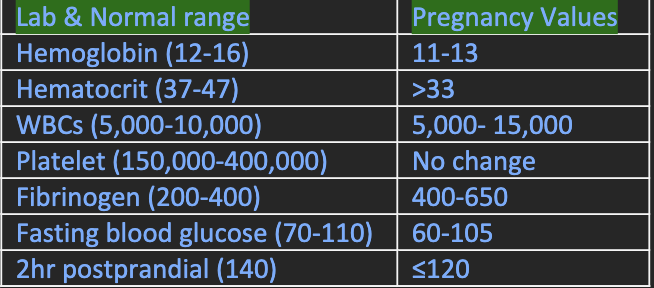
normal lab alterations of pregnancy
NORMAL: PREGNANCY: hemoglobin 12-16 11-13 hematocrit 37-47 >33 WBCs 5000-10,000 5000-15,000 platelet 150,000-100,000 no change fibrinogen 200-400 400-650 fasting blood glucose 70-110 60-105 2hr postprandial 140 <120
key terms
Gravid-pregnant. Parity- # of completed pregnancies where fetus 20+wks. Term-37wk+. Postdate- 42wk+. Preterm-between 20-37wks. Nulligravida- never been & not currently pregnant
signs of pregnancy
Positive (dx)- fetal heart sounds (US/). Fetal movement palpated by examiner. Fetus visualization by ultrasound
Probable(objective)- changes of uterus (chadwick, goodell, hegar, braxton hicks), ballottement, + pregnancy test --Chadwick- blue/pruple vulva/vaginal tx/cervix. d/t incr blood flow to pelvis. @ 6-8wk. Last till birth. --Goodell- cervix soften first 4-8wk. d/t incr blood flow/vascularization in cervix d/t growing uterus. Dr feel in physical exam that cervix has softened from firm texture (tip of nose) to softer texture (lips) --Hegar- softening of cervix, esp cervical isthmus. @ 4-8wk --Ballottement- rebounding of fetus against examiners fingers on palpation --Braxton hicks- irregular painless contractions occur intermittent throughout pregnancy
Presumptive(subjective)- least reliable. n/v, tender breast, amenorrhea, urinary frequency, fatigue, quickening
estimate due date from LMP (last menstrual period)
Naegele's rule LMP date - 3mn + 7days + 1 yr OR LMP date + 7 days + 9mn G/P- 2 dgiit system g- gravida, # pregnancies, including present one p-para, # of completed pregnnacies that reached 20+wks GTPAL g-gravida, # pregnanacies including this one t-term- # of pregnancies that ended in term births (37=wks) p-preterm-# pregnancies that ended in preterm (between 20wks-36wks) a-abortion, #of pregnancies that ended in miscarriage (spontaneous abortion) or elective terminaton (therapeutic abortion) before 20wk or weigh <500g @ birth l- living, # of children currently living
initial prenatal visit assessment components
Confirm pregnancy, health hx & physical exam, diagnostics, education, cultural variations, psychosocial
Ideally, start prenatal care before wk 10 of pregnancy. Baseline Bp/weight. Risk assessment -Comprehensive health hx- current pregnancy, previous pregnancy, family, psychosocial, physical, dx, risk -Meds, herbal, illicit substances, vaccines, vitamins. Assess diet, BMI, MH -urine, cervical, & blood sample
routine checkup schedule from conception to birth
Every 4wks for 1st 28wks. Every 2wks from 29-26wks. Every wk from 36wks to delivery. More if high risk
Physical exam, fundal height, fetal assess, gestational age, fetal heart tone, fetal movement
labs/ diagnostics during pregnancy
@ each follow up visit= BP, urine test, weight, assess fetus. Lab tests 1st TRIMESTER
patient Hx/Physical (OB, medical, surgical, family, baseline vs)
Confirm pregnancy & estimate due date- FHTs, hcg, naegel's rule, transvaginal US
Labs- CBC, blood type, UA every visit, STI test, Pap, rubella /hepb/ hepc
Genetic screen-blood test for aneuploidy(monosomie/trisomie) & sex chromosome, ultrasound. cfDNA
Imaging- TV US (too small to feel)=, dating, site of pregnancy, #, genetic screening (nuchal translucency)
Pt education- nutrition, weight gain, expectations, safety, warning signs
2nd TRIMESTER
Weight, BP, UA, fetal assessment, discomfort, warning sign. Glucose test wk24-28
Fetal assessment- continue FHTs. Fetal movement (16-20wk). Fundal height
Genetic testing- quad screen, AFP & US
Ultrasound- anatomy scan(18-20wk), growth/amniotic fluid scan if need, cervical length
Education- CBE, breastfeed, birth plan, safety, warning signs
3rd TRIMESTER
Lab- GTT(24-28wk), H/H antibody screen, repeat STI, GBS (36/37wk)
Immunoglobulin/vaccine- RhoGAM, TDaP, RSV, covid, flu
Fetal assess- HFTs/fundal heigh, daily movement/kick count
Education- birth plan/cbe, postpartum plan, breastfeed, safety, warning sign, labor sign
prenatal education
Risk for falls, UTIs, STIs, oral health, physical/sexual activity, travel precautions, OTC meds/herbal meds/vitamins, CAMs, kegels, breastfeeding, childbirth, core blood banking, HCP/birth setting/type, birth plan,
Exercise- decr intensity, avoid risks like contact sports, scuba diving, valsalva, consider balance/coordination, avoid supine after 16wk, incr water, calories, rest, stretching, supportive bra, shoes, hose, warning sign, good posture, body mechanics. Minimal risks, promote well being. 150min/wk, side lying
Travel- long distance/airplane incr risk VTEs, consider availability of OB care, consider safety of vaccines, seat belt
Breastfeed- flat/inverted nipple, milk production in pregnancy, attend course or read book, know community resources to call for help
Nutrition, Rh testing, incr sweat, loose clothes, good shoes/bra, don't stand/sit long periods of time,
CBE- coping w/ labor, pain control, relaxation techniques, postpartum expectations, newborn care, breastfeeding
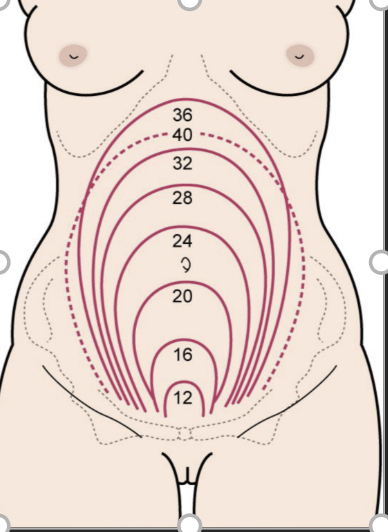
interpret fundal height
<12wk- can't palpate fundus cuz inside pelvic bone
12wk- can actully feel fundus
20wk- below umbilicus
~20-22wk- @ umbilicus
24wk- above umbilicus
36wk- highest fundus gets
Wk38-40- fundus descends/drops into pelvis- lightening, descend after 36wk
fundal height correlate w/ gestational age +/- 2wk from wks 18-30
measure from symphysis pubis to fundus. R hip wedge when supine
common discomforts & related recommendations/ interventions
Syncope- prevent=rest, posture/body mechanics, exercise, relax, avoid stimulant, avoid hypoglycemia
Headache- manage BP, position changes, fluid, snack, acetaminophen in some trimester (ask hcp)
Hemorrhoid- sitz bath, sit on pillow, high fiber food, fluid, exercise, meds
Backache- rest, support while sleep, posture, shoes, pelvic tilt exercise, rule out labor
leg cramp- exercise, dorsiflex foot, incr calcium
Sob- rest, elevate head, avoid overexxertion, good posture, extra pillows
hand numb- avoid pressure on nerves (computer work), stretches, wrist splinting
Gingivitis/bleed- dental visit, health diet, soft toothbrush
n/v- small/frequent meals, bland nonspicy food, low fat non fried food, antiemetics, vit B6, ginger, acupressure band, dry/starchy food? Avoid empty/overloaded stomach. Eat dry carb in morning.
Heartburn- small freq meals, consume fluids apart from food, avoid spicy food, wear loose clothes, avoid lying down after eating. Sip milk for relief
Constipation- incr fiber/fluid, regual physical activity, deep breathing
urine urgency/frequency- kegel exercise, void regualrly, avoid caffeine, report UTI s/s, limit bedtime drink, pad
tender breast- supportive bra, avoid soap on nipples
vaginal discharge- hygiene, cotton underwear, avoid douching, report infection s/s (itch, malodor)
nasal stuffy/epistaxis- humidifer, saline rinse (avoid medicated nose spray & antihistamine)
ankle edema/varicose vein- elevate legs, support hose, side lying, change positions
psychological considerations in pregnant women
Psych changes- ambivalence, acceptance, emotional lability, body image, relationship w/ fetus & mother role identity, birth preparation, reordering relationships, partner/sibling adaptations, mood swing, competency
Perinatal depression – most common pregnancy complication
Screen for depression & anxiety
Risk factors- low socioeconomic status, financial diff, lack of support from partner, inadequate social support, unintended pregnancy, pregnancy complication/loss, stressful life event. control
warning signs to report to provider
Decr/absent fetal movement, vaginal bleeding, preterm contraction/cramp/pelvic pressure, signs of infection, persistent severe vomit, preterm ROM, preeclampsia s/s (blurry, double spot, face/hand swell, headache, seizure, RUQ pain)
1st tri- severe vomit, chills, fever, burning on urination, diarrhea, abdominal cramp, vaginal bleeding
2nd/3rd-persistenet severe vomit, sudden vaginal discharge before 37wk, vaginal bleed, severe abdominal pain, severe backache/flank pain, change in fetal movement, absent fetal movement, absent fetal heart rate, uterine contractions/pelvic pressure/cramp before wk37, blurry/double vision/spots, face/finger/sacrum swell, severe/ freq/continuous headache, muscular irritability/seizure, epigastric/abdominal pain, glycosuria
vaccines in pregnancy
Avoid live virus (nasal flu, MMR, varicella) - contraindicated d/t teratogenicity
Can give tdap, hepB, covid, inactivated influenza
Injection flu vax recommended
TDAP 27-36wk for passive immunity to fetus
Rh immune glovulin for Rh – women (26-30wk)