Week 2 Kidneys
 Call Kai
 Learn
 Practice Test
 Spaced Repetition
 Match
 Flashcards
 Knowt Play
1/31

There's no tags or description
Looks like no tags are added yet.
32 Terms
What are the primary roles of the:
proximal convoluted tubule (PCT)
Loop of Henle
distal convoluted tubule (DCT)
fluid and electrolyte reabsorption (65-70%)
reduces urine volume while reabsorbing Na+ and CL-
final active reabsorption of Na+
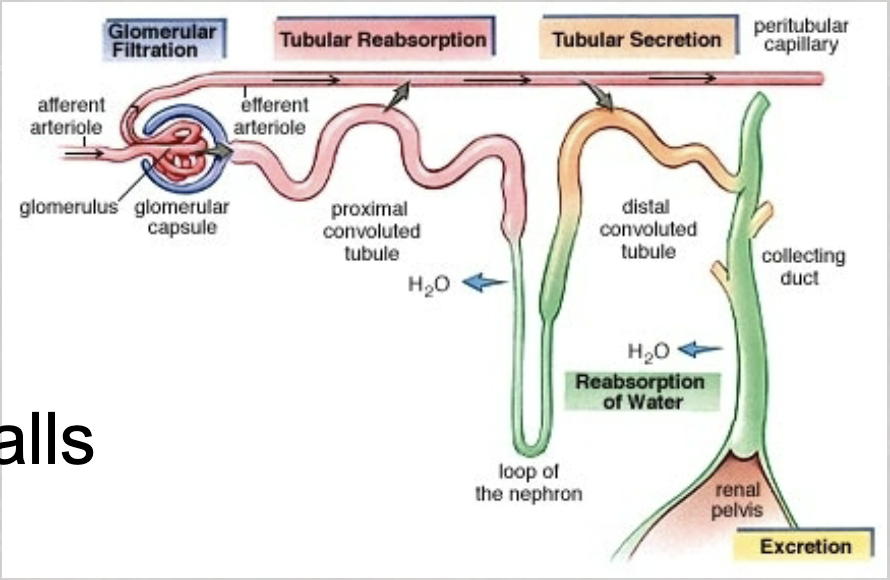
What is the glomerular filtrate described as? And what 2 macromolecules are reabsorbed?
Described as the plasma filtrate
proteins and glucose
What is the glomerular filtrate influenced by? (4)
cellular structure
hydrostatic pressure
Aldosterone/renin feedback
number of functioning nephrons
What is the definition of renal clearance? Can we just use urine volume to calculate for kidney function?
the volume of plasma cleared of a substance in a timed interval
no
What is an ideal substance to measure renal clearance test?
Is freely filtered and not reabsorbed or secreted
stable and measurable within the time interval
can easily be measured using colorimetric assays
What is the difference between an endogenous and exogenous clearance test?
endogenous: substances produced within the body (urea, creatinine)
exogenous: substances produced outside the body (inulin, PAH test)
What are the 3 exogenous clearance test gold standards?
inulin, iothalamate, iohexol
What are the 2 methods for measuring tubular reabsorption tests?
specific gravity (refractometer or urinometer) and osmolality (freezing point depression)
** What is the definition of isothenuria?
It is the hallmark of renal failure, where kidneys cannot [ ] or dilute urine
** What is the equation for the creatinine clearance? The creatinine clearance w/ correction?
CrCl = (UCR*VU ) / (PCr * T) U= urine creatinine, V= urine volume P = plasma creatinine T= time frame
CrCl * 1.73/A where A = surface area found from the nomagram
What is the difference between creatinine clearance vs GFR?
creatinine clearance: requires a timed urine collection, easily automated testing but difficult to collect older patient specimens
GFR: can be calculated with serum creatinine value & patient demographic info. correlates well w/ renal function
** What are the interferences that can increase/decrease the creatinine clearance test results for
Jaffe method (cheap & easy)
Enzymatic method (more accurate less interferences)
Jaffe method: Increase (Ascorbic acid, glucose, ketones, uric acid, cephalosporin antibiotics, dopamine, Hgb, Lipemia) Decrease (bilirubin)
Enzymatic method: Decrease (ascorbic acid, bilirubin)
Why does creatinine clearance test overestimate the approximated calculated GFR?
because creatinine is secreted in the proximal tubule
What 4 factors can decrease GFR or creatinine clearance test results?
renal plasma flow decreases
clogged basement membrane
chronic renal disease
age
What are non-protein nitrogen compounds (NPN) used for? ** What is the definition of azotemia?
used to monitor/assess renal function
elevated level of NPN compounds in blood
What is the definition of uremia?
azotemia with renal failure
What are the 3 major byproducts of protein catabolism that is excreted by the kidneys and their general characteristic?
urea: ammonia → urea. ~50% reabsorbed by PCT but is freely filtered in glomerulus
creatinine: skeletal dehydration product. excreted into circulation at a constant rate
uric acid: product of purine breakdown, mostly reabsorbed by PCT
What organ is ammonia formed in? Where is it metabolized into urea?
GI tract by deamination of amino acids
liver
What causes the equilibrium to shift to increased ammonia [ ] in the blood? What does it lead to?
increase in plasma pH
ammonia → blood brain barrier and can be toxic
**What are the 4 clinical diseases that can lead to increased blood ammonia levels (hyperammonemia)?
liver disease
Reye’s syndrome ( acute liver failure + brain swelling in children)
renal disease (as BUN increases, more diffuses in GI → converted back to ammonia)
inherited deficiency of urea cycle enzymes
** What is the reference range of urea (BUN) and the BUN/creatinine ratio?
BUN reference range: 6-20 mg/dL
BUN/creatinine ration: 10:1 to 20:1
** What are the pre-renal, renal, and post-renal issues associated with BUN?
pre: decreased renal blood flow from CHF, shock, dehydration, hemorrhage
renal: acute/chronic renal failure, glomerular nephritis, tubular necrosis
post: obstruction of urine flow
How and where is uric acid synthesized? What form is it most present in plasma? **What is the reference range for uric acid?
Synthesized in liver from breakdown of nucleic acids (DNA/RNA)
monosodium urate (MSU)
** 3.5-7.2 mg/dL male
2.6-6.0 mg/dL female
**What is Lesch-Nyhan syndrome? What type of urcemia is this?
deficiency of HGPRT (enzyme needed for purine recycling) → increased uric acid
hyperuricemia
What are the 2 analytical methods for uric acid?
phosphotungstic method: uric acid, phosphotungstic acid → tungsten blue
uricase method: uric acid + uricase → allantoin (absorbance measured)
How does gout occur? What is the cause of gouty arthritis?
uric acid so elevated → precipitates out of solution in plasma
MSU crystals deposit into joints → pain and inflammation
What is cystatin C? What may an increase in serum cystatin C indicate?
cysteine protease inhibitor produced by all nucleated cells (neutrophils, monocytes, etc)
indicates impaired renal function
What is acute glomerulonephritis?
injury to glomerular tissue by immune complexes formed in response to B-hemolytic strep
B-hemolytic strep → immune complexes → glomerular tissue injury
What is chronic glomerulonephritis?
loss of nephron mass over prolonged period of time
What is nephrotic syndrome? What are the lab findings of it? (2)
increased permeability of the glomerular basement membrane induced by disorders (diabetes, lupus, etc)
decreased GFR and acidosis due to decrease H+ excretion
** What are the 5 lab findings of end stage renal disease?
increased BUN + serum creatinine
decreased GFR
increased serum phosphorus + potassium
decreased serum calcium
increased BP
What are the 5 stages of chronic kidney disease?
