BIOL exam 3
 Call Kai
 Learn
 Practice Test
 Spaced Repetition
 Match
 Flashcards
 Knowt Play
1/50

There's no tags or description
Looks like no tags are added yet.
51 Terms
what body systems are involved in cellular respiration?
digestive system (food), respiratory system (O2), circulatory system (putting things where they need to be)
cellular respiration
oxidation of organic compounds (food) to obtain energy
dehydrogenation/hydrogenation
movement of H often involved in redox. electrons often accompanied by protons
redox coenzymes
NAD+—accepts 2e- and 1p+ to become NADH
FAD—accepts 2e- and 2p+ to become FADH2
both are electron carriers
aerobic respiration final e- receptor
O2
anaerobic respiration final e- receptor
some inorganic molecule
fermentation final e- receptor
some organic molecule (lactic acid, yeast, ethanol)
substrate lvl phosphorylation
attaching a 3rd phosphate to ADP to make ATP. inefficient bc limited by how much PEP is available. an enzyme acts on a substrate.

oxidative phosphorylation
complete oxidation of glucose occurs in 4 stages:
glycolysis
pyruvate oxidation
krebs cycle (citric acid cycle)
e- transport chain
glycolysis, process and products
occurs in cytoplasm. convert 1 glucose (6C) to 2 pyruvates (3C). products(net): 2 ATP, 2 NADH, 2 H2O, 2 pyruvates. (note: recall that 4 ATP are produced, but 2 are consumed.)

edosymbiosis + cellular respiration
CR happens in plasma membrane of mitochondria in eukaryotic cells. CR happens in the plasma membrane of prokaryotic cells. evidence that mitochondria was once prokaryotic cell that got engulfed. p
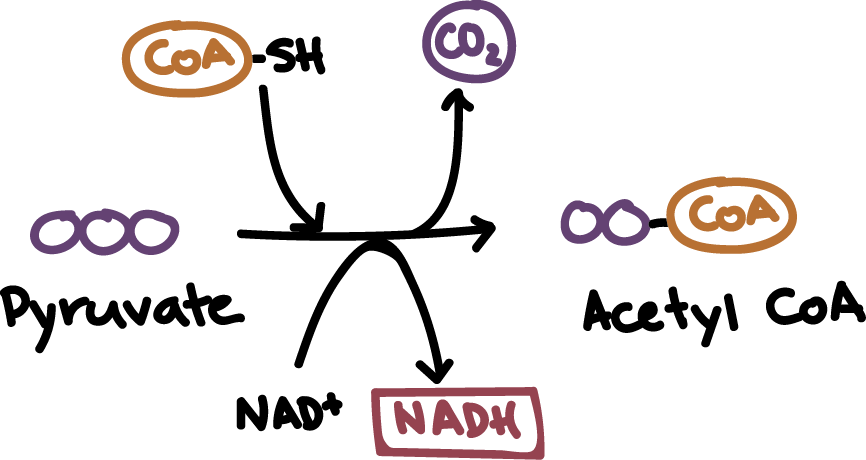
pyruvate oxidation, process and products
3C pyruvate oxidized to 2C acetate; binds to coenzyme A to make acetyl-coA
products (per pyruvate): 1 CO2, 1 NADH, 1 acetyl coA
krebs cycle, process and products
acetyl coA (2C) + oxaloacetate (4C) → citrate (6C). products per acetyl coA: 2 CO2, 3 NADH, 1 FADH2, 1 ATP, regenerate oxaloacetate
electron transport chain, process and products
1) electrons from NADH → NAD+ move to NADH dehydrogenase.
2) electrons move to ubiquonone (electrons from FADH2 → FAD move straight to ubiquonone)
3) electrons move to bc1 complex (cytochrome reductase)
4) electrons move to cytochrome c
5) electrons move to cytochrome oxidase
6) electrons move to matrix, ½ O2 + 2 H+ + 2e- → H2O
intermembrane more positively charged because protons released as electrons move, matrix more negative. concentration gradient from intermembrane to matrix; protons move down it via ATP synthase. ATP is generated from the movement of the protons down the cg

chemiosmosis
harvesting of energy from molecules going down the concentration gradient
theoretical and actual yield of eukaryotic cells. why are they not the same?
theoretical: 32, actual: 30. some protons don’t go through ATP synthase
inhibition of phosphofructokinase
regulates cellular respiration at the glycolysis stage; inhibited by ATP and/ior citrate
inhibition of pyruvate dehydrogenase
regulates cellular respiration at the pyruvate oxidation stage; inhibited by high levels of NADH
fermentation
in the absence of O2, reduces organic molecules in order to regenerate NAD+
lactic acid fermentation- electrons transferred from NADH to pyruvate to produce lactic acid
photosynthesis equation
6CO2 + photons + 6H2O → C6H12O6 + 6O2
thylakoids
internal membranes that contain chlorophyl
grana
stacks of thylakoids
stroma
semiliquid surrounding the thylakoid
photosynthesis occurs in 2 stages:
light dependent and light independent reactions
light dependent reactions
require light; make NADPH; capture energy from sunlight. occur in thylakoids.
photon of light captured by pigment molecule
energy transferred to reaction center; an excited electron transferred to an acceptor molecule
electron transport. electrons move thru carriers to reduce NADP+
chemiosmosis produces ATP
light independent reactions
carbon fixation; absence of light; use ATP + NADPH to make glucose from CO2. occur in stroma. includes calvin cycle
pigments absorb __________
photons
photons
light energy
shorter wavelengths = _________ energy
higher
2 pigments used in green plant photosynthesis
chlorophyll A + chlorophyll B
chlorophyll A
only pigment that can directly convert light energy → chemical energy. absorbs violet, red, and blue light. main pigment in plants and cyanobacteria
chlorophyll B
absorbs wavelengths of light that chlorophyll A does not
absorption spectrum
range and efficiency of photons a molecule is capable of absorbing
carotenoids
absorb wide rand of photons, reflect yellows and oranges
antenna complex
light harvesting complex. gather photons and feed captured light energy to reaction center

reaction center
passes excited electrons out of photosystems. chlorophyll in rc absorbs a photon, electron is excited to a higher energy lvl. oxidized chlorophyll fills its ‘electron hole’ by oxidizing water. creates O2 waste

chloroplasts have 2 photosystems:
P700- photosystem 1
P680- photosystem 2 (can generate an oxidation potential high enough to oxidize H2O)
production of additional ATP
noncyclic photophosphorylation generates ATP, NADPH, O2
cyclic photophosphorylation is used to produce additional ATP by short circuiting photosystem 1
carbon fixation
attachment of CO2 to RuBP to form PGA (3C sugar)
calvin cycle
carbon fixation (attachment of CO2 to RuBP to form PGA)
reduction of PGA to G3P
regeneration of RuBP
6CO2 + 12NADPH + 18ATP → 2G3P + 6NADP+ + 18 ADP
G3P is used to form sugars like sucrose

bacteria divide by ____________
binary fission
chromosomes are composed of
chromatin—complex of DNA, RNA + proteins
histone
like a spool for DNA ‘thread’
nucleosome
complex of DNA and histone proteins. histones positively charged and strongly attracted to negatively charged phosphate groups of DNA
karyotype
picture of chromosomes in an individual
diploid
2 sets of chromosomes
haploid
one set of chromosomes
kinetochores
attachment sites for microtubules at centromeres
eukaryotic cell cycle
interphase:
G1: primary growth phase, longest phase
S: synthesis
G2: organelles replicate, microtubules organize, prep for division
m phase:
M: mitosis. nuclear division, subdivided into 5 phases
C: cytokinesis. separation of 2 new cells
centromere
middle of chromosome where we see protein association
mitosis 5 phases
prophase
prometaphase
metaphase
anaphase
telophase