5 - Language
 Call Kai
 Learn
 Practice Test
 Spaced Repetition
 Match
 Flashcards
 Knowt Play
1/96

There's no tags or description
Looks like no tags are added yet.
97 Terms
Arbitrary Association
the word chosen is arbitrary.
ignore
ignore
Cooing
begins 8 weeks
Expressive Vocabulary
Words that children can actually speak.
Fast Mapping
Learning the meaning of a word after only 1 or 2 encounters with it.
Grammar
Rules governing how words are combined to form sentences; grammatical rules differ between languages.
Holophrastic Phase
Stage when a child uses a single word to express the meaning of an entire sentence.
Infant-Directed Speech
Speech to infants using a higher pitch and exaggerated pitch changes and rhythm; helps 6–7-month-olds distinguish vowel sounds and may help them learn the vowel categories of their native language.
Language Acquisition Device (LAD)
Innate mechanism for language acquisition proposed by Noam Chomsky.
Morphemes
Smallest units of sound that contain information in oral languages
in sign languages, the smallest meaningful units are signs rather than sounds.
Naming Explosion/word spurt
rapid expansion of vocabulary between 18–24 months
Onomatopoeia
Exception to the arbitrary nature of language; words imitate natural sounds to reflect their meaning.
Overregularizations
Syntactic errors involving the application of a grammatical rule too broadly.
Perceptual Narrowing
a person loses the ability to distinguish sound contrasts that are not used in their native language
Phonemes
Smallest units of sound in a language
Pragmatics
skills that allow children to communicate appropriately and effectively in social situations, such as taking turns in conversation
Productive
feature of language allowing a limited set of symbols and rules to be combined in infinite ways to produce and understand a wide range of meanings
Receptive Vocabulary
Words that children can understand but may not yet speak; develops well before expressive vocabulary.
Rule-Governed
Language's infinite combinations of symbols are constrained by the rules of each language; for example, rules determine which phonemes can occur in succession.
Sapir-Whorf Hypothesis
Idea that language may influence how we perceive and experience the world.
Semantics
Meaning of words; also refers to how a word's meaning can change depending on context.
Telegraphic Speech
begins between 18–24 months
infants use short phrases containing only the most crucial information they want to communicate
Transparent Orthographies
writing systems where a given letter always makes the same sound
Underextension
using a general term for only a very particular instance of an item
less common than overextensions
Universal Phonemic Sensitivity
Ability to discriminate between virtually all phonemes across languages; this ability is lost into adulthood through perceptual narrowing.
criteria for a true language
‘regular’ - governed by rules + grammar
arbitrary - sound assigned to a concept doesn’t need to represent it in any way
productive - limitless ways to combine words to describe objects
sapir-whorf hypothesis
language influences our thoughts and the way we perceive and experience the world
study of Peraja supporting the sapir-whorf hypothesis
native language consists of 3 counting words corresponding to ‘1’, ‘2’, and ‘many’
according to the sapir-whorf hypothesis, members of this tribe should have trouble understanding fine numerical concepts
tester asked members of the tribe to match groups of objects according to the # of objects in each group; they sucked with groups of 3 or greater objects

evidence that counters the sapir-whorf hypothesis
some cultures lack specific words to differentiate relatives (e.g. French and Korean) but can still understand the difference between (lets say) mother and aunt, or brother and grandfather
there are over ____ languages active in the world today
3000
morpheme
smallest unit of sound that contains info
often a word, but some word contain multiple morphemes
e.g. table is 1 morpheme, but tablecloth is 2 morphemes
not all morphemes can be used as an individual word (e.g. (table)(s))
phoneme
the smallest unit of sound in speech
e.g. dog has 3 phonemes (d o g)
syntax/grammar
the rules that govern how words in a sentence are put together
semantics
meaning of each individual word
the sentence here doesn’t violate any grammar rules, but the words are arranged in such a way that makes no sense overall

milestones of language
cooing
turning head towards voices
imitates sounds
babbling

babbling
drawn-out sounds made up of a variety of combinations of vowels + consonants
may sound like a real sentence/question bc of the use of inflection + rhythm in the production of the babble
combinations progress to become real words
language explodes in complexity b/w _ to _ years of age
1.5, 6
why does it seem like someone speaking in a foreign language is speaking really fast?
you have difficulty segmenting the speech stream into word units (ie. like reading a sentence w/ no spaces in b/w words)
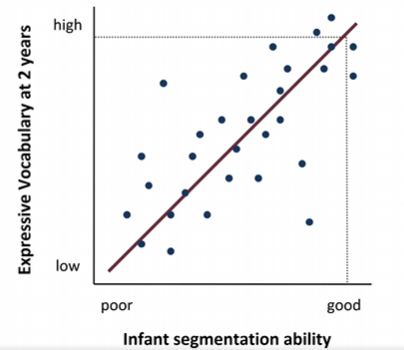
speech segmentation ability in infants does/does not predict expressive vocabulary size in childhood
does (positive correlation)
true or false: infants cannot distinguish b/w more phonemes than adults
false
children develop phonemic sensitivity based on the _______ they grew up with
language

universal phoneme sensitivity
ability of infants to discriminate b/w any sounds they hear
includes sounds from non-native languages
head-turn procedure
technique to test an infants universal phonemic sensitivity
some phoneme is played on speakers (same one over and over) but then a new phoneme is played
the infant ideally turns their head towards the speaker at the new phoneme, indicating they can discriminate b/w the 2 sounds

true or false: infants are just as good as native speakers in distinguishing b/w foreign phonemes
true

when does universal phoneme sensitivity in infants disappear?
by the end of first year of life

genie case study
was locked in a small room + no interactions w/ people
rescued at 13
had no language skills
struggled for the rest of her life to learn language
what does the genie case study show
w/o exposure to language, children can’t develop it
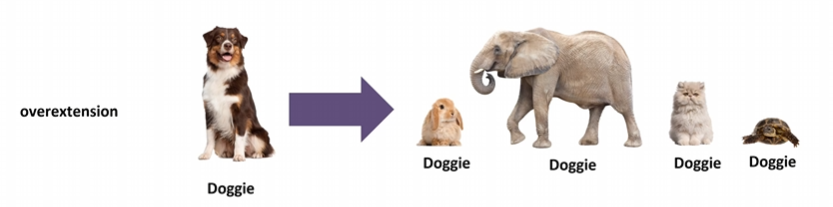
overextension
children apply a rule too broadly
e.g. a child learns his pet is called doggie and uses doggie to label any 4-legged animal
overregularization
type of overextension
child makes syntactical error by applying a grammatical rule too broadly
e.g. a child says they “played” with their friends yesterday but applies the -ed saying they “runned” instead of “ran”

underextension
children apply a rule to a specific object only
e.g. child uses “doggie” to refer to their dog only but no other dogs
language acquisition device
innate mechanism, present only in humans, that helps language develop rapidly according to universal rules
babies like listening to speech rather than anything else
congenitally deaf children develop a universal sign language without formally learning it
congenitally deaf children develop a universal sign language without formally learning it
infants brains are wired to adapt to the sounds and their associated meanings presented in their first environment
infants brains are wired to adapt to the sounds and their associated meanings presented in their first environment

social learning theory
humans need to socialize with others to learn language
children learn language through a combination of imitation + operant conditioning
innate mechanism theory
language acquisition device is present in all humans which innately allows us to learn languages without human interaction
examples of animal communication
honey bee waggle dance
bird songs for mate attraction
honey bee waggle dance
waggle phase - bee moves forward w/ the direction of the line indicating the direction of the food source
a food source directly in line with the sun is indicated by a waggle in the straight upward direction, with the waggles at an angle indicating the angle away from the line of the sun that the bee should follow to find the food.
distance of the waggle
communicates the distance of
the food source from the hive
return phase
the bee returns to its starting position in a loop, either to the left or to the right, forming a figure eight pattern.

washoe
chimp raised by scientists + taught how to communicate via ASL
lacked grammar (not regular)

sarah
chimp raised by scientists + taught how to communicate via plastic symbols
could not generate new sentences (wasn’t productive)

kanzi
chimp raised by scientists + taught how to communicate via lexigrams
instrumental conditioning NOT used to teach language
used full immersion to see if kanzi would learn the language through observation
no grammar

language is a defining characteristic of _____ cognition
human
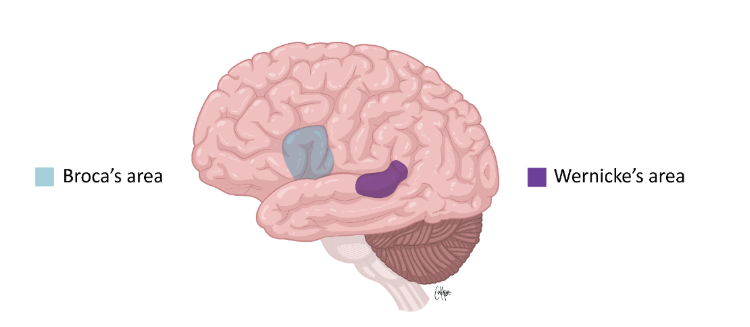
broca’s area
thought to play a role in production of language
wenicke’s area
thought to play a role in comprehension of speech
supporting evidence for social learning theory and innate mechanism theory
social learning theory:
genie case study
babies learn words when they are reinforced
innate mechanism theory:
sign language - innate and autonomic grammar
babies prefer speech sounds over non-speech sounds
overextensions
under-extensions

use of the words “give” vs “get” over time demonstrate the shift in Western culture from community-based to individual-based
our _____ _______ is activated when we use swear words
basal ganglia
our _________ is activated when we hear swear words
amygdala
taboo words activate brain areas associated with ________ emotion: the _____ hemisphere
negative, right
tourettes is connected to what region of the brain
basal ganglia; in charge of uncontrollable swearing in people w/ tourettes
the types of swear words used give a glimpse into what is important in a certain ________. give an example
culture
e.g. in Eastern countries, swear words/insults about family are more common, because people of these cultures value family above all else
euphemism vs dysphemism
euphemism: nicer words to talk about icky thing
dysphemism: purposefully using a crude word because you want the person to think about how bad it is
emphatic swearing
swearing to add emphasis (can be good or bad)
cathartic swearing
swearing to feel better about a situation
rage-circuit theory
when people (or animals) are injured, they emit loud, angry noises (in the case of humans, we swear) to release negative emotions
e.g. you stub your toe and say the f word; you tend to actually feel less pain for a shorter period of time (cathartic swearing)
children learning to lead languages with ________ ___________ have a much easier time than children learning to read English and master reading relatively quickly.
transparent orthographies
languages differ grammatically in terms of the ____ in which words occur in a sentence.
order
at what age do children use 50-250 words
2 years
The pattern of perceptual narrowing in language development indicates that there may be a biological basis for phoneme discrimination that is influenced by _________ in the first year of life
experience
Laurel Trainor baby-talk study
when people talk to infants, they exaggerate changes in pitch, which helps infants discriminate b/w different vowel sounds
foreign accent syndrome (FAS)
patients have typically suffered from a stroke/head injury that damaged areas in the L hemisphere involved in motor control of speech
patients have a foreign accent when speaking their native language

Broca’s area
area in L frontal lobe
damage leads to difficulty in production of fluent speech
individuals can understand words, but can’t find the words to respond
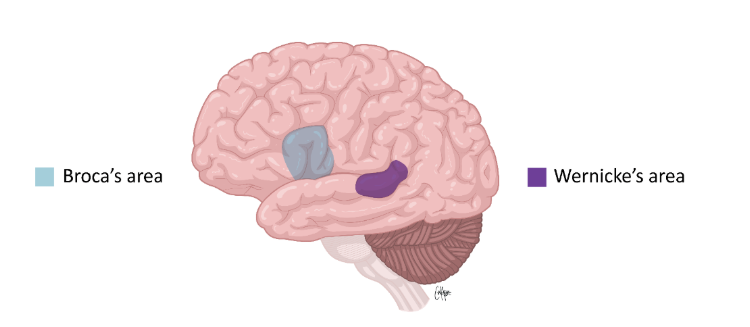
Wernicke’s area
area in L temporal lobe
damage leads to fluent but nonsensical speech + difficulty understanding written/spoken language
still-face procedure
an adult looks at an infant with a non-responsive, neutral facial expression
infants 2/3 months old will become distressed (indicating that they have expectations about how a face-to-face social interaction should proceed)
some infants will smile (direct response to social interaction)
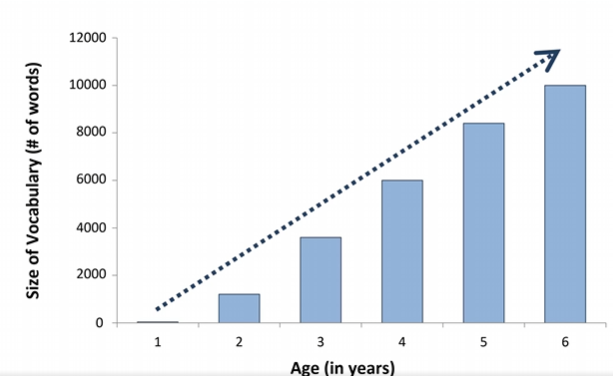
by 6 years old, a child has mastered _______ words
10 000
at around _ years of age, increase in vocab starts to slow down, and most children have mastered a large majority of the vocabulary of their language
6
true or false: girls typically have larger vocabularies and overall better language skills than boys between the ages of approximately 2 and 6 years
true
_____-born children tend to develop larger vocabularies earlier than their _____-born siblings
first, second
true or false: girls start using words about social relations and for objects that need to be cared for (e.g., doll, baby) earlier than boys. In contrast, boys start using words for loud moving objects earlier than girls.
true
Interestingly, overextensions in ________ persist longer than overextensions in __________
production, comprehension
(e.g. if a boy uses the word car for a bus, a truck, and a wagon, he can still point to the correct items if asked)
bilingualism has ___ effect on intelligence, but ________ effects on other factors
no, positive
true or false: bilingual children have better episodic and semantic memory
true
true or false: bilingual children have more developed non-verbal cognitive abilities
true
true or false: very young infants and even newborns prefer listening to speech over non-speech sounds
true
Although the symbols used to represent meaning are different in kind to those used in oral languages, sign languages and oral languages follow similar developmental trajectories, activate similar areas of the brain, and have similar underlying structures. This suggests that although the physical methods of communicating languages may differ due to developmental limitations, the fundamental bases of human language are the same, suggesting at least a partially inherent foundation for human language.
Although the symbols used to represent meaning are different in kind to those used in oral languages, sign languages and oral languages follow similar developmental trajectories, activate similar areas of the brain, and have similar underlying structures. This suggests that although the physical methods of communicating languages may differ due to developmental limitations, the fundamental bases of human language are the same, suggesting at least a partially inherent foundation for human language.
interactionist theories
combined role of nature and nuture in language development (both innate mechanism theory and social learning theory combined)
by 2 years old, children have a vocabulary of about ___ words
250
by 2 ½ years old, children have a vocabulary of about ___ words
850