Ecosystem Ecology and the Human Microbiome
 Call Kai
 Learn
Learn Practice Test
 Spaced Repetition
 Match
Match Flashcards
 Knowt Play
1/54

Earn XP
Description and Tags
Vocabulary practice flashcards covering ecosystem ecology, primary productivity, nutrient cycles, isotopic tracking of atmospheric carbon dioxide, and gut microbiome dynamics.
Name | Mastery | Learn | Test | Matching | Spaced | Call with Kai | Chat |
|---|
No analytics yet
Send a link to your students to track their progress
55 Terms
Ecosystem
A biological community of interacting organisms together with their abiotic environment, interconnected through continuous biological, geological, and chemical processes.
Ecosystem ecology studies interactions
Nutrient flow, primary productivity, human impacts
Nutrient flow
a representation of the nitrogen cycle in a backyard ecosystem, also think of phosphorus,carbon, sulfur, and water
primary productivity
pools of energy from which all other organisms must draw, photosynthetic organisms both on land and in the ocean.
human impact
refers to the effects of human activities on ecosystems, including pollution, habitat destruction, and climate change. Long been a primary driver of ecological changes in the air, land, and oceans,
Primary producers
photosynthetic organisms that use the energy from the sun to convert inorganic CO2 into organic, bioavailable carbohydrates (sugars)
Energy transfer from primary producers is
highly inefficient
An organisms energy must be used for what processes
metabolic processes and other activities.
Why does an organism energy not reach high consumers
lost to the subsequent levels, which is why tertiary consumers receive only a fraction of primary producers energy.
Gross Primary Productivity (GPP)
The total amount of carbon fixed or energy produced per year through photosynthesis by primary producers in an ecosystem.
Net Primary Productivity (NPP)
The energy or biomass remaining after primary producers have met their metabolic and cellular respiration requirements (NPP=GPP−R), representing the energy available to consumers.
Which energy is available for consumers that make up the rest of the food web
Net primary productivity NPP
Through what industry do humans also contribute to NPP and consume it
Agriculture
What is available for consumers that is all carbon and is converted to the primary producers biomass which can be eaten.
net primary productivity (NPP)
What are the most productive terrestrial ecosystems
tropics and temperate zones.
GPP in tropics
GPP on land is driven by plants, which depend upon favorable temperatures and precipitation. In the tropics, GPP is high due to abundant sunlight and warm temperatures, supporting rapid plant growth and photosynthesis.
Major GPP source
oceans particularly near shore and tropics
What does GPP depend on for aquatic ecosystems
nutrient availability more than anything else
Why is the shoreline particularly productive
its due to runoff from the land as well as upwelling of nutrients from the ocean floor to the surface.
Why is upwelling particularly important
it supports roughly 50% of the fish harvest, despite affecting only roughly 1% of ocean area.
What drives GPP in oceans
phytoplankton (unicellular)
Upwelling cycle
is the process where deep, nutrient-rich water rises to the surface, enhancing productivity in marine ecosystems. Wind that is parallel to the coastline can push water away from the coast.

water pushed away in upwelling
water is warm and nutrient-depleted
what replaces displaced water
cold, nutrient rich water from the seafloor
what accounts for almost half of NPP
the ocean and tropics
Energy flow of an ecosystem
unique in each ecosystem and based on the properties of its producers and consumers
What shows how energy moves through ecosystems
pyramids
Energy flow in forrest
large primary producers, little primary consumers, and even fewer secondary consumers.
energy flow in grasslands
large primary producers, moderate primary consumers, less secondary consumers
energy flow of open ocean
large primary producers, less primary consumers than grassland, and same amount of secondary consumers in grasslands.
biomass of forrest
very large primary producers, very small primary consumers, even less secondary consumer
biomass grasslands
large primary producers, moderate primary consumers, very slim secondary consumers
biomass of open ocean
moderate primary producers, very large primary consumers, small amount of secondary consumers
regardless of ecosystem, what is the majority of energy with
primary producers, but that energy is not equally accessible everywhere.
Energy transfers
predatory-prey interactions
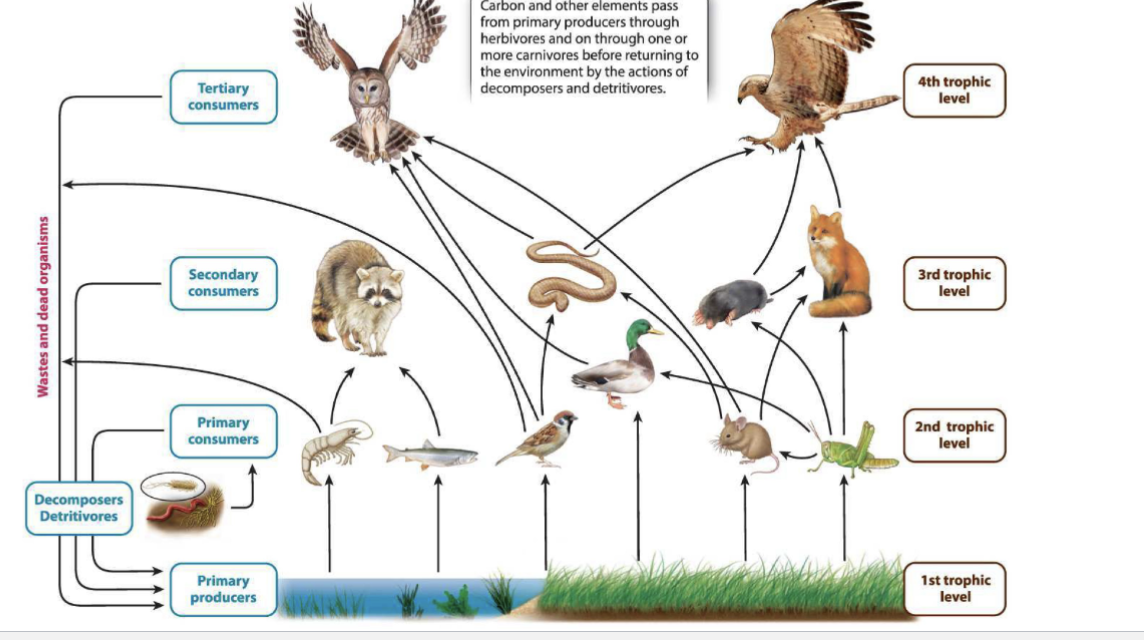
How can primary consumers be drawn or diagramed
can be tightly enmeshed in food webs
Primary consumer food webs
show deep connects to other organisms, show predators, prey, and competitors.
What is the result of disturbing a food web
trophic cascade

Upwelling
An oceanographic process where surface winds drive warmer surface waters offshore, causing colder, nutrient-rich deep water to rise to the surface and support high primary productivity.
Inverted biomass pyramid
A pattern characteristic of marine open-ocean ecosystems where primary producers (unicellular algae) have a smaller standing biomass than primary consumers because they reproduce and turn over extremely rapidly.
Trophic cascade
An ecological phenomenon where the removal or addition of top predators indirectly alters the populations of lower trophic levels, including herbivores and primary producers.
Primary producers
Autotrophic organisms, such as plants and phytoplankton, that utilize solar radiation to convert inorganic CO2 into bioavailable organic carbohydrates.
Keeling Curve
A continuous graph of atmospheric CO2 concentrations recorded at the Mauna Loa Observatory in Hawaii since 1958, demonstrating an ongoing long-term rise with seasonal annual oscillations.
CO2 added to the atmosphere by
geologic inputs such as volcanoes, mid-ocean ridges, biological inputs (ex. respiration), human activities (ex, deforestation, burning fossil fuels)
CO2 removed from the atmosphere by
gelogic removal (ex. chemical weathering of rocks), biological sequestration (ex. photosynthesis and storage in organisms)
what ice provides a snapshot of historic CO2 levels
antarctic ice, correlation between increasing CO2 content of the atmosphere and human activities.
Carbon-12 (12C)
The most abundant, stable isotope of carbon (≈99% of all carbon) that is preferentially utilized by photosynthetic enzymes during biological processes.
Carbon-13 (13C)
A stable carbon isotope comprising roughly 1% of carbon that is discriminated against by enzymes in living organisms; a declining atmospheric 13C/12C ratio indicates that added CO2 originates from organic matter rather than volcanic emissions.
Carbon-14 (14C)
A rare radioactive carbon isotope with a half-life of roughly 5,730 years; its declining atmospheric concentration demonstrates that added carbon stems from ancient fossil fuel sources whose 14C has completely decayed.
Carbon sequestration
The process of capturing and storing atmospheric carbon dioxide over long periods in biological reservoirs (such as trees and soil organic matter) or geologic formations.
Sediments and sedimentary rock reservoir
The largest carbon reservoir on Earth, containing an estimated 66,000,000 to 100,000,000GtC.
Clostridium difficile
An opportunistic intestinal bacterium that colonizes disrupted gut niches, releasing potent toxins that cause diarrhea and inflammation, and surviving treatments via antibiotic-resistant spores.
Fecal microbiota transplant (FMT)
A clinical treatment involving the transfer of healthy donor gut microbiota into a patient to re-establish microbial diversity and halt recurrent Clostridium difficile infections.
Christensenellaceae
A beneficial bacterial taxon within the human gut microbiome known for promoting host health, which notably increases in relative abundance in the elderly and centenarians.