BIOL 3103: Exam 1 Practice Questions
 Call Kai
 Learn
Learn Practice Test
 Spaced Repetition
 Match
Match Flashcards
 Knowt Play
1/124

There's no tags or description
Looks like no tags are added yet.
Name | Mastery | Learn | Test | Matching | Spaced | Call with Kai | Chat |
|---|
No analytics yet
Send a link to your students to track their progress
125 Terms
What is something that chemical synapses can do that electrical synapses cannot?
Amplify the signal in the target cell.
What is something that electrical synapses can do that chemical synapses cannot?
Form a direct cytoplasmic link with the target cell.
Which feature is characteristic of chemical rather than electrical synapses?
Signal amplification through neurotransmitter release.
Which type of synapse allows ions to move directly from one cell into another?
Electrical synapse
In general, how is intensity of a neural signal communicated via a neuron?
By increasing the frequency of successive action potentials
Which of the following does NOT normally communicate the intensity of a neural signal?
Increasing the amplitude of individual action potentials.
A stronger stimulus causes a neuron to respond primarily by:
Increasing action potential frequency
If stimulus intensity doubles, what usually happens to individual action potentials?
Their frequency may increase, but their amplitude stays approximately the same.
Imagine a neuron with multiple dendritic inputs. Which of the following DOES NOT influence the likelihood of stimulating an action potential at the axon hillock?
The strength of the incoming action potential
Which factors DO influence whether an action potential occurs at the axon hillock?
Type of stimulus (excitatory/inhibitory), location, timing, and number of stimuli
Which characteristic of synaptic inputs affects whether threshold is reached?
Location, timing, number, and whether they are EPSPs or IPSPs.
Which property of an incoming action potential is NOT used by the postsynaptic neuron when integrating signals?
Its amplitude
Which ion triggers vesicular release?
Ca++
Which ion does NOT directly trigger neurotransmitter vesicle release?
Na⁺, K⁺, or Cl⁻
Opening voltage-gated calcium channels at the presynaptic terminal directly causes what?
Synaptic vesicle fusion and neurotransmitter release
What enters the presynaptic terminal after an action potential and causes exocytosis?
Ca2+
Which of these molecules is not involved in priming and/or docking the vesicle for release?
Dynamin
Which molecule is involved in retrieving/recycling synaptic vesicle membrane after neurotransmitter release?
Dynamin
Neurotransmitters are usually produced in the cell body of a neuron and secreted at the axon terminal. How are these chemical messengers get from the cell body to the distal end of the axon?
They are packaged in vesicles that get moved by motor proteins like kinesin along microtubules.
How do neurotransmitters not normally travel from the cell body to the axon terminal?
They do not simply diffuse down the axon or move through the hollow center of microtubules.
Which cytoskeletal structure acts like a track for transport toward the axon terminal?
Microtubules
Which motor protein is associated with movement toward the distal axon?
Kinesin

In the depiction on the right circles labeled P represent a membrane-permeable solute and molecules labeled N are non-permeable. Assuming there are equal concentrations of total solutes inside and outside the “cell,” which of the following is true?
The solution is isosmotic but not isotonic
If total solute concentrations were unequal, could the solutions still be isosmotic?
No
What determines osmolarity
All dissolved solutes.
What determines tonicity?
Nonpenetrating/nonpermeable solutes and their effect on cell volume.
Equilibrium potential is
The point at which there is no net movement of ions
If Vm is not equal to an ion's equilibrium potential, what exists?
A driving force causing net ion movement if channels are open.
What happens when Vm = Eion?
There is no net movement of that ion.
Does equilibrium mean ions stop moving completely?
No. Movement can occur both ways, but there is no net movement.
Which of these are you least likely to find as part of a cell membrane?
Nucleic acids
Which substances are commonly found in cell membranes?
Phospholipids, proteins, glycolipids, and glycoproteins.
Which biomolecule forms the basic membrane bilayer?
Phospholipids.
Which membrane components have carbohydrates attached?
Glycoproteins and glycolipids.

What type of biomolecule is this?
lipid
Which structural clue would suggest this is not a carbohydrate or protein?
Long hydrocarbon chains rather than many hydroxyl groups or an amino-acid chain.
A molecule contains many repeating amino acids linked by peptide bonds. What would it be instead?
Protein
Primates and rodents have two slightly different amino acid sequences that make up the enzyme glucose-6-phosphate dehydrogenase, but the two versions share an evolutionary ancestor and still perform the same cellular process. These two versions of the enzyme could be called _______
orthologs
What would you call different versions of a gene within the same species?
Alleles
Homologous proteins in different species that descended from a common ancestral gene are called what?
Orthologs

In the picture below, glucose enters a cell via which form of membrane transport?
secondary active symport
If Na⁺ and another molecule moved in opposite directions, what type would it be?
Antiport
A transporter uses the Na⁺ gradient to move glucose into the cell without directly using ATP. What type?
Secondary active transport
What does symport mean?
Two substances move in the same direction.
If a cell membrane has a VEQ for K+ that is +40mV (measured inside the cell), then which one of the following statements is most likely true?
There is a higher concentration of K+ outside the cell than inside the cell.
If K⁺ were much more concentrated inside the cell than outside, what sign would EK normally have?
Negative
A positive equilibrium potential for a positive ion suggests what concentration arrangement?
More of that positive ion outside than inside.
At exactly +40 mV, what would happen to net K⁺ movement?
No net K⁺ movement.
Which organism is likely to have the highest basal metabolic rate?
Blue whale (175,000 kg)
Which organism would likely have the lowest absolute basal metabolic rate?
Shrew
Which organism would likely have the highest mass-specific metabolic rate?
Shrew
Which organism uses the most total energy at rest?
Blue whale
Which organism uses the most energy per gram of body mass?
Shrew
What opens immediately after threshold is reached?
Voltage-gated Na⁺ activation gates.
What causes the falling/repolarizing phase?
K⁺ channels open and K⁺ exits.
Why does afterhyperpolarization occur?
K⁺ channels stay open longer and close relatively late.
Which of the following happens last during an action potential?
The voltage-gated K+ channels close
You stay inside your house for 24 hours. Your body temperature goes up during the day and down during the night, even though the temperature in your house doesn’t change at all. This is an example of
feedforward regulation
Your body temperature increases, sensors detect the increase, and your body activates mechanisms that lower your temperature. This is an example of
negative feedback
A response begins before the regulated variable actually changes. What type of regulation is this?
feedforward/anticipatory regulation
If your nervous system initiates a change in your body’s function when there is no change in your internal environment, this is
feedforward control
If your nervous system initiates a response after detecting a change in the internal environment and works to reverse it, this is
negative feedback
Your body prepares for a predicted disturbance before homeostasis is actually disrupted. This is
feedforward control
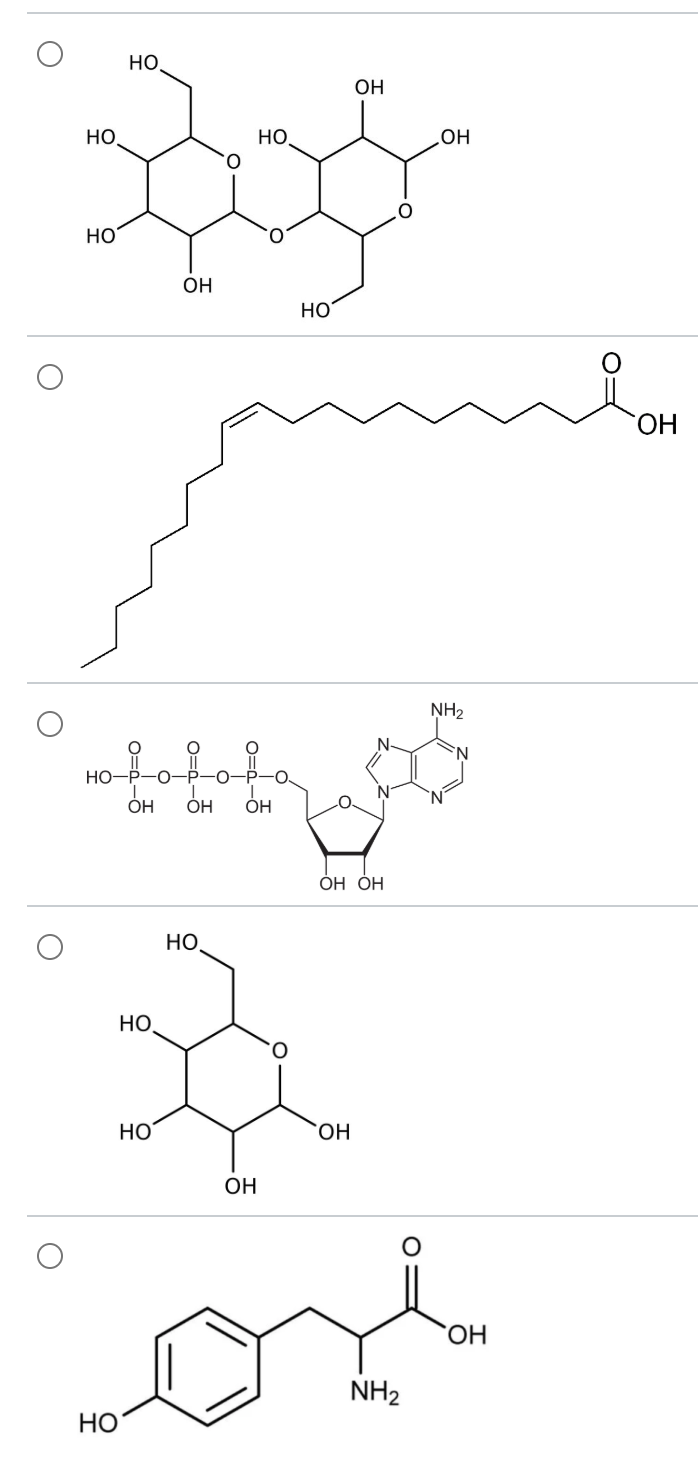
Which of these contains a nucleotide?


Which of these is a carbohydrate?

You wake up this morning and realize that you have an exam in a few hours. Your heart rate increases and you breathe faster, although you are still lying in bed. This is an example of
anticipatory regulation
Your heart rate increases only after exercise causes increased metabolic demand. A response then acts to restore normal conditions.
negative feedback
Heart rate increases before you begin running because you know a race is about to start.
anticipatory/feedforward regulation
A sensor detects an increase in the amount of a certain substance; this causes an effector to produce more of that substance. This is
positive feedback
A sensor detects an increase, and the effector causes the amount to decrease.
negative feedback
The response amplifies the original change instead of opposing it.
positive feedback
If you could suddenly remove all of the Na+/K+ (sodium/potassium) pumps from a normal cell, which of the following would stop immediately?
none of the above
What process would stop directly when Na⁺/K⁺ pumps are removed?
ATP-driven Na⁺/K⁺ pumping itself.
If molecules are crossing a lipid bilayer that contains no proteins, the molecules could be moving across via which one of these?
simple diffusion
If molecules require a membrane protein but no energy, what transport mechanism could they use?
facilitated diffusion
A small nonpolar molecule crosses directly through phospholipids. What type of transport?
simple diffusion
If we magically increase the concentration of potassium ions (K+) in the interstitial fluid that surrounds a typical neuron at rest, this will
depolarize the neuron
Decreasing extracellular K⁺ would generally make the K⁺ gradient outward stronger and tend to
hyperpolarize the neuron
What happens to Vm if extracellular K⁺ increases?
Vm becomes more positive/less negative.
Which of the following contributes to a typical resting potential?
all of the above
What maintains a typical neuron near −70 mV?
Na⁺/K⁺ gradients, leak channels, and Na⁺/K⁺ pumps.
What triggers the opening of voltage-gated potassium (K+) channels?
depolarization
Does repolarization trigger voltage-gated K⁺ channels to open?
No. Their opening helps cause repolarization.
Which channels open more slowly after the membrane depolarizes and then allow K⁺ to leave?
voltage-gated K⁺ channels
Which of the following has two kinds of voltage-dependent gates?
voltage-gated sodium (Na+) channels
Which major AP channel does not have both an activation and inactivation gate in your class model?
voltage-gated K⁺ channel
Which ion channel first opens and then becomes inactivated during an action potential?
voltage-gated Na⁺ channel
A toxin binds to a voltage-gated sodium channel preventing it from changing from inactivated to closed/rest after opening. What effect does this have on the neuron?
Another action potential is impossible
If Na⁺ channels successfully recover from inactivated → closed/rest, what becomes possible again?
Another action potential.
If every voltage-gated Na⁺ channel remains inactivated, can a second AP occur?
No
A neurotransmitter is released from an axon terminal and diffuses across a synapse to stimulate a chemically-gated K+ channel. When these channels open it increases the membrane permeability of K+ by a factor of 10. What effect will this have on the membrane potential?
Membrane potential will become more negative
Increasing Na⁺ permeability would generally make the membrane potential
more positive
Opening many K⁺ channels usually causes what type of postsynaptic potential?
Hyperpolarizing/inhibitory potential.
Which type of glial cells serve as myelination for most of the peripheral nervous system in vertebrates?
Schwann cells
Which glial cells form myelin in the CNS?
Oligodendrocytes
Damage to PNS myelin most directly suggests damage to
Schwann cells.
Which division of the nervous system uses only acetylcholine as a neurotransmitter?
Parasympathetic nervous system
Which autonomic division is primarily associated with norepinephrine/epinephrine in your notes?
sympathetic nervous system.
The body's basic-maintenance/rest-and-digest system is primarily associated with which neurotransmitter?
Acetylcholine
Free nerve endings in the skin function primary to transduce
pain