unit 3 kkq predictions
 Call Kai
 Learn
Learn Practice Test
 Spaced Repetition
 Match
Match Flashcards
 Knowt Play
1/17

There's no tags or description
Looks like no tags are added yet.
Name | Mastery | Learn | Test | Matching | Spaced | Call with Kai | Chat |
|---|
No analytics yet
Send a link to your students to track their progress
18 Terms
spectroscopy
ability to disperse light into brightness as a function of wavelength
what is kirchoff’s spectrums of light in spectroscopy
1. continuous spectrum- light emitted form a hot and dense matter, featuring unbroken light across all wavelengths
2.emission spectrum- light emitted from a warm, low density gas, featuring distinct, bright lines at specific wavelengths
3.absorption spectrum- light emitted from passing through a cool, low-density gas, featuring dark lines over a continuous background.
key. hot dense interior just below a star’s photosphere (aka atmosphere) emits a __________ blackbody spectrum
continuous
the thin photosphere is _____ on the outside due to _______ to space, it can absorb light from a ______ stellar interior
cooler, energy loss, warmer
what is the cause of spectral features (emission / absorption lines)
interaction between (radiative) energy and atoms/molecules.
key: specific energy photons will interact with atoms and produce features at a corresponding discrete _________
wavelength
balmer lines
visible wavelength hydrogen spectral lines
when Bohr modeled the Hydrogen atom, he used a semi-classical approach. what two aspects were not like classical physics?
1.angular momenta of the electron orbits were quantized. it’s restricted to discrete, quantized integer multiples of Planck's reduced constant where n = principal quantum number.
2.an orbiting (accelerating) electron doesn’t emit light as Maxwell’s classical laws of E&M dictate. Electrons can revolve only in specific orbits without radiating energy. Light is emitted or absorbed only when an electron makes a discrete transition between two levels.
quantized energy levels
Discrete energy states of bound electrons where transitions emit or absorb photons with ΔE=hf.
explain reading an energy level diagram and how an atom can transition between them
each energy level has a discrete E. the most bound level is n=1. an excited H atom can either absorb photons to transition to n>3 (H*n=3) or emit a photon of a certain energy and transition to a lower energy level.
key: an exact change in energy from n to n’ corresponds to _________
exact change in wavelength from n to n’
what are the names of the three main spectral series of electron transitions, their EMS range, and principal quantum number
Lyman (UV, n=1)
Balmer (visible, n=2)
Pashen (IR, n=3)
spontaneous emission
atoms de-excite rapidly back to ground state through emission of photons
key: each hydrogen atom emits a _____ in a ______ direction
photon, random
ion
atom with a charge (non-neutral)
ionization
liberating a previously bound electron from an atom, creating a free electron and an ion
photons with a wavelength shorter than a specific limit (series limit) will do what to an atom
ionize
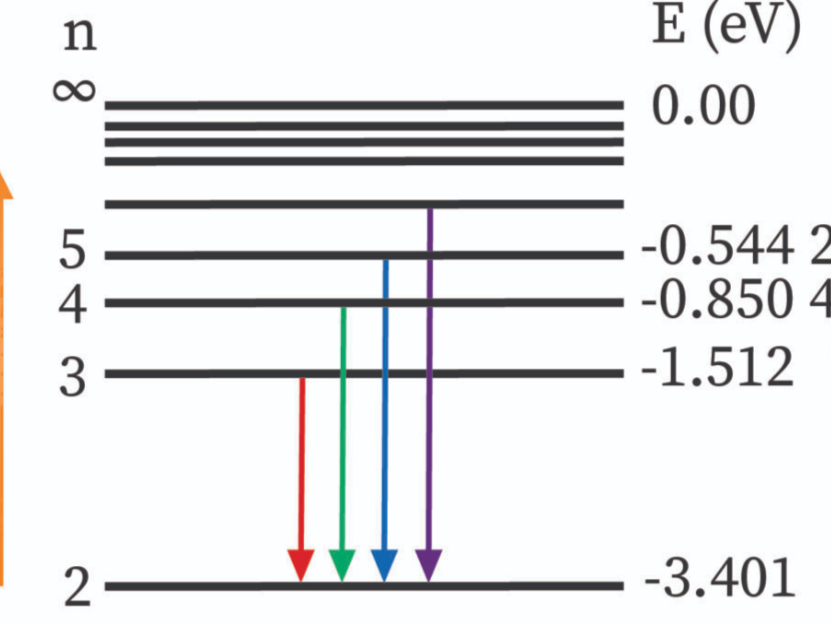
define the 4 lines of the Balmer series including the wavelength
656 nm (Hα), 486 nm (Hβ), 434 nm (Hγ), 410 nm (Hδ)
