Art History Chapters 24&28
 Call Kai
 Learn
 Practice Test
 Spaced Repetition
 Match
 Flashcards
 Knowt Play
1/39

There's no tags or description
Looks like no tags are added yet.
40 Terms

The Spread of the Islamic Caliphate
Arabia to Spain and Central • c. 622–750 CE Asia
Qibla
the direction Muslims face to pray, toward the Ka'ba in
Mecca.

The Ka'ba, al-Haram Mosque, Mecca
Mecca, Saudi Arabia • pre-Islamic shrine
Mihrab
a prayer niche, usually concave in shape with an arched
top, located in the qibla wall of a mosque and indicating
the direction of Mecca.

The Dome of the Rock
Jerusalem — Umayyad period
• c. 691–92 CE
Minaret
a tower at a mosque; can be used to give the call to prayer
and also functions as a visible marker of the mosque on the
skyline.

The Dome of the Rock
(Cross-Section)
Jerusalem — Umayyad period • c. 691–92 CE
Qibla wall
the wall in a mosque that indicates the direction toward
which Muslims face to pray, usually indicated by the
presence of a mihrab
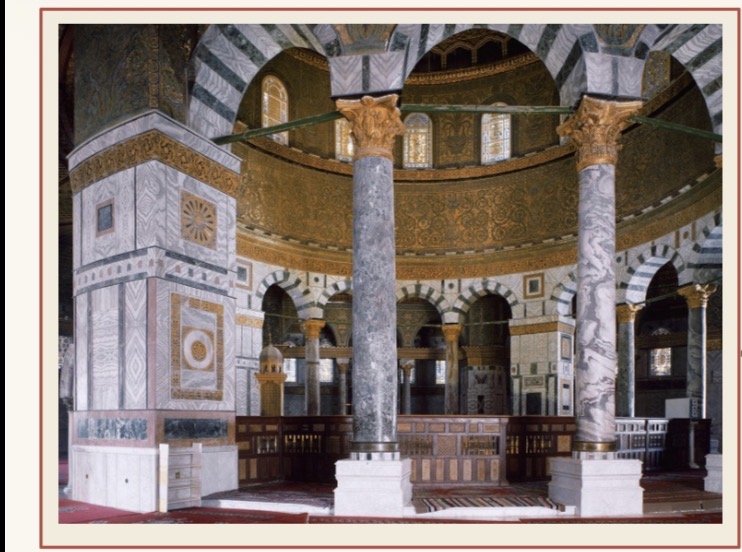
The Dome of the Rock (Interior)
Jerusalem — Umayyad period • c. 691–92 CE
Minbar
a stepped pulpit from which the sermon at Friday noon
prayer is given in a mosque; usually placed directly next to
the mihrab on the qibla wall.

The Great Mosque of
Damascus
Damascus, Syria — Umayyad
period • c. 715 CE
Aniconism
opposition to visual depictions of living creatures or
religious figures.
EUROPE
Aral
Sea

The Great Mosque of Damascus
(Plan)
Damascus, Syria — Umayyad period • c. 715 CE
Pendentive
a curved triangular wall section linking dome with a
supporting vertical pier or wall.

Mosaics, West Portico, Great Mosque
of Damascus
Damascus, Syria — Umayyad period • c. 715 CE
Apse
a recess at the end of an interior space, often
semi-circular, and typically reserved for someone or
something important, such as the altar in a church or
the throne of a ruler.

Umayyad Prince, Khirbat al-Mafjar
near Jericho — Umayyad period • c. 724–44 CE
Icon
a painted or mosaic image of a holy figure, used in
prayer and devotion.

Spiral Minaret,
Great Mosque of al-Mutawakkil
Samarra, Iraq — Abbasid period • 848–52 CE
Narthex
the entrance hall or vestibule of a church.

Stucco Wall Panel from a Private
House, Samarra
Samarra, Iraq — Abbasid period • c. 836–93 CE
Iconoclasm
the intentional destruction or rejection of images on
religious or political grounds.

Mihrab and Minbar, Great Mosque of
Qayrawan
Qayrawan, Tunisia — Abbasid period • 862–63 CE
Pantocrator
"ruler of all": a frontal image of Christ as universal ruler
and judge, usually placed in a dome or apse

Folio from the Blue Qur'an
Tunisia, probably Qayrawan — Abbasid • c. 850–950 CE

Folio from a Qur'an
Copied by Ibn al-Bawwab
Baghdad, Iraq — Abbasid period • 1000–1001 CE

The Byzantine Empire
Constantinople and the eastern Mediterranean
• c. 540–1450 CE

Hagia Sophia
Constantinople (Istanbul),
Turkey
• 532–37 CE

Hagia Sophia (Interior)
Constantinople (Istanbul), Turkey • 532–37 CE

Methods of Supporting a Dome

Church of San Vitale (Cutaway and
Plan)
Ravenna, Italy • c. 546 CE

Justinian and His Entourage
Apse mosaic, San Vitale, Ravenna • c. 546 CE

Theodora and Her Entourage
Apse mosaic, San Vitale, Ravenna • c. 546 CE

Virgin and Child with Angels and
Saints
Monastery of St. Catherine, Mount Sinai, Egypt • c. 700 CE

The Crucifixion with Iconoclasts,
Khludov Psalter
Byzantine manuscript • c. 850–75 CE

Christ as Pantocrator, Church of the
Dormition, Daphni
Daphni, Greece • c. 1090–1100 CE

The Virgin of Vladimir
Constantinople (Istanbul), Turkey • c. 1131 CE

Lamentation
Nerezi, Macedonia • 1164 CE

Deësis, Hagia Sophia
South gallery, Constantinople • c. 1261 CE

Anastasis
Church of Our Savior in Chora, Constantinople
• 1316–21 CE