Forest Structure
 Call Kai
 Learn
Learn Practice Test
 Spaced Repetition
 Match
Match Flashcards
 Knowt Play
1/39

Earn XP
Description and Tags
ENVS 31: Forest Ecology
Name | Mastery | Learn | Test | Matching | Spaced | Call with Kai | Chat |
|---|
No analytics yet
Send a link to your students to track their progress
40 Terms
Stand Structure
The horizontal and vertical distribution of components of a forest stand. Includes height, diameter, crown layers, and densities of living trees, shrubs, herbs, and deadwood.
Landscape Structure
Spatial character, arrangement, and context of forest stand across large spatial extents (e.g. fragments, complex, aggregated).
Vertical Forest Structure
The distribution of tree heights and canopy layers within a forest stand.
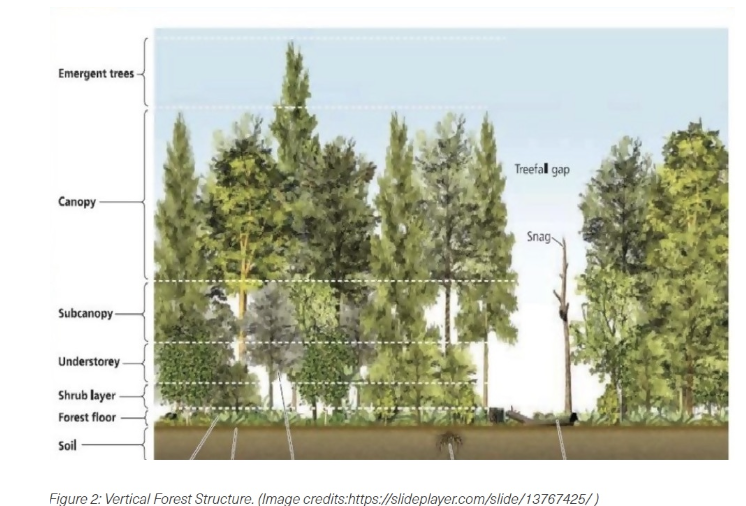
Canopy layers
Emergent trees, canopy, sub canopy, understory, shrub layer, forest floor.

What is influenced by vertical structure?
Levels of forest growth (how much photosynthesis occurs), understory light environment, distribution of habitat for canopy dwelling organisms, amount and distribution of understory plants.
Horizontal Structure
The degree of patchiness and nature of spacing between trees.

What is influenced by horizontal structure?
Distributions of habitats for wildlife (foraging, nesting, resting), and the number of other tree and plant species supported.
What exhibits the most control over horizontal forest structure?
Gap-scale disturbance and variation in soil conditions.

Old-Growth Forests
Forests with an abundance of layering and complexity due to downed trees allowing new ones to emerge in the spaces left by them over many years.
Coarse Woody Material
Dead woody materials in various stages of decomposition, including sound and rotten lots, snags (standing dead trees), and large branches. Play an important role in nutrient cycling, carbon storage, tree regeneration, and maintenance of biological diversity.
Patterns in deadwood abundance following stand-replacing disturbances:
Total woody debris peaks, then drops steeply at first, then increases up to a baseline.

Forest Composition
All plants and animal species found in a stand or landscape. Generally characterized based on dominant tree species given “top-down” control that tree composition has on diversity of other lifeforms.
How do tree species exhibit top-down control on what types of life can exist in the forest?
Leaf litter quality, overstory influence on light. Hardwood trees, like white ash, provide greater litter quality.
Forest Dynamics refers to
how the collection of trees changes in response to events that may be either unplanned (e.g. forest fires, hurricanes) or planned (harvesting).
What determines whether or not a tree will continue to grow once established?
Interaction, competition, and survival strategies.
What are good indicators of a tree’s ability to compete?
Size/condition of roots and canopy.
What is size-asymmetric competition? Give an example.
Large trees have a disproportionate effect on the ability of smaller trees to compete for light. Since light is a unidirectional resource, taller trees intercept it, not only increasing their access but intercepting it and decreasing it for those below them. Taller trees deprive the smaller ones.
What is size-symmetric competition? Give an example.
Larger roots grant a proportional increase to a tree’s ability to acquire nutrients, but since nutrients are a multidirectional resources, the large trees of a neighboring plant doesn’t diminish the ability of other plants to get nutrients themselves.
How can competitive history in trees be observed?
By examining growth rings. Smaller rings = years with greater competitive demands (less resources to allocate toward growth).
Environmental Gradient
Variations in site characteristics, may be described by changes in elevation, soil index/acidity/composition/fertility/moisture, land use history, edges.
How do environmental gradients influence forest structure?
Changes in vegetation structure and composition can be observed along these gradients.
Niche
A place occupied by an individual, live tree, representing the sum of the resources requires for the tree to survive in the environment. Indirectly represents the response of the tree to the resources available.
Fundamental niche
The complete range of resource conditions (abiotic) that a species can persist in.
Realized Niche
The actual range of conditions that a tree persists in given biotic conditions, namely competition from other trees.
Coexistence of tree species can occur where niches _______
overlap
Succession
Orderly supplanting of one community of plants by another
Niche Reconstruction Process
The ability of a species to modulate the availability of resources for themselves and other species (e.g. beavers).
What is a sere.
A sequence of successional changes, each stage within a sere is called a seral stage.
Autogenic Succession vs Allogenic Succession.
Autogenic succession is when developing vegetation itself is the main cause of change (i.e. trees grow in size) and Allogenic succession is when outside factors (e.g. harvests or natural disasters) influence (or are the direct cause of) the change.
Variables influencing disruptions can either be
stochastic or relatively predictable
Primary succession
Occurs on barren landscapes with NO VEGETATION OR SOIL (such as a landscape that had soil removed by landslides).
Secondary Succession
Occurs under the formation of events that do not cause unoccupied substrate, having soil resources and usually in areas where there was vegetation that has now been removed or killed by natural or anthropogenic events (e.g. wildfires, cyclones, harvests).
Ex: forests growing into lands cleared by abandoned crops.
Pioneer species
Those that exhibit the fastest growth following a disturbance and therefore appear as the dominant tree species. Very influential in areas undergoing succession.
Stand Initiation Stage
When most seedlings in a forest initiate following a disturbance. Represents the beginning of an even-aged forest, though over time it may transition to an uneven-aged forest or all-aged forest.
Stem Exclusion Stage
The point in succession when new trees can no longer occupy the growing space as resources become limited.
The Understory Reinitiation
Occurs when the overstory matures and shrubs and advanced regeneration reinvade the understory.
Climax
Last stage of succession, highly uncommon to occur w/o a disturbance happening first.
Climax forest
Ecological equilibrium supporting an ideal/max range of diversity.
Old-Growth Forests
similar to climax forests and are maintained in an oscillating steady state through thinning, gap formation, and regeneration.
Gap Dynamics
refer to the process where one or more trees in a forest die and leave a hole in the canopy that frees up light and nutrient resources for new seedlings and saplings to grow.