Health Psychology Exam #1
 Call Kai
 Learn
Learn Practice Test
 Spaced Repetition
 Match
Match Flashcards
 Knowt Play
1/84

There's no tags or description
Looks like no tags are added yet.
Name | Mastery | Learn | Test | Matching | Spaced | Call with Kai | Chat |
|---|
No analytics yet
Send a link to your students to track their progress
85 Terms
Leading causes of death vary by ethic group
White and Black Americans are more likely to die of heart disease
Asian and Hispanics of cancer
Groups with higher poverty levels and low education report
Lower life expectancies
People with higher education report
Better jobs, higher incomes, better health care access, fewer daily health symptoms, less stress, and healthier habits
Escalating cost of medical care
Longer life expectancies have contributed to medical costs
50% of US pop. have chronic disease
86% of health care dollars spent
72% of doctor visits
76% of hospital stays
88% of prescriptions written
Solutions to escalating costs of medical care? - BAE
Better preventive measures
Advertisement/awareness → education/outreach to the community
Early age screenings (ex. 40 for mamograms, 45 for colonoscopy
Biomedical model of Health
Traditional view of health, defines the health as the absence of disease (outdated)
Psychosomatic medicine
Early theorists asserted that psychological and emotional factors contribute to physical problems
Still, many regarded psychosomatic disorders (stress makes the condition worse, ex. high blood pressure, migraines) as being “all in the head”
Behavioral medicine
An interdisciplinary field that attempts to use psychology in conjuction w/ medicine to achieve better health
Health Psychology
branch of psychology that cosniders how indivdual behaviors and lifestyles affect a person’s physical health (1978 APA division 38)
Biopsychosocial model of health
in addtion to biological factors, psych and social are considered (ex. lung cancer)
WHO defintion of health
Is a state of complete physical, mental, and social well-being, and not merely the absence of disease infirmity
Network stress
the secondary stress an individual experiences due to major crises, life events, or problems happening to people within their personal social network, such as family members, close friends, or neighbors
How did psychology become involved in health care?
By the early 1970s, psychology and other behavioral sciences began to play a role in the prevention and treatment of chronic diseases and in the promotion of positive health, giving rise to two new fields:behavioral medicine and health psychology.
Placebo
Inactive substance or condition that has appearance of an active treatment
Why placebo groups?
We need to sure that the improvement is really from the treatment/drug
Placebo effect
Patient condition improves
What are some factors influencing the strength of placebo effect?
Patient expectations
placebo should resemble treatment (more expensive and in a name-brand bottle)
cultures that have a stronger belief in medicine
Nocebo effect
Patient’s condition worsens from the placebo (side effects/patient expectations)
What makes a treatment deemed effective?
Treatment effect must be > placebo effect
Double-blind design
Optimal design, both researchers and participants are “blind” to condition
Single-blind design
Only participants are “blind” to condition
Correlational studies
provide information about the degree of relationship between variables
Correlation coefficient
Can range from -1 to +1
The sign tells us the direction, and the number tells us the strength
Correlation (two things change together) does not equal causation (One thing produces a change in the other.)
Ex.) There is a strong positive correlation between ice cream sales and sunburns: as ice cream sales increase, sunburn cases also tend to increase. However, this does not mean ice cream causes sunburn. A third variable, such as hot and sunny weather, may influence both.

Cross-sectional study
Looks at one point in time, comparing two or more groups of people with similar backgrounds but different ages
CONS: no cause-and-effect (no causation); other variables affecting the relationship (confounding), requires careful interpretation bc of unclear directions)
Longitudinal study
follows the same group of people over an extended time period to gather information about their health as they get older (cons: time, expenses, patient unreliability)
Experimental designs
used to determine casuality
random assignment is important
Independent Variable
is what the researcher manipulates
Dependent variable
is measured health outcome
Control groups vs experimental group
does not receive treatment (may receive placebo) vs receives treatment
Ex Post Facto designs (quasi-experiments)
Researchers use an ex post facto design (quasi-experiment) when variables of interest are impossible or unethical to manipulate
• Choose variable of interest and select participants who already differ on this variable
• No random assignment to groups because IV is not manipulated
Can't control patient lifestyle, demographics, enviornment
Example: Lung cancer and Smoking, IV: Smoking history can not be manipulated, already exists
Epidemiology
Branch of medicine that investigates factors contributing to health or disease in a particular population
Prevalence
Proportion of population that has a particular disease or condition at a specific time. Total number of existing cases in the population
ex.) How many people have been diagnosed with diabetes
Incidence
Frequency of new cases of a particular disease or condition during a specified period, usually one year
Ex.) How many new cases of diabetes this year
Observational methods
can show an association between variables but cannot show causation (sounds like a correlational study)
Retrospective (case control) studies
Begin with a group of people who are already suffering from a disease and work backward to determine what factors preceded their sickness (past risk factors)
Pros: low cost, fast results, good for rare conditions (gather enough past cases)
Cons: People’s recollections may not be accurate; incomplete data, weak causal link
Prospective studies
Begin with a population of disease-free participants and follow them over time (like a longitudinal study)
Pros: Higher accuracy, less bias, stronger causal evidence
Cons: long time, expensive, participant unreliability
Randomized controlled trials
• Equivalent to experimental research in psychology
• Participants are randomly assigned to either a study group or a control group
• Researchers must control variables other than those of primary interest to
prevent them from affecting results
• Most RCTs are clinical trials
Make sure its a double blind/researchers look for side effects
Non experimental studies
can be used to make inferences about causal relationships, particularly when suspected cause cannot be manipulated (e.g., cigarette smoking → lung cancer)
Epidemiologists (investigate patterns of disease) use 7 criteria for determining a cause-and-effect relationship between a suspected cause and a disease
1.) There is a dose-response relationship between possible cause and disease (the more of smth, the stronger the effect → more ciagrettes, more side effects (higher risk)
2) Removal of possible cause reduces prevalence or incidence of disease
3) Possible cause must precede disease (cause has to come before effect)
4) Cause-and-effect relationship is physiologically plausible (has to make sense that ciagrettes could lead to lung cancer)
5) Research studies consistently show a relationship (if we look at research, we see a consistent/causal relationship)
6) Strength of association is relatively high (lung cancer + smoking across different designs)
7) Studies are well-designed
Can someone have a diease and not be ill?
Early stages
Hidden progression
Immune response
Silent killers/asymptomatic (ex. hypertension, type 2 diabetes, infections, early cancer)
Health
state of positive physical, mental, and social well-being
Disease
The process of physical damage within the body
illness
The experience of being sick or having a diagnosis
Symptoms
sign(s) that may or may not indicate disease
illness behavior
activities undertaken by someone who experiences symptoms but has not yet recieved a diagnosis
Diagnosis
label for symptoms, which can be from a health care provider for a self-diagnosis
Sick role behavior
Defined as behaviors or activities engaged in by people who believe they are ill for the purpose of getting well
examples: medicate, change lifestyle/activities, stay home/work, more googling
Segall’s 3 rights and 3 duties
3 rights:
to make decisions concerning health issues
to be exempt from normal duties
to become dependent on others for assistance
3 duties:
to maintain health and to get well
to perform routine health care management
to use a range of health care resources
What problems are there with Segall’s 3 rights and 3 duties? - Always Inspect Dirty Old Items
Assumes illness is acute and temporary, no chronic illness
Ignores socioeconomic inequalities
Disregards gender and cultural differences
Oversimplifies patient autonomy and stigma
Ignores systemic barriers/disparities in healthcare availability
Factors that affect health care seeking
Personal factors - stress, anxiety, neuroticism predict greater healthcare seeking
Gender - women seek health care > men
Age - older people seek health care (close to death) > younger people
Socioeconomic,ethic, and cultural factors people lower in SES (lack of insurance, financial concerns, no child care, missing work, cost of gas) and ethnic minorities seek health care less often
Stigma - people with embarassing or stimgatized conditions are less likely to seek health care (ex. STI, mental health, obesity, smoker lung cancer, incontinence, obesity, acne, hormonal conditions)
Characteristics of symptoms - people with symptoms that are percieved as visible, severe, interfering with daily life, and continuous are more likely to seek health care
Conceptualization of the disease - people base their decisions on whether to seek health care, in part, on incomplete and sometimes inaccurate beliefs
Components of Disease Conceptualization - I Think Dogs Can Count 🐶
identity of disease - what is the diagnosis? is it minor or major?
Timeline of disease and treamtent - how long is the disease expected to last? what is the course of treatment?
Determination of CAUSE - what cause the disease to develop (if u can identify cause, you are less likely to go to doctor)
Consequences of disease - now that i have the disease, what will happen to me?
Controllability of disease - can the disease be controlled?
Seeking medicial info from nonmedical sources: Internet
Often the first place people go, may provide greater understanding, second opinion, or reassurance, can also provide misinformation, highly educated women (feel comfortable interpreting info) are the most likely demographic to seek health information online
Seeking medicial info from nonmedical sources: Lay referral network
Family and friends who offer information and advice before any official medical treatment is soguht (can encourage or discourage health care seeking)
May help person make sense of their symptoms (if family member has) and either encourage/discourage health care seeking
Recieving medical care: limited access
Employment is an important factor in access to medical care
Those who are unemployed
single (no spouse insurance or younger)
native american, hispanic/latino are more likely to be uninsured
Even for those with insurance, it is still expensive
Choosing a practicioner
Patients who are satisfied in their relationship with their provider are more likely to follow medical advice and to continue using medical services
Verbal communication is one of the most important factors in the patient provider relationship
What personal characteristics do patients most desire in providers? Who exhibits these more often?
Women.
Confidence, thoroughness, personability, humaneness, honesty, respectfulness, and empathy
Questions doctors wish patients would ask
1. “I Googled my symptoms, but what do you think?”
2. “What Internet resources can I trust for medical
information?”
3. “What should I work on before my next visit?”
4. “What can I do to prevent this from happening again?”
5. “Why am I taking this medication?”
6. “What do you do for your personal wellness?”
7. “How many patients like me have you treated?”
8. “Does my child really need an antibiotic for this?”
9. “What is the best way for me to lose weight?”
10. “When should I come see you again?”
Being hospitalized
Hospitalization is a stressful experience, particularly for children (separated from parents, unfamiliar environment, fear of mortality
Hospitalized adults report being treated like a “nonperson” and having to
tolerate lack of information, loss of contro
Intention-behavior gap
When one intends to behave in a healthy manner, but does not follow through
Health behavior adherence
Extent to which one’s behavior coincides with medical advice or recommended health practices
Ex. working out, eating healthy, sleep, hydration, meds, doctor appts, yoga, wearing a seatbelt
Average rate of nonadherence
25%
People adhere more often when - BDR
Behavior is easy (less time/resources
Diagnosis is percieved as severe (if patient sees it as so [HIV, heart conditions, arthritis, cancer]; low adherence may be seen in diabetes or lung disease)
Regimen is less complex (once or twice a day pills/ one big pill, 8 small pills)
Health behavior theories
Help us understand why people make the health choices they make and how they successfully adhere to medical advice
Continuum theories
A name given to theories that seek to explain adherence with a single set of factors that should apply equally to all people, regardless of their existing levels or motivations for adhering. In other words, a “one-size-fits-all” approach.
Stage theories
first classifying people into different stages of behavior change and then identifying the unique variables that predict adherence among people in different stages.
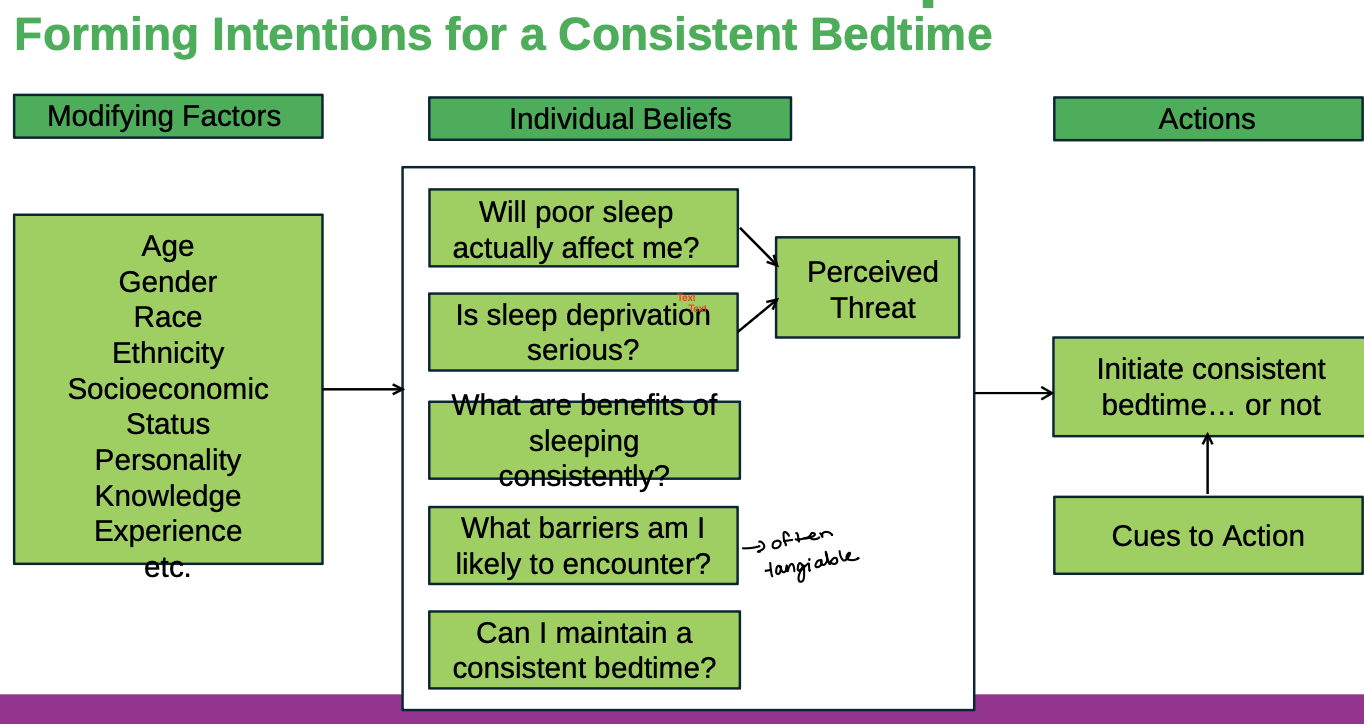
Health belief model
Assumes that health-related actions are predicted by four primary beliefs: perceived susceptibility to a disease, perceived severity of the illness, perceived benefits of taking protective action, and perceived barriers (such as financial cost or inconvenience)
Modifying factors that then influence individual beliefs to then influence a cue to action (internal symptoms, external media) to behavior
Self-efficacy theory
Grounded in social cognitive theory and reciprocal determinism (person behavior, personal factors, and enviornment influence and shape one another).
It posits that adherence depends heavily on a person's self-efficacy (their situation-specific belief in their capability to execute a behavior) alongside their outcome expectations (the belief that performing the behavior will lead to valuable results)
Theory of planned behavior
Contends that the immediate predictor of behavior is a person's intention to act. Intentions are driven by three elements: attitudes toward the behavior, subjective norms (perceived social pressure and motivation to meet others' expectations), and perceived behavioral control
Behavioral theory
(based on B. F. Skinner’s operant conditioning) Focuses on environmental factors, habits, and reinforcement principles. Adherence is established and maintained using positive and negative reinforcement, reminder cues/prompts, and contingency contracts
Transtheoretical model/stages-of-change model
Proposes that people progress (and often regress/relapse) through five spiraling stages when altering behavior: precontemplation, contemplation, preparation, action, and maintenance. Interventions are most effective when tailored to an individual's specific current stage

Health action process approach HAPA
Not just how intentions form but how they translate into behavior change
risk perception - ppl have to perceive that they have a risk
outcome expectancies - what do they expect the outcome to be if they change their behavior (they have to have favorable perceptions, like perceived benefits)
self-efficacy - acknowledges the confiendence that someone needs to have to make the change
planning is a critical middle step
this model argues that there are action planning (planning for how we are going to carry out this change) and coping planning (we are planning for setbacks, barriers, what am I going to do if there is a setback that does not let me reach this goal)
Many people fail because they do not think of the setbacks
HAPA motivational phase
The individual forms an intention to change based on risk perception, outcome expectancies, and action self-efficacy
HAPA volitional phase
The individual translates that intention into action, where detailed action planning (identifying when, where, and how to act) and coping planning (identifying how one will cope with potential barriers or obstacles that could get in the way of the goal-striving process) are essential to maintain the behavior
HAPA vs HBM
Stage theory vs continuum theory
Motivational/Volitional phase vs modifying factors/indivdual beliefs phase
Crucial for bridging intention to action vs No planning (HBM does not explain well how we fall through on those actions)
Specifically designed to solve the intention–behavior gap by making detailed planning a required bridge between having an intention and successfully taking action vs Focuses heavily on motivation and attitudes, but fails to account for the intention–behavior gap (it does not explain how a motivated person actually executes or sustains a new habit)
Complex, ongoing lifestyle behaviors vs Best for one-time or infrequent health actions
Adherence is difficult
adherence does not equal willpower
multiple, overlapping barriers (personal, economic, sociocultural
If a person fails to adhere it does not mean they are weak, there are many barriers to consider. We are complex beings and everyday things can work against us
Personal barriers to adherence - Tom Only Makes Friends In Secret Rooms
Time and effort (too difficult/time consuming
Optimism bias—belief that one will be spared from negative consequences (Weinstein, 1980, 2001)
Mental health (stress [binge-eating, substance use, everyday behaviors], depression [risk of nonadherence is 3x greater with people w/depression than not])
Forgetfulness (common in older people; impacts not going to the gym, taking ur meds)
Treatment is perceived as ineffective
Side effects (for some experiencing the side effects/ knowing the side effects turns them off from continuing to take the meds)
Starting to feel better (if a patient starts to feel better, they will feel that they do not need to continue to take meds or seek help because they are “recovered”)
Economic, Social, & Cultural Barriers to Adherence
Low income (affects both access to healthcare and ability to pay)
Food deserts (lesser access to fresh produce)
Lack of transportation or childcare (prevents adherence to regular checkups)
Work or school schedules (can make it hard to find an available appointment and find one that fits your schedule; working out and making dinner can be hard if ur schedule is irregular)
Lack of social support (our friends and families can be critical in helping us adhere, just can be support (emotional, physical, and tangible; ex.) someone to remind us of a medicine)
Stigma and discrimination (with racial and ethnic minority group, LGBTQ, stigmatized health conditions)
Low health literacy (reading directions or following doctor’s instructions)
Cultural and religious beliefs (more resistence of modern medicines and doctors, more true for immigrants (storng ties to culture)
Improving adherence: implementation intentions
Specific plans that identify not only what one intends to do, but also where, when, and how
• I will [do action] at [time] in
[location]
ACTION PLANNING
Should also plan for barriers
• If [this happens], then I will [do
this]
COPING PLANNING
Improving adherence: behavioral strategies
opt in for reminders
fit the behavior into existing habits and routines, tying the behavior into other things that you are already doing (compatible with ur life; ex., medicine with food, exercise with listening to an audiobook)
gradually increase intensity
have an accountability buddy
modify your environment (for sleep: turn the lights down, putting ur devices in the other room; gym bag by the door; food in the fridge is healthier/fresh produce)
reduce stress
Key findings of the Scherer et al. (2021) article
Susceptibility is Generalized, Not Topic-Specific: Individuals who believe misinformation about one medical subject (such as the HPV vaccine) are highly likely (r=.70–.71) to believe misinformation about other subjects (such as cancer treatments or statin medications)
Core psychosocial factors: The findings highlight that susceptibility to medical misinformation is influenced by psychosocial factors, including lower health literacy, positive attitudes toward alternative medicine, distrust in healthcare, and a preference for active interventions.
Personal Health & Cognitive Factors: having a relevant health diagnosis doesnt make you more immune to misinformation except statin users. Also, lower analytical thinking correlates with higher susceptibility overall
Key implications from Scherer et al. (2021) article
Target Audience Characteristics, Not Diagnoses: Public health communications should be tailored to specific psychosocial groups (e.g., populations with lower health literacy or higher healthcare distrust) rather than creating separate messaging solely by patient diagnosis
Addressing Distrust and Alternative Beliefs: Interventions must address root causes of distrust in the medical system and engage respectfully with beliefs surrounding complementary medicine, rather than focusing purely on fact-checking.
Health misinformation often incorporates partial truths or genuine patient concerns.
People’s motivations for spreading misinformation - S M P S
Sharing new information: People like to feel that they have new or exclusive information that others don't know.
Protecting loved ones: People want to keep friends and family safe, often adopting a "better to be safe than sorry" mindset even without checking the facts first.
Making sense of events: People may share content when seeking explanations or trying to process conflicting information.
Seeking connection: Sharing health information serves as a way to feel connected to others
Types of misinformation sharers
Oversharer: Driven by the belief that it is better to provide as much information as possible when seeing something worrying or helpful.
Casual Sharer: Shares carelessly out of habit or distraction, such as while waiting in line or scrolling late at night.
Believer: Deeply connected to an online community whose false or misleading claims they genuinely believe and want to spread.
Enthusiast Posts misinformation frequently in support of a specific cause or person
Hoaxsters/Disinformers: Financial gain or political advantage
Mischief-Makers: Mischief or trickery, such as seeing if they can fool people for fun
If you had a friend or family member that you were worried would be suseptible, what are the DOs and DONTs?
DOs: Listen to their fears and feelings, empathize and ask open questions, don’t shame, use inclusive language, point toward credible sources
DON’Ts: Don’t lead with a fact-check, don’t publicly shame them, don’t jump to conclusions and call them out
Communication problems
Physicians may not have a lot of time to devote to a patient, which may create communication problems that reduce patients’ satisfaction. These problems include using medical language unfamiliar to the patient, as well as focusing on determining and describing a diagnosis rather than allowing patients to fully describe their concerns.