NSG 202: Benign Prostatic Hypertrophy/Hyperplasia & Prostate Cancer
 Call Kai
 Learn
 Practice Test
 Spaced Repetition
 Match
 Flashcards
 Knowt Play
1/48

There's no tags or description
Looks like no tags are added yet.
49 Terms
Location

Effects of Aging on Urinary System
Aging in men means:
Decrease kidney size
Increased DHT
Change in urinary pattern
Results in
Tissue hyperplasia
Local inflammation
Increased stasis
Urinary retention/dribbling
Etiology
Very common & cause not understood
Due to hormonal changes Dihydrotestosterone
(DHT) & aging
Develops in the inner part of prostate gland
Excessive prostate tissue = obstructive s/s
Risk Factors
Age
Only “known” factor
Race
Black men have higher incidence
Asian men have less incidence
Genetic connection
Variants in some genes
Modifiable
Obesity
Metabolic syndrome
Coffee and caffeine intake
Sedentary lifestyle
Benign Prostatic Hypertrophy/Hyperplasia (BPH)
Enlargement of the prostate gland not cancer
Occurs in 50% of men between 50-60 yrs
80% of men > 70 yrs
Not correlated to sexual frequency
Does NOT increase risk of prostate CA
What happens in BPH?
Increase in DHT
Causes hyperplasia
Enlargement of the tissue
Causes LUTS - Urinary retention/leaking/incontinence
UTI and/or bladder stones
Residual/statis
Assessment of Urinary System
Subjective
Objective

Collaborative Care
History
Determine severity of LUTS
International Prostate Symptoms Score (I-PSS)
Physical Assessment
Elimination pattern
Urination specific questions
Hesitancy, reduced force, incomplete sensation, straining, dribbling, leaking
Blood in urine
Inspect & palpate abd
Prepare for HCP to do DRE
Testing
Labs
CBC for WBC/RBC
BUN/Creatinine
PSA
Serum acid phosphatase
Biopsy
Urine
US
C&S
Residual
Pressure
flow test
Imaging
TRUS
MRI
PSMA PET
Bladder US
DRE
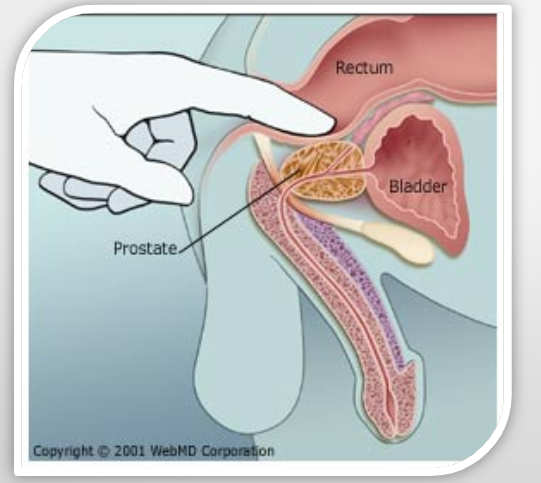
Normal vs. Enlarged

What type of kidney failure is the client with BPH at risk for developing?
What lab value will give you a hint?
What type of kidney failure is the client with BPH at risk for developing?
What lab value will give you a hint?
What type of lab would you want to evaluate prior to a biopsy of the prostate?
Nonsurgical Management

Drug Therapy: Alpha₁-Adrenergic Antagonists
Alpha₁-Adrenergic Antagonists
alfuzosin (Uroxatral)
tamsulosin (Flomax)
doxazosin (Cardura)
terazosin (Hytrin)
silodosin (Rapaflo)
Relaxes smooth muscle in the bladder neck
Monitor BP → S/E dizziness, HA, weakness → Flomax/Uroxatral 30 min after meals & same time daily → Can interfere w/other drugs
Drug Therapy: 5 Alpha - Reductase Inhibitors
5 Alpha - Reductase Inhibitors
finasteride (Proscar)
dutasteride (Avodart)
Combo Avodart and Flomax – called Jaylen
Combo of Proscar and Cardura
Reduces size of prostate to improve urine flow
Assess BP
Gynecomastia
Risk for cancer
Teratogenic - dermal absorption
Full glass water
Don't open capsule
Drug Therapy Continued
Erectogenic Drugs
tadalafil (Cialis)
Herbal Therapy
saw palmetto
Complementary/Integrative
Frequent sexual intercourse
Prostate Artery Embolism

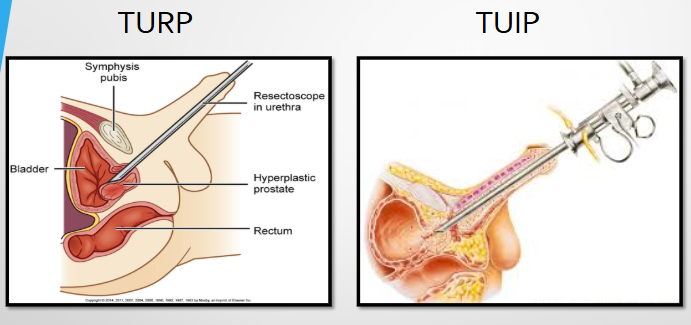
Surgical Management HoLEP

Surgical Management TURP & TUIP
Pre/Post Op Care
Anxiety
r/t fear of ED
r/t fear of incontinence
Medications
Review meds to be stopped prior to sx per HCP
Catheter
If needed they may see small clots or tissue
If home w/ catheter - teach care
Foley Irrigation
Continuous
Closed Intermittent &
Open Catheter
Nursing Diagnosis for BPH
Acute pain r/t bladder distention
Risk for infection r/t indwelling catheter, urinary stasis
Acute pain r/t inflamed tissues secondary to sx
Urinary retention r/t blockage from enlarged prostate
Urinary incontinence r/t over distention of bladder
Disturbed sleep pattern r/t nocturia
Risk for infection r/t residual urine
Knowledge deficit r/t management of BPH
The nurse notes bright red urinary drainage from a client who had a TURP with continuous bladder irrigation yesterday. What is the appropriate initial nursing action?
Calculate intake and output
Monitor Hgb/Hct
Increase the rate of the bladder irrigation
Document findings in the EHR
A client has a continuous bladder irrigation after surgery yesterday. The amount of bladder irrigating solution that has infused over the past 12 hours is 1100 mL’s. The amount of fluid in the urinary drainage bag is 1950 mL’s.
The nurse records that the client had how many mL’s urinary output in the past 12 hours?
Prostate Cancer

Prostate Cancer Pathophysiology
This cancer loves hormones!
Androgen dependent adenocarcinoma
Tumors on outer area of prostate
Slow growing
Mets has predictable pattern

Prostate Cancer Risk Factors
Age
First degree relative
African American
Diet
Prostate Cancer Clinical Manifestations
Asymptomatic in early stages
Eventually may experience s/s similar to BPH
Urination issues
Gross hematuria late sign
Pain
Pelvis, hips, spine & ribs
Swollen lymph nodes
Unexpected weight loss (advanced stages)
Important History
Age
Ethnicity
Family history
Nutritional habits
Urinary issues
Medications
Changes in sexuality
STI's
Pain
Last DRE
Last PSA
Labs & Dx Studies for Prostate CA
Initially:
PSA – Normal <50 yrs is 2.5 ng/mL
- suspicious if >4.0 ng/mL
DRE
Biopsy – TRUS
Prostate specific biomarkers
Once diagnosed:
Lymph node biopsy
CT abd and pelvis and lymph nodes
MRI
Radionuclide bone scan
Liver function study
Serum acid phosphatase
Serum alkaline phosphatase
Plan of Care Status Post Diagnosis
Based on extent of disease & pt physical condition
Active surveillance in early stage
Consider pt overall health
Consider s/e of treatment r/t age of patient
Consider estimated life expectancy
Can be done for up to 10 years before tx starts
Follow up imperative
Get regular DRE and PSA
Consider palliative tx to control spread or relieve distressing s/s
Biopsy
Staging
TURP
Staging done and potential removal of tumor
Consider:
Tx with consideration for age, ED and incontinence potential.
Radiation therapy
Hormone therapy
Chemo
Metastasis of Prostate CA to Pelvis and Lumbar Spine

Non-surgical Radiation Therapy: External Beam Radiation Therapy (EBRT)
3D-CRT
3-dimensional conformal radiation therapy
Targets cancer
Reduced damage to nearby organs & tissue
IMRT
Intensity modulated radiation therapy
Most common
Very high doses to the prostate
SBRT
Stereotactic body radiation therapy
Large doses to prostate over a few days
Takes less time than IMRT but has more s/e
Non-surgical Radiation Therapy EBRT Side Effects
Erectile Dysfunction
Causes ED in many men well after the tx is done
Elimination issues
Urine frequency
Diarrhea
Acute radiation cystitis
Avoid caffeine
Drink plenty of fluids
Radiation proctitis
Irritation of the rectum
Causes cramping and diarrhea and rectal leaking
Usually resolves following tx but rare cases it is permanent
Avoid spicy foods, fatty foods, caffeine and dairy products
Brachytherapy
Implantation of radioactive seeds
One time outpatient tx
Side effects
Urinary issues
ED issues
Fatigue
Radiation proctitis

Drug Therapy
Androgen deprivation therapy (ADT) (two types)
Androgen synthesis inhibitors
Androgen receptor blockers
Luteinizing hormone-releasing hormone (LHRH) agonist or antiandrogens
Chemotherapy
Drug Therapy: Androgen Receptor Blockers
Example: flutamide (Eulexin), nilutamide (Nilandron), bicalutamide (Casodex)
Block the action of testosterone by competing with circulating androgens at receptor sites
Can be combined with LH-RH agonists
Side effects: loss of libido, erectile dysfunction, hot flashes, breast pain, and gynecomastia
Radiopharmaceuticals
To tx prostate cx that has spread
Must have previously been tx with hormone therapy & chemo
Intravenously in specific cycles
Side Effects
Low RBC
Low platelets
Low WBC
Kidney damage
Drug Therapy Luteinizing hormone-releasing hormone agonist (LHRH agonist)
Examples:
leuprolide (Lupron)
goserelin (Zoladex)
histrelin (Supprelin)
triptorelin (Trelstar)
Injections
Decreases testosterone production
For advanced prostate cancer
Goal: palliation
Drug Therapy Gonadotropin-releasing Hormone Antagonist
Examples:
degarelix (Firmagon) is injection
relugolix (Orgovyx) is oral
Suppresses the testes' ability to produce androgens
For advanced prostate cancer
Drug Therapy Androgen Receptor Blockers
Examples:
flutamide (Eulexin)
bicalutamide (Casodex)
nilutamide (Nilandron)
Block the body’s ability to use available androgens
May be used in combo with LHRH agonists for maximum effect
For metastatic disease and surgical or chemical castration with Degarelix/Relugolix
Liver toxicity danger
Chemo
Systemic
For patients with mets or if other therapies have not worked
Done to slow the growth not to cure the cancer
For quality-of-life purposes
Minimally Invasive Surgery Laparoscopic Radical Prostatectomy (LRP)
Done with robotic assistance
Most common procedure
Removal of prostate gland, surrounding tissues and seminal vesicles
Radical Prostatectomy
Type is decided related to desired outcome and stage of the cancer
Removal of entire prostate, prostatic capsule, the cuff at bladder neck, seminal vesicles and regional lymph nodes
Post Op
Catheter in place 1-2 weeks
PCA for pain control
Monitor for PE and/or DVT
No strain with BM
1 & O's
Monitor for infection - keep urinary meatus clean
No rectal meds or enemas
Teach
Catheter care at home
Follow up visits imperative
Invasive: Radical Prostatectomy

Nursing Diagnosis
Impaired Urinary Elimination
Anxiety/Fear
Acute Pain / Chronic Pain
Risk for sexual dysfunction
Dysfunctional grieving or anticipatory grieving
The nurse is caring for a patient after a radical perineal prostatectomy for advanced cancer of the prostate. What is a priority nsg dx for this patient?
Risk for infection
Sexual dysfunction
Total urinary incontinence
Risk for situational low self-esteem