Salmonella as a foodborne pathogen
 Call Kai
 Learn
 Practice Test
 Spaced Repetition
 Match
 Flashcards
 Knowt Play
1/19

There's no tags or description
Looks like no tags are added yet.
20 Terms
Why is Salmonella such a burden on society?
It is the 2nd most common bacterial food pathogen after Campylobacter
Foodborne illness has huge clinical implications, i.e. stress on resources, staff, especially in busy seasons i.e. winter
Commercial implications such as reduced productivity due to workers taking sick leave, as well as financial losses e.g. 2 million eggs were recalled in June 2025 in the US due to a Salmonella contamination
What are some clinically important strains of Salmonella?
• S. Typhi and S. Paratyphi: involved in causing the systemic invasive disease known as enteric or typhoid fever
• S. Typhimurium and S. Enteritidis: results in a self limiting non-systemic infection resulting in gastroenteritis.
• But some strains can do both → S. Dublin
What are the main infections caused by S. Typhimurium?
• Infection in humans leads to gastroenteritis → high dose normally required but can vary, due to host factors playing a role in disease progression
• Infection in mice leads to typhoid-fever-like disease
• Infection in a calf leads to gastroenteritis
• Much of the Salmonella research carried out in these organisms → as it has two good animal model organisms
How does a Salmonella infection occur in relation to food-borne illness?
The bacteria is taken up through ingestion of contaminated food *always spread via oral route/ touching a contaminated surface, and then touching your mouth and can overcome host defences such as surviving stomach acid, bile as well as digestive enzymes
What is meant by the infectious cycle in relation to Salmonella?
The infectious cycle of Salmonella refers to the process through which the bacteria invade hosts, multiply, and spread, typically beginning with ingestion through contaminated food.
It may involve transmission mechanisms, host colonisation, evasion of immune responses, and production of virulence factors that facilitate infection.
i.e. survival after phagocytosis within MP can lead to systematic infection as they can travel and be brought to new sites

How does Salmonella use their flagella as a mechanism of reaching host colon cells?
Typical commensals don’t permeate the mucus layer, however flagella allow it to bypass the thick mucus layer by utilising its rotating appendages (powered by a MCP methyl-accepting chemotaxis protein)
This allows it to propel down the mucus layer that sits above the basal colon epithelial cells and invade.

How does Salmonella adhere to host cells:
Has a wide array of fimbrial adhesins (ex of virulence factor)
– Mannoside binding type 1 fimbriae
– Plasmid encoded (pef)
– Long polar fimbriae (lpf)
• Adhesins to sub epithelial tissue incl:
– PgtE and Rck to Laminin (protein-protein interactions allow tight binding)
– ShdA and MisL to Fibronectin and Collagen
• A large array of putative adhesins identified
What are Pathogenicity islands (PAIs) and what is the role of Salmonella’s?
Regions within the chromosome which include virulence genes, which often contain their own regulators (in order not to waste energy & when all genes are close together makes translation by RNAP faster)
• Generally have a different GC content suggesting horizontal gene transfer (HGT) i.e. from phage gene insertion i.e. in tRNA genes.
• Salmonella has 17 PAI with key islands being SPI-1 and SPI-2 →which encode T3SS
What does the SPI-1 and SPI-2 PAIs encode and what is the function?
SPI-1 and SPI-2 encode Type III secretion systems (T3SS), which are essentially molecular syringes which facilitate the injection of effector proteins into host cells in order to cause harm/ conduct their pathogenic effect.

What does the SPI-1 PAI encode?
• Hil regulatory genes → gene regulation is important as building this needle complex requires a large amount of cellular energy and is then turned on in high-salt, low O2 environments
• Encodes a large variety of effector, chaperone proteins as well as the structural genes which make up the T3SS
• Expressed under low aeration and high salt conditions
• T3SS also secretes effectors from outside SPI-1
What type of signalling pathways do effectors encoded by SPI-1 induce?
Sop effector proteins trigger cytoskeletal rearrangements i.e. actin rearrangement and inflammatory signalling cascades
→ by activating Rho GTPases which activate the MAPK leading to NF-kB activation → IL-8 production helps recruit phagocytic neutrophils

What does SPI-2 encode?
SPI-2 encodes additional effector proteins and a second T3SS which assists in intracellular survival i.e. within macrophages and replication within host cells.
the SsrAB two component regulatory system regulates the expression of these proteins, and is induced by stress conditions

How do Salmonella survive within macrophages during the systemic infection?
The reduction in proinflammatory mediators and induction of MP death by necroptosis diminishes the immune system’s ability to control the replication and spread of Salmonella within the host.
PAMPs from Salmonella are recognized by TLRs i.e. TLR4 ,where its signals induce an array of responses, including acidification of the phagosome.
This drop in pH triggers Salmonella to secrete effectors, which in turn modify the phagosome to generate a replicative compartment known as the Salmonella-Containing Vacuole (SCV).
NLR activation, of both NLRC4 (activated by flagellin) and NLRP3 occurs, leads to processing of pro- Caspase-1 into its active form, followed by cleavage of pro-IL-1β and pro-IL-18 into their active forms leading to pyroptosis → aids spread of bacteria
NLRP6 and NLRP12 activation by Sakmonella inhibit phosphorylation of IκBα and ERK, thus preventing nuclear translocation of NF-κB and ERK, respectively
→ diminishing the production of proinflammatory mediators and results in the inefficient clearance of phagocytized bacteria.
Type I IFN signalling is activated through the production of type I IFNs, leading to the association b.w IFNAR and RIP1.
Formation of the RIP1–RIP3 complex,results in necroptosis of MPs

What are features of the virulence plasmid?
• Approx 96kb
• Encodes fimbriae (Pef)
• Originally identified as playing a role in virulence in the mouse model
• Only 10% of the plasmid plays a role in virulence
• The SPV genes seem to originate on this plasmid
• Not always on plasmid
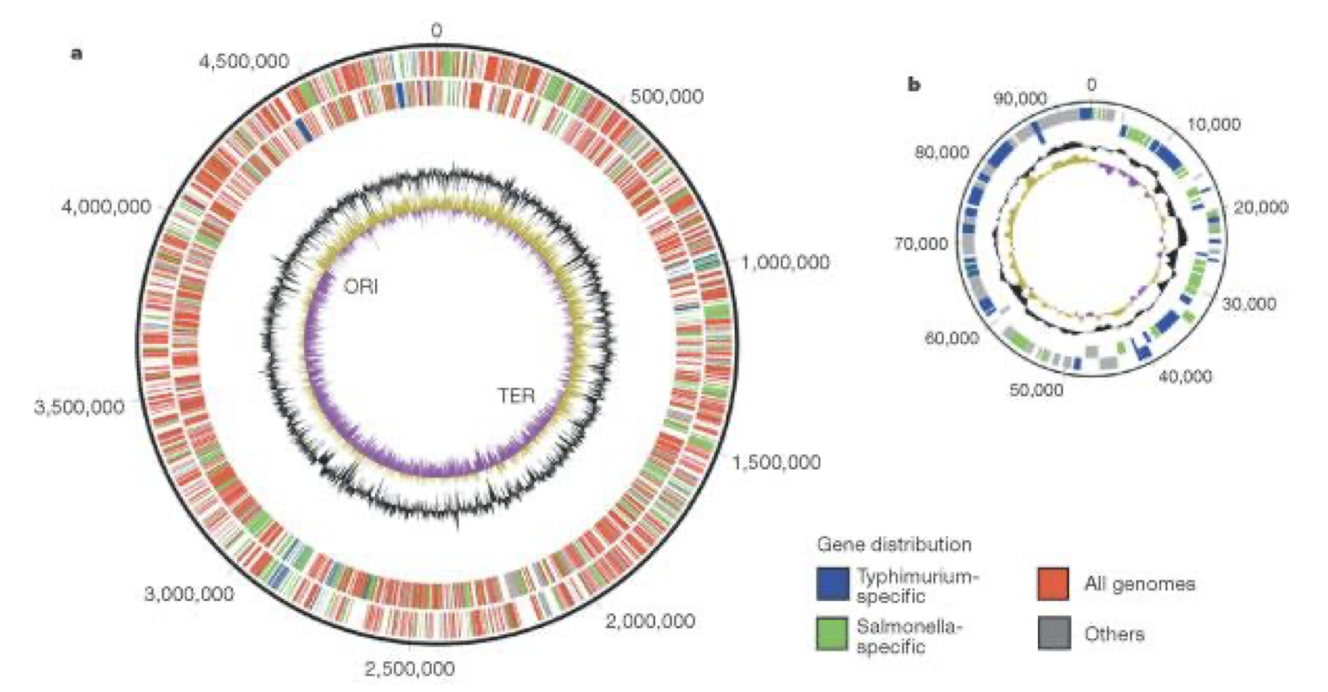
What is the SPV gene cluster in Salmonella?
The SPV gene cluster in Salmonella is a collection of virulence genes located on the virulence plasmid that are involved in the pathogenicity and survival of the bacteria within the host.

What is SpvR (encoded on the SPV gene cluster)?
SpvR, a regulator encoded on the SPV gene cluster, modulates the expression of effector proteins that are part of the SPI-2 system, enhancing Salmonella's ability to survive and replicate within host cells.
Activates expression both of itself and SpvA.
It itself is regulated by chromosomal regulators such as RpoS and PhoPQ
What is SpvB involved in?
SpvB involved in actin rearrangement in macrophages
What is SpvC involved in?
SpvC is a phosphothreonine lyase inhibiting MAPK in macrophages
What are some key differences b/w S. Typhi and S. Typhimurium in terms of studies on Typhoid fever?
• S. Typhi has no suitable animal model
• Thus S. Typhimurium used as a model in mice
• S. Typhi has around 600 genes absent from S. Typhimurium
• Seem to be differences in SPI-2 kinetics too (see ref Thurston 2023)
What is key for Salmonella to cause systemic disease?
Dissemination is key:
• Several routes across the intestinal barrier to cause systemic disease
• Main route appears to be through the Mesenteric Lymph nodes (via Peyers patches) with SPI-1 favours M-cell invasion
