Introduction to Infectious Diseases
 Call Kai
 Learn
Learn Practice Test
 Spaced Repetition
 Match
Match Flashcards
 Knowt Play
1/14

There's no tags or description
Looks like no tags are added yet.
Name | Mastery | Learn | Test | Matching | Spaced | Call with Kai | Chat |
|---|
No analytics yet
Send a link to your students to track their progress
15 Terms
Viruses
-Strict intracellular parasites of living cells.
-One of the smallest infectious agents cannot be seen in conventional microscopes.
-Genetic material may be dsDNA, ssDNA, or ssRNA.
May contain a lipid envelope around theis capsid
*** Enveloped virus tend to be less resistance(biolipid layer os easy to dissolve)
Viral Infections
-Attachement
-Penetration
-Uncoating
-Replication
-Assembly
-Maturation
-Release
Viral Replication: DNA and RNA viruses
DNA viruses
Viral DNA is replicated (usually in the cell nucleus).
Viral DNA is transcribed as RNA and translated into viral proteins.
RNA viruses
Viral RNA is directly replicated (usually outside the nucleus)
Viral mRNA directly translated into viral proteins
Retroviruses (RNA)
Viral RNA is reverse transcribed into viral RNA and mRNA which will be transcribed as viral proteins.
Bacteria
Unicellular prokaryotic organisms (no nucleus).
0.1-10um, so can be seen in conventional microscopes.
Genetic materials is dsDNA, and some bacteria may have extrachromosomal DNA (plasmids).
Most pathogenic bacteria reproduce by binary fission.
How bacteria is categorized
May be extracellular, intracellular, or both .
May be aerobic, anaerobic, or both.
Gram- and Gram+ bacteria

Toxins
Some bacteria, like Clostridium tetani, Clostridium botulinum, and Corynebacterium diphtheriae produce toxic substances that cause disease in human (exotoxins).
Vaccine and treatment include eliminating the bacteria and also neutralizing the toxin.
Gram-negative bacteria may also release endotoxin, a component of their outer membrane that can elicit a strong inflammatory response in the host.
**How bacteria harms us**
Bacteria can attack cell.
Immune system attacks bacteria but can also attack body cells.
Bacteria produce toxins.
asy way to remember:
Bacteria harm us by:
D → T → I → I
Damage cells
Make Toxins
Cause Inflammation
Invade tissues
Fungi
Eukaryotic organisms
Can reproduce sexually and asexually (fragmentation, budding, or sporification)
Can exist as yeast or hyphae/mold
Both yeasts and hifae can lead to localized and severe disease, especially in patients with co-morbidities and/or immunocompromised.
Parasites
-Very broad range of organisms ranging from unicellular
eukaryotic organisms (Cryptosporidium parvum) the size
of bacteria to very large organisms (Dyphyllobothrium
latum can reach 30ft)
Pathogenic Mechanisms
1. Infectious agents may produce toxins and change the
microenvironment of tissues, making them less suitable
for host cells (e.g., lower pH)
2. Attachment of infectious agents to host cells may
activate membrane and intracellular receptors and
trigger responses that disrupt cell function
3. Infectious agents may cause direct tissue damage in
replicating (e.g., virus bursting cells after replicating)
4. Infectious agents may trigger inflammatory responses
that damage tissues and hinder tissue function
Pathogenic and non-pathogenic agents

Pathogenic and non-pathogenic
organisms
Huma microbiota
-Residents (they are always there; they are regardless) vs Transient flora (temporary visitors).
-Commensal (helpful bacteria) vs [potential] pathogens (can cause harm).
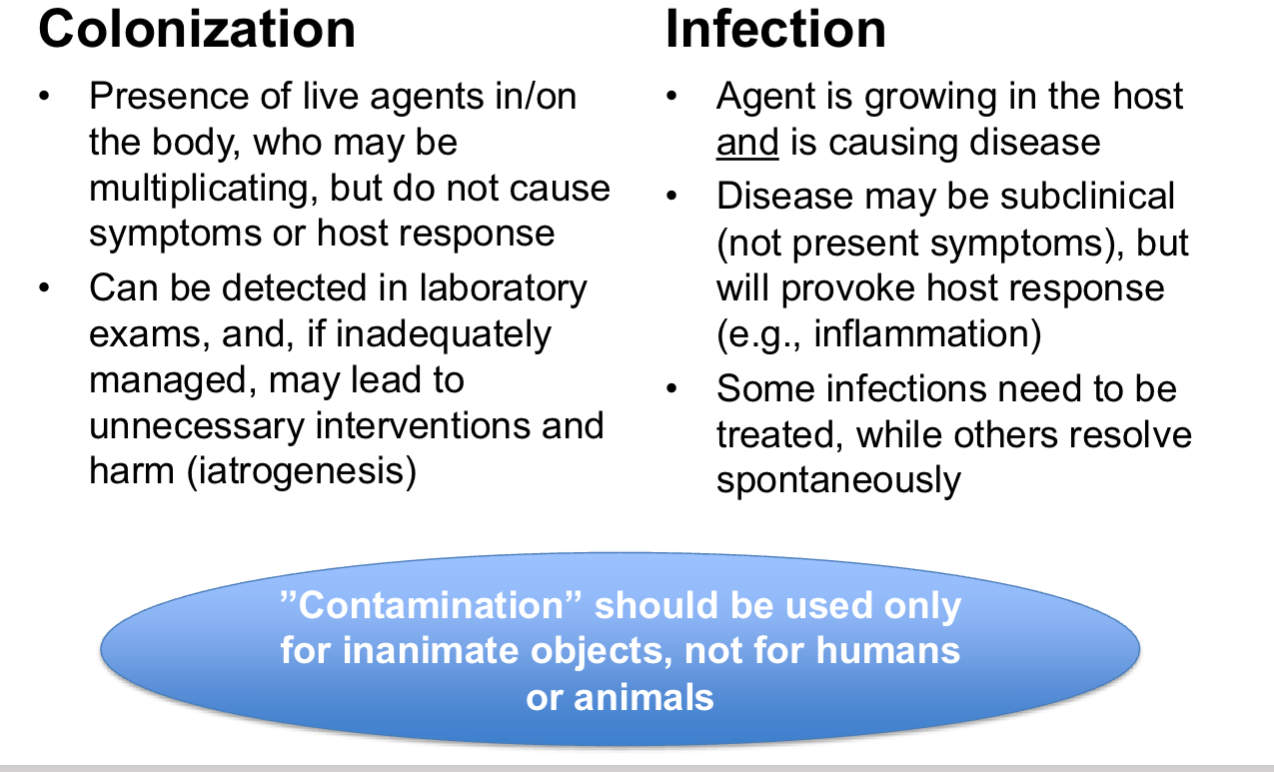
-Carrier state: a colonization (not causing disease).
-Opportunistic agents: typically don’t cause disease but if you get someone that is vulnerable it would cause them the disease.
Resident vs. Transient
• Transient flora colonize individuals for hours to weeks, but not
permanently.
• Surgical hand washing / scrubbing aims to eliminate transient
flora and reduce resident flora.
Pathogenic agents
Pathogenicity: ability to cause disease.
Virulence: (how bad the disease is) extent of disease/harm caused to a host.
Transmissibility: (How easy it is to spread) ability to infect other hosts.
Susceptibility to treatment; (how easy it is to treat) extent to which agents respond to treatments.
***Virulence + Transmissibility + Susceptibility to treatment: hard to find
Epidemiologic triad
