pre calc equations 3
 Call Kai
 Learn
 Practice Test
 Spaced Repetition
 Match
 Flashcards
 Knowt Play
1/26

There's no tags or description
Looks like no tags are added yet.
27 Terms
pythagorean equation

quadratic formula

reference angle

amplitude and period: y= a sin/cos (bx)
amp= a, period= 2π/b
amplitude and period: tan/ cot
period= π/b
reciprocal identities
sinx= 1/cscx, cosx= 1/secx, tan= 1/cotx
ratio identities
tanx= sinx/cosx, cotx= cox/sinx
pythagorean trig identities

double-angle identity for sine
sin (2θ)= 2sin(θ)cos(θ)
double-angle identity for cosine

double-angle identity for tangent

power-reducing trig identity

half-angle identities: tangent, sine & cosine

definition, domain, range: y=sin^-1(x) (or y=arcsin (x))
y=sin^-1(x) if and only if x=sin(y)
domain: [-1,1]
range: [-π/2, π/2]
So, y=sin^-1(x) lies in the 1st or 4th quadrant
definition, domain, range: y=cos^-1(x) (or y=arccos (x))
y = cos^-1(x) if and only if x=cos(y)
domain: [-1,1]
range: [0, π]
So, y=cos^-1(x) lies in the 1st or 2nd quadrant
definition, domain, range: y=tan^-1(x) (or y=arctan (x))
y = tan^-1(x) if and only if x=tan(y)
domain: (-∞,∞)
range: (-π/2, π/2)
So, y=tan^-1(x) lies in the 1st or 4nd quadrant
the law of sines
if A,B, and C are the measures of the angles of a triangle, and a, b, and c are the lengths of the sides opposite these angles, then:
a/sin(A) = b/sin(B) = c/sin(C)
the law of cosines

area of a triangle (SAS form)
K=1/2bc sin(A)
K=1/2ac sin(B)
K=1/2ab sin(C)
heron’s formula for the area of a triangle (SSS form)
If a,b and c are the lengths of the sides of a triangle, then the area of the triangle is
√s(s-a)(s-b)(s-c)
where s=1/2(a+b+c) is the semiperimeter
definition of an inverse function
obtained by switching its input and output values ( results in the flip-flopping of the domain and range)
horizontal line test
the function is 1 to 1 if no horizontal line intersects its graph at more than one point
how to show 2 functions f and g are inverses
show that
f(g(x))=x
and
g(f(x))=x
steps for finding the inverse of a function f(x)
Verify that f is 1 to t (HLT)
Substitute y for f(x)
Switch x and y
Solve for y
Substitute f^-1(x) for y
(restrict the domain of f^-1 to match the range of f if necessary)
definition of an exponential function with base a
f(x)= a^x, where a>0, a doesn’t equal zero, and x is any reak number
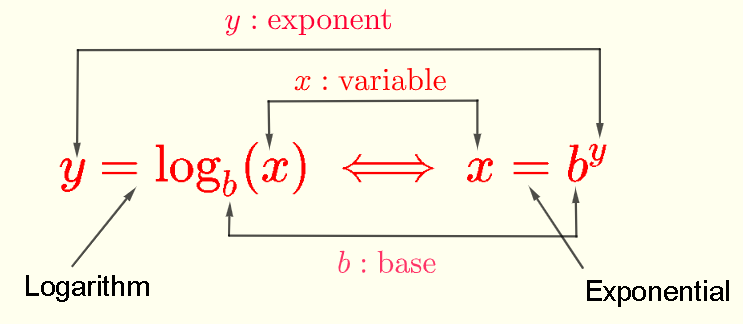
the definition of a logarithmic function with base a
y=loga(x) is equal to a^y=x for x>0, a>0, and a doesn’t equal 1
exponential to log