Week 3 - Non-Disjunction

0.0(0)
Studied by 0 people
call kaiCall Kai
learnLearn
examPractice Test
spaced repetitionSpaced Repetition
heart puzzleMatch
flashcardsFlashcards
GameKnowt Play
Card Sorting

1/21

encourage image

There's no tags or description

Looks like no tags are added yet.

22 Terms

1
New cards

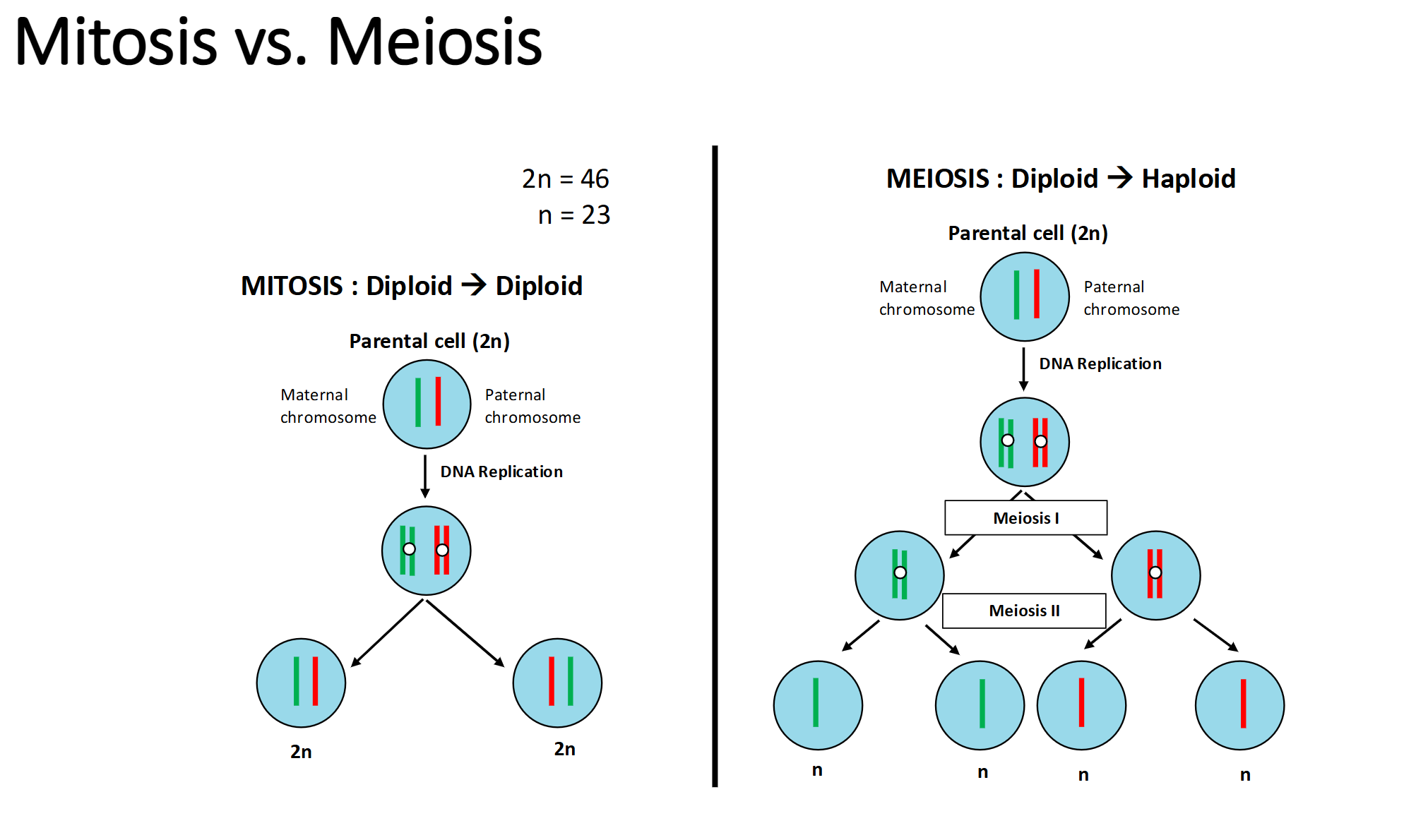
Mitosis vs Meiosis Review


<p></p>
2
New cards

Mitosis Review

knowt flashcard image
3
New cards

What is the biggest difference between meiosis I and meiosis II?

  • Meiosis I: Homologous Chromosomes Separate

  • Meiosis II: Sister Chromatids Separate


<ul><li><p>Meiosis I: Homologous Chromosomes Separate</p></li><li><p>Meiosis II: Sister Chromatids Separate</p></li></ul><p></p>
4
New cards

What is nondisjunction and when can it occur during meiosis?

  • Nondisjunction is the failure of chromosomes to separate properly during cell division.

  • In Meiosis I, homologous chromosomes can fail to separate.

  • In Meiosis II, sister chromatids can fail to separate.

  • This can produce gametes with an extra chromosome (n + 1) or a missing chromosome (n − 1).

  • In humans, this can produce gametes with 24 or 22 chromosomes instead of the normal 23.


<ul><li><p><strong>Nondisjunction</strong> is the failure of chromosomes to separate properly during cell division.</p></li><li><p>In <strong>Meiosis I</strong>, homologous chromosomes can fail to separate.</p></li><li><p>In <strong>Meiosis II</strong>, sister chromatids can fail to separate.</p></li><li><p>This can produce gametes with an <strong>extra chromosome (n + 1)</strong> or a <strong>missing chromosome (n − 1)</strong>.</p></li><li><p>In humans, this can produce gametes with <strong>24 or 22 chromosomes instead of the normal 23</strong>.</p></li></ul><p></p>
5
New cards

What is the difference between nondisjunction and aneuploidy?

  • Nondisjunction = the event/mistake: chromosomes fail to separate properly.

  • Aneuploidy = the result: a cell has an abnormal number of particular chromosomes.

  • An n + 1 gamete fertilized by a normal gamete can produce trisomy (2n + 1).

  • An n − 1 gamete fertilized by a normal gamete can produce monosomy (2n − 1).

  • Example: trisomy 21 results from having three copies of chromosome 21.


<ul><li><p><strong>Nondisjunction = the event/mistake:</strong> chromosomes fail to separate properly.</p></li><li><p><strong>Aneuploidy = the result:</strong> a cell has an abnormal number of particular chromosomes.</p></li><li><p>An <strong>n + 1</strong> gamete fertilized by a normal gamete can produce <strong>trisomy (2n + 1)</strong>.</p></li><li><p>An <strong>n − 1</strong> gamete fertilized by a normal gamete can produce <strong>monosomy (2n − 1)</strong>.</p></li><li><p>Example: <strong>trisomy 21</strong> results from having three copies of chromosome 21.</p></li></ul><p></p>
6
New cards

What are linked genes and how do they behave during meiosis?


  • Linked genes are genes located on the same chromosome and therefore tend to be inherited together.

  • Example: if the paternal chromosome carries Ab and the maternal chromosome carries aB, an AaBb individual has the linked arrangements Ab/aB.

  • During Meiosis I, the homologous chromosomes separate, keeping A with b and a with B if no crossing over occurs.

  • Without crossing over, the gametes are therefore Ab and aB, rather than all four possible combinations.

  • Crossing over can produce new (recombinant) allele combinations.


<p></p><ul><li><p><strong>Linked genes</strong> are genes located on the <strong>same chromosome</strong> and therefore tend to be inherited together.</p></li><li><p>Example: if the paternal chromosome carries <strong>Ab</strong> and the maternal chromosome carries <strong>aB</strong>, an <strong>AaBb</strong> individual has the linked arrangements <strong>Ab/aB</strong>.</p></li><li><p>During <strong>Meiosis I</strong>, the homologous chromosomes separate, keeping <strong>A with b</strong> and <strong>a with B</strong> if no crossing over occurs.</p></li><li><p>Without crossing over, the gametes are therefore <strong>Ab and aB</strong>, rather than all four possible combinations.</p></li><li><p><strong>Crossing over can produce new (recombinant) allele combinations.</strong></p></li></ul><p></p>
7
New cards

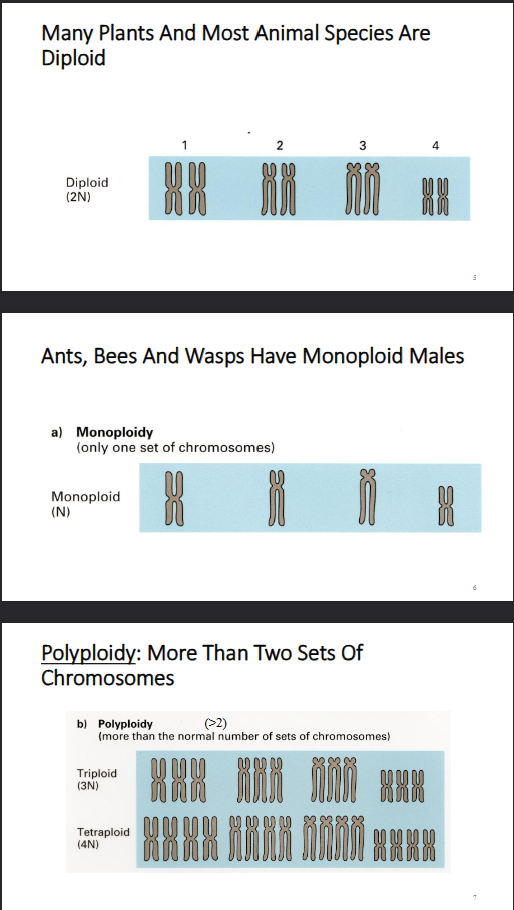
What is polyploidy, and how does it differ from aneuploidy?

  • Polyploidy = having more than two complete sets of chromosomes.

  • Examples: 3n = triploid, 4n = tetraploid, 6n = hexaploid.

  • Polyploidy is especially common in plants and relatively rare in animals.

  • Aneuploidy involves the addition or loss of individual chromosomes, not entire sets.

  • Example: 2n + 1 = trisomy and 2n − 1 = monosomy.

  • Key distinction: polyploidy = whole chromosome sets; aneuploidy = individual chromosomes.


<ul><li><p><strong>Polyploidy</strong> = having more than two <strong>complete sets of chromosomes</strong>.</p></li><li><p>Examples: <strong>3n = triploid, 4n = tetraploid, 6n = hexaploid</strong>.</p></li><li><p>Polyploidy is especially common in <strong>plants</strong> and relatively rare in animals.</p></li><li><p><strong>Aneuploidy</strong> involves the addition or loss of <strong>individual chromosomes</strong>, not entire sets.</p></li><li><p>Example: <strong>2n + 1 = trisomy</strong> and <strong>2n − 1 = monosomy</strong>.</p></li><li><p>Key distinction: <strong>polyploidy = whole chromosome sets; aneuploidy = individual chromosomes.</strong></p></li></ul><p></p>
8
New cards

What is the difference between autopolyploidy and allopolyploidy?

  • Autopolyploidy: extra chromosome sets come from the same species.

  • Allopolyploidy: chromosome sets come from different species, typically through hybridization followed by chromosome doubling.

  • Memory trick: AUTO = same species; ALLO = different species.


9
New cards

What are the three major types of chromosome-level changes?

  • Chromosomal rearrangement: part of a chromosome is altered, such as by deletion, duplication, or inversion.

  • Aneuploidy: individual chromosomes are gained or lost (e.g., 2n + 1).

  • Polyploidy: entire chromosome sets are added (e.g., 3n or 4n).

    • It’s especially common in plants but can also occur in some animals and fungi.

    • Plant Kingdom: 30-35% of flowering plants and 70-80% of grasses are
      polyploids

    • Animal Kingdom: Polyploidy is rare


<ul><li><p><strong>Chromosomal rearrangement:</strong> part of a chromosome is altered, such as by <strong>deletion, duplication, or inversion</strong>.</p></li><li><p><strong>Aneuploidy:</strong> individual chromosomes are gained or lost (e.g., <strong>2n + 1</strong>).</p></li><li><p><strong>Polyploidy:</strong> entire chromosome sets are added (e.g., <strong>3n or 4n</strong>).</p><ul><li><p><span>It’s especially common in plants but can also occur in some animals and fungi.</span></p></li><li><p><span>Plant Kingdom: 30-35% of flowering plants and 70-80% of grasses are<br>polyploids</span></p></li><li><p><span>Animal Kingdom: Polyploidy is rare</span></p></li></ul></li></ul><p></p>
10
New cards

Autopolyploids in Plants

  • The chromosome sets are all identical

  • All chromosomes are derived from the same species

  • Autopolyploids usually have:

    • More vegetative growth (larger cells, thicker leaves, bigger flowers, larger plants, bigger fruits)

    • Less seed production - extra chromosome sets can pair and separate unevenly during meiosis, producing abnormal gametes and reducing fertility.

    • Example: A plant doubles its own genome due to errors in cell division


<ul><li><p>The chromosome sets are all identical</p></li><li><p>All chromosomes are derived from the same species</p></li><li><p>Autopolyploids usually have:</p><ul><li><p>More vegetative growth (larger cells, thicker leaves, bigger flowers, larger plants, bigger fruits)</p></li><li><p>Less seed production - extra chromosome sets can <strong>pair and separate unevenly during meiosis</strong>, producing abnormal gametes and reducing fertility.</p></li><li><p>Example: A plant doubles its own genome due to errors in cell division</p></li></ul></li></ul><p></p>
11
New cards

Examples of Polyploid Plants

  • Many seedless varieties of citrus are triploids or pentaploids

  • Diploid watermelons have seeds

  • Seedless watermelons are triploids

  • Diploid bananas have seeds - Commercial bananas are triploids and seedless

  • Seedless grapes are triploids

  • Many commercial varieties of strawberries 8N/Sugarcane 8N or 16N/Oats 6N/Peanut 4N/Potato 4N/Coffee 4N


<ul><li><p><span>Many seedless varieties of citrus are triploids or pentaploids</span></p></li><li><p><span>Diploid watermelons have seeds</span></p></li><li><p><span>Seedless watermelons are triploids</span></p></li><li><p><span>Diploid bananas have seeds - Commercial bananas are triploids and seedless</span></p></li><li><p><span>Seedless grapes are triploids</span></p></li><li><p><span>Many commercial varieties of strawberries 8N/Sugarcane 8N or 16N/Oats 6N/Peanut 4N/Potato 4N/Coffee 4N</span></p></li></ul><p></p>
12
New cards

Why are triploid organisms such as commercial bananas usually sterile?

  • Triploid bananas have 3 copies of each of 11 chromosome types (3N = 33).

  • During meiosis I, homologous chromosomes normally pair and then separate evenly.

  • With 3 homologous chromosomes, pairing is difficult because they cannot form simple pairs and divide evenly.

  • The chromosomes may form:

    • Bivalents + univalents: 2 homologs pair while the 3rd remains unpaired.

    • Trivalents: all 3 homologs associate together.

  • These chromosomes can segregate unevenly during meiosis I.

  • This produces unbalanced gametes containing extra copies of some chromosomes and missing copies of others.

  • Most of these gametes are nonviable, causing very low fertility and explaining why commercial triploid bananas generally do not produce functional seeds.

Key idea: Odd-numbered polyploidy (e.g., 3N) makes it difficult to divide homologous chromosomes evenly during meiosis → unbalanced gametes → sterility/reduced fertility.

13
New cards

Visualization of the Problem

knowt flashcard image
14
New cards

Why are there so many possible chromosome segregation outcomes during meiosis in a triploid banana (3N = 33)?

  • A triploid banana has 33 chromosomes = 3 copies of each of 11 chromosome types.

  • Therefore, 11 separate chromosome sets must make a segregation decision during meiosis I.

  • For each set of 3 homologs, chromosomes may form a trivalent or a bivalent + univalent.

  • Different chromosome sets can behave differently in the same meiotic cell (e.g., 10 trivalents + 1 bivalent + 1 univalent, 9 trivalents + 2 bivalents + 2 univalents, etc.).

  • Each group can also segregate in different ways, creating a huge number of possible chromosome combinations in the gametes.

  • Therefore, producing a gamete with the correct chromosome combination is extremely rare.

Key idea: 11 chromosome sets making independent pairing/segregation decisions → many possible gametes, very few balanced ones.

<ul><li><p>A triploid banana has <strong>33 chromosomes = 3 copies of each of 11 chromosome types</strong>.</p></li><li><p>Therefore, <strong>11 separate chromosome sets must make a segregation decision during meiosis I</strong>.</p></li><li><p>For each set of 3 homologs, chromosomes may form a <strong>trivalent</strong> or a <strong>bivalent + univalent</strong>.</p></li><li><p>Different chromosome sets can behave differently in the same meiotic cell (e.g., <strong>10 trivalents + 1 bivalent + 1 univalent</strong>, <strong>9 trivalents + 2 bivalents + 2 univalents</strong>, etc.).</p></li><li><p>Each group can also <strong>segregate in different ways</strong>, creating a huge number of possible chromosome combinations in the gametes.</p></li><li><p>Therefore, producing a gamete with the correct chromosome combination is <strong>extremely rare</strong>.</p></li></ul><p><strong>Key idea:</strong> 11 chromosome sets making independent pairing/segregation decisions → <strong>many possible gametes, very few balanced ones</strong>.</p>
15
New cards

Reminder: What are Allopolyploids?

  • Hybrids with two different sets of chromosomes, technically a different species than both parents

  • Some polyploids are the result of crosses between 2 or more species (usually related species).

  • Example: Wheat is an allopolyploid formed from multiple ancestral species


<ul><li><p><span>Hybrids with two different sets of chromosomes, technically a different species than both parents</span></p></li><li><p><span>Some polyploids are the result of crosses between 2 or more species (usually related species).</span></p></li><li><p><span>Example: Wheat is an allopolyploid formed from multiple ancestral species</span></p></li></ul><p></p>
16
New cards

How can chromosome doubling restore fertility in an interspecific plant hybrid and produce an allopolyploid?

  • Two diploid species (AA and BB) undergo meiosis to produce A and B gametes, which fuse to form an AB hybrid.

  • The AB hybrid is usually sterile because the A and B chromosomes are from different species and cannot properly pair as homologs during meiosis I.

  • If the hybrid undergoes chromosome doubling, AB becomes AABB (4N).

  • Now each A chromosome has an A homolog and each B chromosome has a B homolog, allowing normal meiotic pairing and restoring fertility.

  • The AABB allopolyploid can then produce AB (2N) gametes


<ul><li><p>Two diploid species (AA and BB) undergo meiosis to produce A and B gametes, which fuse to form an <strong>AB hybrid</strong>. </p></li><li><p>The AB hybrid is usually <strong>sterile</strong> because the A and B chromosomes are from different species and cannot properly pair as homologs during meiosis I. </p></li><li><p>If the hybrid undergoes <strong>chromosome doubling</strong>, AB becomes <strong>AABB (4N)</strong>. </p></li><li><p>Now each A chromosome has an A homolog and each B chromosome has a B homolog, allowing normal meiotic pairing and restoring <strong>fertility</strong>. </p></li><li><p>The AABB allopolyploid can then produce <strong>AB (2N) gametes</strong></p></li></ul><p></p>
17
New cards

How did Upland cotton become a fertile allotetraploid?

  • American cotton and Old World cotton were each 2N = 26, so their gametes were N = 13.

  • Their gametes fused to form a 2N = 26 hybrid.

  • The hybrid was sterile because chromosomes from the two species could not pair properly during meiosis.

  • Chromosome doubling produced a 4N = 52 plant.

  • After doubling, each chromosome had a homologous partner, restoring fertility.

  • This fertile 4N = 52 allopolyploid is Upland cotton.


<ul><li><p>American cotton and Old World cotton were each <strong>2N = 26</strong>, so their gametes were <strong>N = 13</strong>.</p></li><li><p>Their gametes fused to form a <strong>2N = 26 hybrid</strong>.</p></li><li><p>The hybrid was <strong>sterile</strong> because chromosomes from the two species could not pair properly during meiosis.</p></li><li><p>Chromosome doubling produced a <strong>4N = 52 plant</strong>.</p></li><li><p>After doubling, each chromosome had a homologous partner, restoring fertility.</p></li><li><p>This fertile <strong>4N = 52 allopolyploid is Upland cotton</strong>.</p></li></ul><p></p>
18
New cards

How did allohexaploid bread wheat (Triticum aestivum, 6N = 42) arise?

  • Two diploid species, T. monococcum (2N=14) and T. searsii (2N=14), produced N=7 gametes and hybridized.

  • Their N=7 + N=7 gametes produced a 2N=14 sterile hybrid because chromosomes from the different species lacked proper homologous partners.

  • Chromosome doubling produced T. turgidum (4N=28), restoring homologous pairs and fertility.

  • T. turgidum (4N=28) produced 2N=14 gametes and later crossed with T. tauschii (2N=14), which produced N=7 gametes.

  • 2N=14 + N=7 → 3N=21 sterile hybrid.

  • Chromosome doubling changed 3N=21 → 6N=42, restoring chromosome pairing and fertility.

  • The result was T. aestivum (bread wheat), a fertile allohexaploid with 6 chromosome sets and 42 chromosomes.


<ul><li><p>Two diploid species, <strong>T. monococcum (2N=14)</strong> and <strong>T. searsii (2N=14)</strong>, produced <strong>N=7 gametes</strong> and hybridized.</p></li><li><p>Their <strong>N=7 + N=7</strong> gametes produced a <strong>2N=14 sterile hybrid</strong> because chromosomes from the different species lacked proper homologous partners.</p></li><li><p>Chromosome doubling produced <strong>T. turgidum (4N=28)</strong>, restoring homologous pairs and fertility.</p></li><li><p><strong>T. turgidum (4N=28)</strong> produced <strong>2N=14 gametes</strong> and later crossed with <strong>T. tauschii (2N=14)</strong>, which produced <strong>N=7 gametes</strong>.</p></li><li><p><strong>2N=14 + N=7 → 3N=21 sterile hybrid.</strong></p></li><li><p>Chromosome doubling changed <strong>3N=21 → 6N=42</strong>, restoring chromosome pairing and fertility.</p></li><li><p>The result was <strong>T. aestivum (bread wheat), a fertile allohexaploid with 6 chromosome sets and 42 chromosomes.</strong></p></li></ul><p></p>
19
New cards

How does polyploidy affect fertility, and how does this differ between plants and animals?

  • Polyploids contain more than two complete sets of chromosomes (e.g., 3N, 4N, 6N).

  • Many polyploids are sterile because their multiple chromosome sets can pair and segregate irregularly during meiosis.

  • In interspecies hybrids, chromosomes from the different species may lack homologous partners, causing sterility.

  • Chromosome doubling can restore fertility by giving each chromosome a homologous partner (e.g., AB → AABB), allowing the constituent genomes to segregate properly.

  • This process is relatively well tolerated in plants, which is why fertile allopolyploids such as wheat can form.

  • In animals, chromosome doubling is generally not well tolerated, so interspecies hybrids commonly remain sterile.

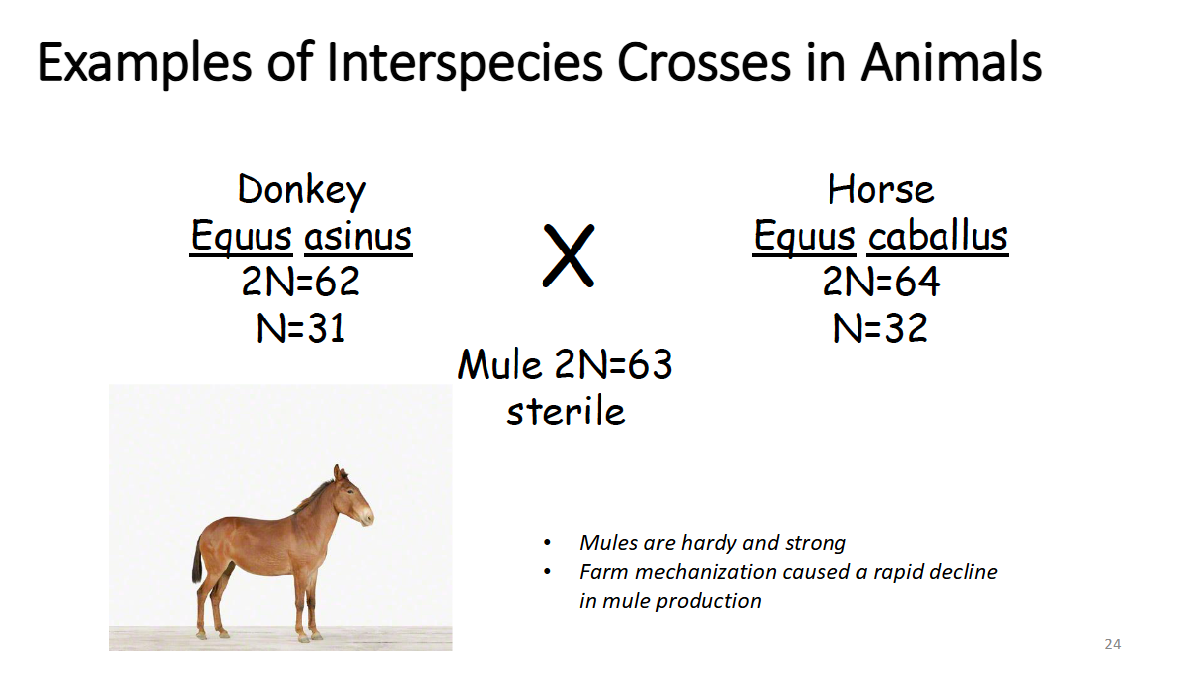
  • Example: donkey (N=31) × horse (N=32) → mule with 63 chromosomes, which is sterile because its chromosomes cannot all form proper homologous pairs during meiosis.

<ul><li><p><strong>Polyploids</strong> contain more than two complete sets of chromosomes (e.g., 3N, 4N, 6N).</p></li><li><p>Many polyploids are <strong>sterile</strong> because their multiple chromosome sets can pair and segregate irregularly during meiosis.</p></li><li><p>In <strong>interspecies hybrids</strong>, chromosomes from the different species may lack homologous partners, causing sterility.</p></li><li><p><strong>Chromosome doubling can restore fertility</strong> by giving each chromosome a homologous partner (e.g., AB → AABB), allowing the constituent genomes to segregate properly.</p></li><li><p>This process is relatively well tolerated in <strong>plants</strong>, which is why fertile allopolyploids such as wheat can form.</p></li><li><p>In <strong>animals</strong>, chromosome doubling is generally not well tolerated, so interspecies hybrids commonly remain sterile.</p></li><li><p><strong>Example:</strong> donkey (N=31) × horse (N=32) → mule with <strong>63 chromosomes</strong>, which is sterile because its chromosomes cannot all form proper homologous pairs during meiosis.</p></li></ul><p></p>
20
New cards

What is aneuploidy, and how is it different from polyploidy?

Aneuploidy is the gain or loss of individual chromosomes, rather than entire chromosome sets.

  • Trisomy = 2N + 1 → one extra chromosome

  • Monosomy = 2N − 1 → one missing chromosome

  • Example: Trisomy 21 = Down syndrome

  • Polyploidy, in contrast, involves extra complete chromosome sets (e.g., 3N, 4N, 6N).


<p>Aneuploidy is the gain or loss of <strong>individual chromosomes</strong>, rather than entire chromosome sets.</p><ul><li><p><strong>Trisomy = 2N + 1</strong> → one extra chromosome</p></li><li><p><strong>Monosomy = 2N − 1</strong> → one missing chromosome</p></li><li><p>Example: <strong>Trisomy 21 = Down syndrome</strong></p></li><li><p><strong>Polyploidy</strong>, in contrast, involves extra <strong>complete chromosome sets</strong> (e.g., 3N, 4N, 6N).</p></li></ul><p></p>
21
New cards

Important! What is nondisjunction, and how can it cause aneuploidy?

Nondisjunction is the failure of chromosomes to separate properly during meiosis.

  • Meiosis I nondisjunction: homologous chromosomes fail to separate → all 4 gametes are abnormal (N+1 or N−1).

  • Meiosis II nondisjunction: sister chromatids fail to separate → 2 normal gametes + 2 abnormal gametes.

  • If an abnormal gamete undergoes fertilization, the resulting offspring may have trisomy (2N+1) or monosomy (2N−1).

  • Therefore: nondisjunction = error/mechanism; aneuploidy = possible result.


<p>Nondisjunction is the <strong>failure of chromosomes to separate properly during meiosis</strong>.</p><ul><li><p><strong>Meiosis I nondisjunction:</strong> homologous chromosomes fail to separate → <strong>all 4 gametes are abnormal (N+1 or N−1)</strong>.</p></li><li><p><strong>Meiosis II nondisjunction:</strong> sister chromatids fail to separate → <strong>2 normal gametes + 2 abnormal gametes</strong>.</p></li><li><p>If an abnormal gamete undergoes fertilization, the resulting offspring may have <strong>trisomy (2N+1)</strong> or <strong>monosomy (2N−1)</strong>.</p></li><li><p>Therefore: <strong>nondisjunction = error/mechanism; aneuploidy = possible result.</strong></p></li></ul><p></p>
22
New cards

What are important examples of aneuploidy in humans?

Autosomal trisomies seen as live births:

  • Trisomy 21 → Down syndrome

  • Trisomy 13 → Patau syndrome

  • Trisomy 18 → Edwards syndrome

Sex-chromosome aneuploidies:

  • XO → Turner syndrome

  • XXY → Klinefelter syndrome

  • XXX → Triple X syndrome

  • XYY → XYY