Clinical Orthopedics 222 Exam 3 Elbow and forearm overview
 Call Kai
 Learn
 Practice Test
 Spaced Repetition
 Match
 Flashcards
 Knowt Play
1/113

There's no tags or description
Looks like no tags are added yet.
114 Terms
What is the difference between the forearm and elbow
The forearm does pronation and supination
the elbow does flexion and extension

The elbow complex
-what does this allow for
Allows for height and limb adjustments in order for one to position their arm correctly for functional purposes

The elbow complex
-what is this the center for
-what kind of joint
Central link in the kinetic chain of the UE
Constrained(limited/restricted) hinge joint

what is the green part highlighted
olecranon

what is the red part highlighted
coronoid process

what is the yellow part highlighted
trochlear notch

what is the blue part highlighted
radial notch
Osteokinematics of the elbow complex
-flexion
0-150
Osteokinematics of the elbow complex
extension
0-150
Osteokinematics of the elbow complex
Supination
0-80
Osteokinematics of the elbow complex
pronation
0-80
Osteokinematics of the elbow complex
capusular pattern?
Humeroulnar Joint: Flexion is more limited than extension (Flexion > Extension).
Humeroradial Joint: Limitation occurs in flexion, extension, supination, and pronation
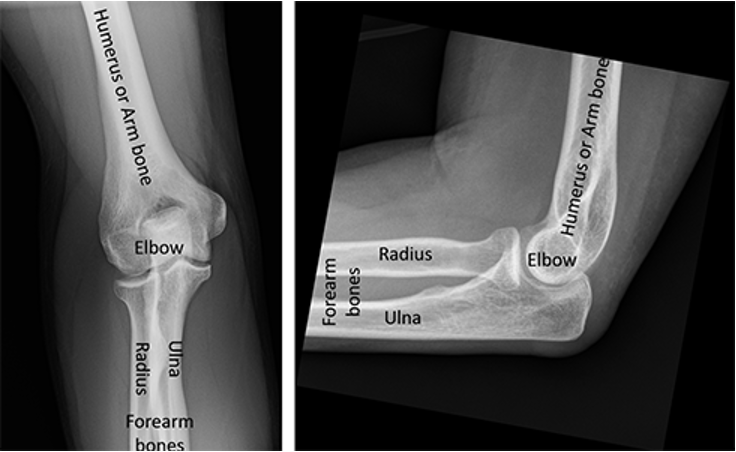
The Elbow
-what kind of joint is this
compound synovial joint
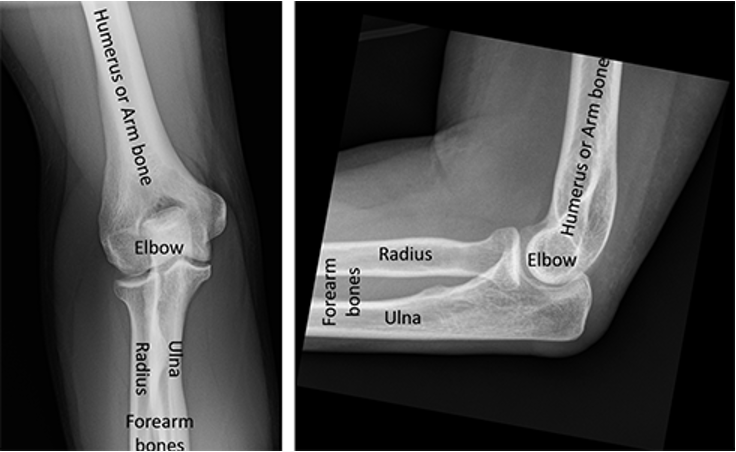
The Elbow
compound synovial joint
-what joints make this up
Humeroulnar (trochlear) joint
Humeroradial joint
Proximal Radioulnar joint

Humeroulnar Joint
-what bones make this up
Olecranon of the ulna
trochlea of humerus

Humeroulnar joint
-what does this give
gives the most structural stability

Humeroulnar joint
-what motion does this joint do
Pure flexion and extension

Humeroulnar joint
pure flexion and extension
-what limits flexion
Passive flexion is limited by soft tissue approximation, bony, ligament and posterior capsule, triceps

Humeroulnar joint
pure flexion and extension
-what limits extension
Extension is limited by biceps/brachialis/supinator tightness
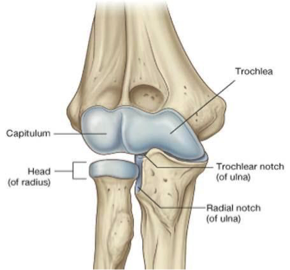
Humeroulnar joint
pure flexion and extension
-what limits extension passively
bony (olecranon), Ulnar collateral ligament, anterior capsule
in the humeroulnar joint
which bone is convex and which is concave
trochela is convex
olecranon is concave

Carrying angle (cubital valgus)
Trochlea tilt
4 degrees in males
8 degrees in females

Carrying angle (cubital valgus)
Cubital valgus
10 degrees in males
13 degrees in females

Carrying angle (cubital valgus)
Most obvious in what movtion, how can it be deviated
most obvious in extension
altered with trauma
Carrying angle (cubital valgus)
what does this create
the ability to function
-carry something by your side (accounts for hips, etc)
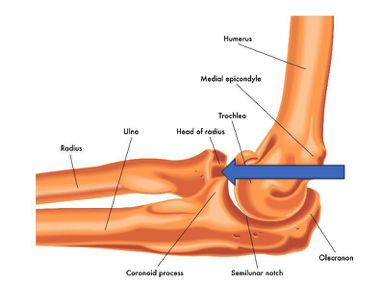
Humeralradial joint
-what bones makes this joint up
Radial head and capitulum of the humerus

Humeralradial joint
-what kind of joint is this
a hinge joint
-it does flexion and extension
-some supination and pronation due to radial head speen
in the humeralradial joint
which bone is convex
which bone is concave
capitulum is convex
radial head is concave
which 2 joints do what (% wise)
humeroulna and humero radial provide 50% of the entire stability of the elbow
humeroulna and humero radial provide 50% of the entire stability of the elbow
-which joint makes up the most stability
the humeroulna
humeroulna and humero radial provide 50% of the entire stability of the elbow
the humeroulna joint provides the most stability
-the rest comes from where
muscles and ligaments

Proximal Radioulnar joint
-what kind of joint
Pivot joint
and has
-radial head
-radial notch of the ulna
-annular ligament

Proximal Radioulnar joint
-what does it have
-what motions does it do
-interosseous membrane
-pronation/supination

Proximal Radioulnar joint
if the humerus is fixed
-what does the radius do
pronation and supination is ONLY the radius moving
(radial head spin )
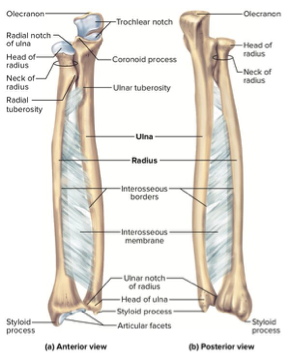
Proximal Radioulnar joint
if the humerus is fixed
-articulation where
at the elbow, distal radiaulnar joint and radiocarpal joint
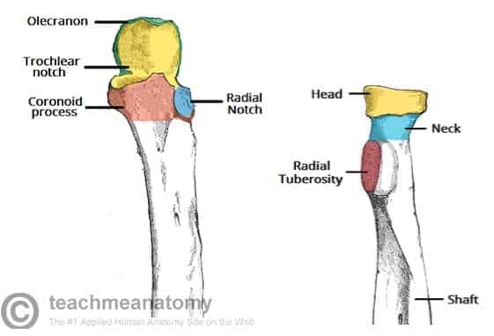
what parts of the radius are convex or concave
the radial head is convex
the radial notch is concave
A note on pronation/supination
-what only only happens during the artiulcation at the elbow, distal radioulnar joint and radiocarpal joint
only radial head movements occur here
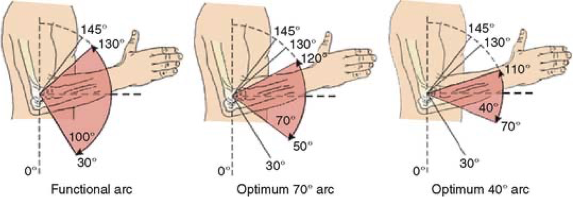
Functional Movement of The Elbow Complex
flexion/extension arc
100 degrees (total)
30 degrees of extension to 130 degrees of flexion

Functional Movement of The Elbow Complex
Pronation/supination arc
-what compensation might occur here
100 degrees (total)
50 degrees into pronation, 50 degrees into supination
shoulder IR/ER

What part is green highlighted
joint capsule

what part is blue highlighted
annular ligament

what part is red highlighted
ulnar collateral ligament

what part is yellow highlighted
radial collateral ligament
Ligaments of the elbow complex (medial side)
Ulnar/Medial collateral ligament

Ligaments of the elbow complex (medial side)
Ulnar/Medial collateral ligament
-functionally what
-what joint is what
Functionally most important to provide stability against valgus stress Humeroradial joint is the secondary stabilizer of valgus load

Ligaments of the elbow complex (medial side)
Ulnar/Medial collateral ligament
-limits what
-what does this provide
limits end range elbow extension
provides stability to medial elbow

Ligaments of the elbow complex (medial side)
Ulnar/Medial collateral ligament
-how many components
3 components
-anterior bundle
-posterior bundle
-transverse bundle
Ligaments of the elbow complex (lateral side)
Radial collateral ligament
annular ligament
joint capsule
Ligaments of the elbow complex (lateral side)
Radial collateral ligament
Made up of annular ligament and accessory collateral ligament
Stability to lateral aspect of elbow against varus forces
-Secondary restraints of lateral elbow are bony articulation, joint capsule and extensor muscles
Prevents posterior translation of radial head
Ligaments of the elbow complex (lateral side)
Annular ligament
Originates from lateral humerus at center of trochlea & capitellum
Maintains relationship between head of radius and the humerus and ulna

Contributions to elbow complex stability
Valgus stability
-elbow extended
anterior capsule, MCL, bony articular

Contributions to elbow complex stability
Valgus stability
-elbow flexed
MCL

Contributions to elbow complex stability
Varus stability
-elbow flexed
joint articulation, LCL

Contributions to elbow complex stability
Varus stability
-elbow extended
anterior capsule, joint articulation, LCL

Contributions to elbow complex stability
Anterior displacement
-elbow extended
anterior joint capsule, trochlea-olecranon articulation

Contributions to elbow complex stability
Posterior displacement
-elbow extended
Anterior capsule, radial head against capitellum, coracoid against trochlea

Contributions to elbow complex stability
Distraction
-elbow extended
anterior capsule, LCL, MCL, triceps, biceps, brachial, brachioradial, forearm muscles

Contributions to elbow complex stability
Distraction
-elbow flexed
LCL, MCL, capsule
Muscles of the elbow complex
-elbow flexion
Brachialis, Biceps Brachii, Brachioradialis, Pronator Teres, Flexor Carpi Ulnaris
Muscles of the elbow complex
-elbow extension
Triceps, anconeus
Muscles of the elbow complex
-forearm supination
supinator, biceps brachii
Muscles of the elbow complex
-forearm pronation
Pronator Quadratus, Pronator Teres, Flexor Carpi Radialis

Muscles of the elbow complex
-prime flexors?
Biceps brachii
Brachialis
brachioradialis

Muscles of the elbow complex
-what is the workhorse of flexion
brachialis
Muscles of the elbow complex
-weak flexors
pronator teres
flexor carpi radialis
flexor carpi ulnaris
extensor carpi radialis longus

Muscles of the elbow complex
-most of the flexors attach to what
to the radius (humeroradial joint)
-pulls radius proximally against humeroradial joint

Muscles of the elbow complex
-brachialis attaches to what so what doesn’t do
Brachialis attaches to ulna so the position of the forearm doesn’t affect it (sup or pro)

Muscles of the elbow complex
-Elbow Extensors
triceps brachii
Anconeus

Muscles of the elbow complex
Elbow Extensors
-triceps
Long head: also performs shoulder extension
Medial Head: workhorse of the elbow

Muscles of the elbow complex
Elbow Extensors
-anconeus
Stabilizes ulna & subanconeus bursa
-To avoid impingement

Muscles of the elbow complex
-Elbow pronators
Pronators teres
Pronators quadratus

Muscles of the elbow complex
-Secondary Elbow pronators
flexor carpi radalis
palmaris longus

Muscles of the elbow complex
-where do the pronators originate
Orginate on the humerus/ulna
Muscles of the elbow complex
-where do the pronators attach
attach to the radius/hand

Muscles of the elbow complex
-pronator teres has 2 heads which are
humeral head (medial epicondyle) / ulnar head (medial coronoid process)

Muscles of the elbow complex
-Supinators
Biceps
Supinators

Muscles of the elbow complex
Supinators
-Biceps
Greatest supinator with elbow flexion to 90 degrees

Muscles of the elbow complex
Supinators
-supinator
Workhorse of supinators
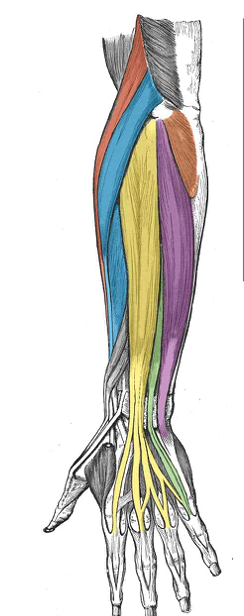
what part is highlighted in red
brachioradialis
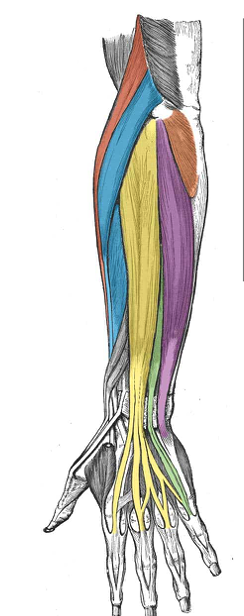
what part is highlighted in blue
extensor carpi radialis
extensor carpi longus
extensor carpi brevis
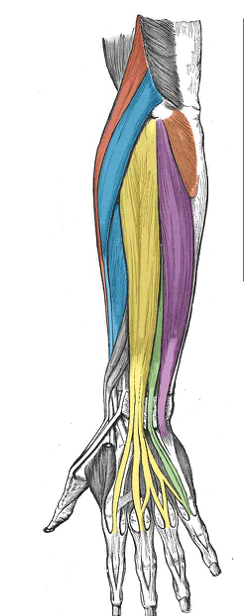
what part is yellow
extensor digitorum
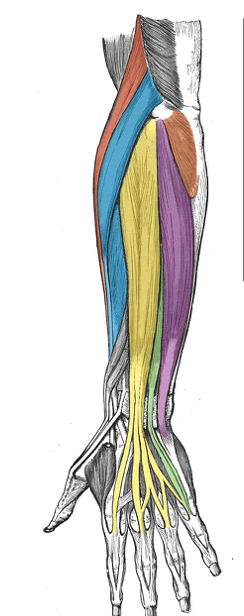
what part is green
extensor digit minimi (little finger )

what part is purple
extensor arpi ulnaris (ulnar deviation)

what part is orange
anconeus

what part is yellow
supinator

what part is red
abductor pollicis longus
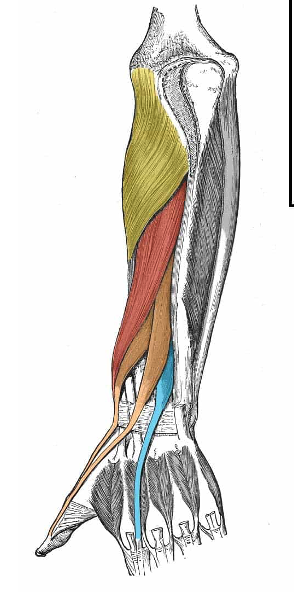
what part is orange
extensor pollicis longus
extensor pollicis brevis

what part is light blue
extensor indicis
Why can you move your fingers while you are pronated and/or supinated
Because their muscle attachment is to the distal HUMERUS – so it doesn’t matter what position the forearm is in

nerves of the elbow/forearm
Musculocutaneous nerve
Radial Nerve
Median Nerve

nerves of the elbow/forearm
Musculocutaneous nerve
innervates the primary elbow flexors
(except the brachioradialis)

nerves of the elbow/forearm
Radial Nerve
innervates the primary elbow extensors

nerves of the elbow/forearm
Median Nerve
innervates the primary elbow pronators

nerves of the elbow/forearm
musculocutanoeus
-what muscles
brachialis, biceps brachii

nerves of the elbow/forearm
radial
-what muscles
triceps, anconeus, brachioradialis
Posterior interosseous
-supinators

nerves of the elbow/forearm
median
-what muscles
pronator teres, flexor carpi radialis
-anterior interosseous
pronator quadratus

nerves of the elbow/forearm
ulnar
-what muscles
flexor carpi ulnaris

Soft tissue structures
-interosseous membrane
between ulna and radius
distributes forces
muscle attachements
Soft tissue structures
interosseous membrane
-it especially distributes which force
compressive forces

Soft tissue structures
-bursa
a small, fluid-filled sac that acts as a cushion and gliding surface between bones, tendons, muscles, and skin around joints