Chapter 12: Meiosis and Sexual Reproduction [Final Exam (30%)]
 Call Kai
 Learn
 Practice Test
 Spaced Repetition
 Match
 Flashcards
 Knowt Play
1/11

There's no tags or description
Looks like no tags are added yet.
12 Terms
Sexual vs. Asexual Reproduction
A____ Reproduction: Generates g____ i____ o____ (c____) from a s____ p____.
S____ Reproduction: Mode of reproduction where o____ i____ g____ from t___ p____, resulting in u____ c____ of t____.
Site of Occurrence: M____ occurs specifically in s_____ e____ r____ c____ called g____ c____ located in g____ (ovaries and testes).
asexual genetically identical offspring, clones, single parent
sexual, offspring inherits genes, two parents, unique combinations, traits
meiosis, specialized eukaryotic reproductive cells, germ cells, gonads
Evolutionary Advantages of Sexual Reproduction
Sexual reproduction s____ e____ a____ from t___ p____ into n____ g____ c____.
In a____ populations, n___ t____ c____ r___ s____ on r____ g____ m____.
S____ reproduction generates n___ t____ c____ in f__ f____ g____ than m____ a____.
An a____ t___ s____ much more r____ through a s____ r____ population.
G____ d____ gives sexually reproducing populations a significantly b____ c____ of s____ e____ c____ compared to clonal populations
shuffles existing alleles, two parents, new genetic combinations
asexual, new trait combinations rely solely, rare genetic mutations
sexual, new trait combinations, far fewer generations, mutation alone
adaptive trait spread, rapidly, sexually reproducing
genetic diversity, better chance, surviving environmental changes
Somatic Cells vs. Gametes
Somatic cells / B____ cells are d____ (2n), containing t___ c____ s___ of h____ c____.
G____ (Sperm and Egg cells) are h____ (n), containing a s____ s___ of c____.
body, diploid, two complete sets, homologous chromosomes
gametes, haploid, single set, chromosomes
Human Chromosome Composition
Total chromosome count in body cells = __ chromosomes, representing __ h____ p____
Autosomes (Non-Sex Chromosomes): __ pairs of chromosomes that are m__ in s____, s____, and g____ c____.
Sex Chromosomes: __ pair (X and Y) that d____ b____ s____ and d____ in s____ and g____ c____.
46, 23 homologous pairs
22, matched, size, shape, genetic composition
1, determines biological sex, differs, size, genetic composition
Homologous Chromosomes, Loci, and Alleles
H____ c____ refer to a pair of chromosomes (one maternal, one paternal) matched in length, centromere position, and gene location.
G____ l____ refers to the specific location of a gene on a chromosome.
A____ refer to the alternative/different versions of the same gene found at the same locus on homologous chromosomes.
homologous chromosomes
gene locus
alleles
Homologous Chromosomes, Loci, and Alleles
Homologous Chromosomes: A p___ of chromosomes (one m____, one p____) matched in l____, c____ p____, and g____ l____.
Gene Locus: The s____ l____ of a g____ on a chromosome.
Alleles: A____ or d____ v____ of the s____ g____ found at the s____ l____ on h____ c____.
Key Principle: H____ chromosomes carry the s____ g____ in the s____ o____, but they may carry d____ v____ (a____) of those genes.
pair, maternal, paternal, length, centromere position, gene location
specific location, gene
alternative, different variations, same gene, same locus, homologous chromosome
homologous, same gene, same order, different versions, alleles
Chromosome Structure Breakdown
M____ d____ c____ contains two identical sister chromatids connected at the centromere, carrying specific gene alleles.
P____ d____ c____ contains two identical sister chromatids connected at the centromere, carrying corresponding gene alleles at matching gene loci.
maternal duplicated chromosomes
paternal duplicated chromosomes
Chromosome Structure Breakdown
Maternal Duplicated Chromosome: Contains t__ i____ s____ c____ c____ at the c____, carrying s____ g____ a____ (e.g. Gene A1, Gene B1).
Paternal Duplicated Chromosome: Contains t__ i____ s____ c____ c____ at the c____, carrying c____ g____ a____ (e.g. Gene A2, Gene B2) at m____ g____ l____.
two identical sister chromatids connected, centromere, specific genetic alleles
two identical sister chromatids connected, centromere, corresponding gene alleles, matching gene loci
Sexual Life Cycles: Alternation of Generations (n and 2n)
Sexual life cycles c____ between h____ (n) and d____ (2n) phases:
M____: C____ d____ (2n = 46) g____ c____ in o____ and t____ into h____ (n = 23) g____.
F____: U____ of a h____ s____ (n = 23) and e___ (n = 23), r____ the d____ s____ in a z____ (2n = 46).
M____ & D____: The d____ z_____ undergoes r____ m____ d____ to g____ into a m____ d____ a____ (2n = 46).
cycle, haploid, diploid
meiosis, converts diploid germ cells, ovaries, testes, haploid gametes
fertilization, union, haploid sperm, egg, restoring, diploid state, zygote
mitosis, development, diploid zygote, repeated mitotic divisions, grow, multicellular diploid adult

Overview of Meiotic Divisions
Meiosis is p____ by a s____ r____ of c____ d____ during i_____ (__ phase), followed by t___ s____ n____ d____:
M____ __ (Reductional Division): P___ u___ and s____ h____ c____ p____, r____ chromosome number from 2n to n and yielding t__ h____ c___ with d____ c____.
M____ __ (Equational Division): S____ s____ c____ w____ i____ D__ r____, producing a total of f___ h____ d____ c____ with u____ c____.
preceded, single round, chromosome duplication, interphase S, two sequential nuclear divisions
meiosis I, pairs up, separates homologous chromosome pairs, reducing, two haploid cells, duplicated chromosomes
meiosis II, separates sister chromatids without interrupting DNA replication, four haploid daughter cells, unduplicated chromosomes
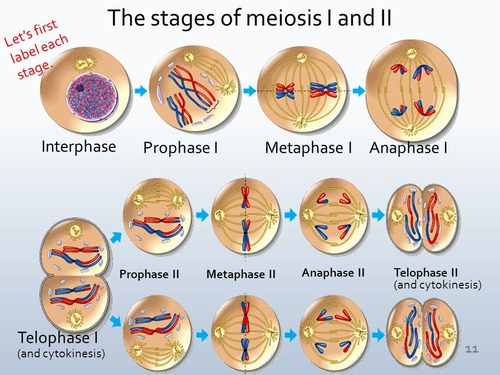
Detailed Step-by-Step Tour of Meiosis
Pre-Meiosis: I____
C____ r____ during the __ phase, c_____ s____-s____ c____ into d____ c____ with t___ s____ c____ held at the centromere.
Meiosis I: Homologous Chromosomes Separate
P____ I
C____ c____ and c____.
S____: H____ chromosomes c____ t_____ as physical p____.
T____ F____: E____ p____ s_____ consists of f____ c____ (two sister chromatids per homologous chromosome).
C____ O____: N_____ chromatids e____ c____ s____ at c____ s____ called c____.
N____ e____ f____ and s____ a____ b____ to a____.
Human Cell Counts: __ chromosomes, __ chromatids
M____ I
H____ pairs (t____) a____ in a d____-f___ a____ along the m____ p____ (cell equator).
S____ m____ a____ to k____ at the c____ of e____ h____ c____.
Human Cell Counts: __ chromosomes, __ chromatids
A____ I
H____ chromosome pairs s____ and m____ toward o____ p____ of the cell
S____ c____ r____ a____ at their c____ and m____ t____ as s____ u____
T____ I & C____
D____ c____ r____ the p____
A n____ e____ r__-f____ around each chromosome set in some species
C____ occurs, p____ the c____
Result: __ h____ d____ c___, each containing o__ s___ of d____ c____
Human Cell Counts: __ chromosomes, __ chromatids
Meiosis II: Sister Chromatids Separate (Occurs in both cells produced by Meiosis I, without any prior chromosome duplication)
P____ II
C____ c____ a____ in relaxed; n____ e____ b____ d____
S____ a____ f____ and m____ c____ toward the c___ m____
M____ II
D____ c____ a____ in a s____-f___ along the m____ p____ at the cell equator
A____ II
C____ s____; s____ c____ s____ and m____ toward o____ p____ as i____,u____ d____ c____.
T____ II & C____
C____ r____ o____ p____; n____ e____ r__-f____ around f____ n___ n____.
C____ d____ the c____.
Result: __ g____ u____ h____ d____ c____ with u____ c____
Human Cell Counts: __ chromosomes, __ chromatids
prophase I
chromosomes coil, condense
synapsis, homologous, come together, pairs
tetrad formation, each paired structure, four chromatids
crossing over, nonsister, exchange corresponding segments, contact sites, chiasmata
nuclear envelope fragments, spindle apparatus begins, assemble
46, 92
metaphase I
homologous tetrads align, double file arrangement, metaphase plate
spindle microtubules attach, kinetochores, centromeres, each homologous chromosome
46, 92
anaphase I
homologous, separate, move, opposite poles
sister chromatids remain attached, centromeres, move together, single units
telophase I, cytokinesis
duplicated chromosomes reach, poles
nuclear envelope re forms
cytokinesis, partitioning, cytoplasm
2 haploid daughter cells, one set, duplicated chromosomes
23, 46
prophase II
chromosomes condense again, nuclear envelope breaks down
spindle apparatus forms, moves chromosomes, cell middle
metaphase II
duplicated chromosomes align, single-file, metaphase plate
anaphase II
centromeres split, sister chromatids separate, move, opposite poles, individual, unduplicated daughter chromosomes
telophase II, cytokinesis
chromosomes reach opposite poles, nuclear envelopes re form, four new nuclei
cytokinesis divides, cytoplasm
4 genetically unique haploid daughter cells, unduplicated chromosomes
23, 0
How Meiosis Introduces Genetic Variation
T____ p____ m____ contribute to the v____ g____ d____ seen in sexually reproducing species.
C____ O____ (P____ I)
Process: N____ c____ of p____ h____ c____ a____ t____, b____, and e____ c____ g____ s____ at p____ c____-o____ called c____.
Outcome: Produces r____c____ that combine m____ and p____ a____ into n____ p_____ n___ p____ in either p____
Products: Out of 4 chromatids in a tetrad, __ r____ p____ c____ and __ becoomes r____ c____
I____ O____ / A____ (M____ I)
Process: E___ p____ of h____ chromosomes a____ r____ at the m____ p____, with e____ p____ that the m____ or p____ c____ f____ e____ p____.
Formula: N____ of p____ chromosome c____ in g____ = 2n, where n = haploid chromosome number
Human Calculation: For humans (n = 23), 223 = 8 388 608 (8.3 million+) possible combinations of homologous chromosomes per gamete—-even without considering crossing over
R____ F____
A____ u____ s____ can fertilize a____ u____ e___
8.4 million x 8.4 million = ~70 trillion possible combinations
Two parents c____ produce g____ i____ o____ in s____ f____
three primary mechanisms, vast genetic diversity
crossing over prophase I
nonsister chromatids paired homologous chromosomes align tightly, break, exchange corresponding genetic segments, physical cross-overs, chiasmata
recombinant chromosomes, maternal, paternal alleles, novel pattern not present, parent
2 remain parental chromosomes, 2 recombinant chromosomes
independent orientation / assortment, metaphase I
each pair, homologous, aligns randomly, metaphase plate, equal probability, maternal, paternal, faces either pole
random fertilization
any unique sperm, any unique egg
cannot, genetically identical offspring, separate fertilizations