AP Psych sensation and Perception
 Call Kai
 Learn
 Practice Test
 Spaced Repetition
 Match
 Flashcards
 Knowt Play
1/56

There's no tags or description
Looks like no tags are added yet.
Name | Mastery | Learn | Test | Matching | Spaced | Call with Kai | Chat |
|---|
No analytics yet
Send a link to your students to track their progress
57 Terms
Cocktail Party Effect
The brains ability to focus on a single voice or conversation while filtering out a loud and crowded background.
Selective Attention
Focusing on a specific stimulus in the environment while filtering out other irrelevant o distracting information
Sensory Adaptation
We are programmed to tune out non- changing aspects of our environments
Change Blindness
Observer fails to notice a major or minor alteration in a visual scene
Inattentional blindness
Where you fail to notice fully visible, unexpected or event because your attention is focused on something
Gestalt Psychology
The whole organizational patterns we tend to perceive
Phi phenomenon
Light flashing in quick succession displaying movement
Stroboscopic motion
Quick succession of still images with slight changes
Kinesthesis
System for sensing the position and movement for individual body parts
Perceptual adaptation
In vision, the ability to adjust to an artificial displaced or inverted visual field
Transduction
Changing one form of sensory energy into something our brains can use
Weber’s Law
The amount of change in a stimulus needed to detect a difference is given by a constant ration or fraction called constant of original stimulus
Autokinetic effect
Starting at a stationary light in a dark room, our eye movement makes the light seem to move
Gestalt Principles
How the brain organizes visual information into patterns and meaningful objects
Figure Ground
Organizing our visual field into objects that stand out
Proximity
If objects are close together, we place them in the same group
Similarity
Put items that look similar in the same group
Perceptual Constancy
The cognitive phenomenon where the brain perceived familiar objects to have stable size, shape, and color even when sensory input or lighting changes
Color constancy
An objects color has not changed under different light
Shape
An object shape hasn’t changed even though the angle has
Light constancy
Even thought lighting changes we know the color of objects stays the same
Size
Objects remain same size, only distance changes
Binocular cues
Allow for depth perception ( 2 eyes)
Retinal disparity
The difference between the images you see with the retinas in your right and left eyes
Convergence
Tension in the eye muscles when the eyes track inward to focus on objects close the viewer
Monocular cues
Depth perception using ( 1 eye)
Linear perspective
Parallel lines seem to converge in the distance
Relative size
The closer an object is the larger it appears
Relative Clarity
Distant objects are less clear
Texture Gradient
Distant objects have a much smoother surface than closer objects
Interposition
Closer objects block further objects
Role of Vestibular system
Sense of head and body movement and position including the sense of balance
6 types of taste receptors
sweet
Salty
Bitter
Sour
Umami
Oleogustus
Chemical Senses
Taste and Smell
Parallel processing (dual processing)
The processing of several aspects of a problem simultaneously, the brains natural mode of information processing
Bottom up processing
Info processing that focuses on raw material entering trough our sensory organs
Top Down Processing
Info processing that focuses on expectations and experiences in interpreting incoming sensory info
Pain Gate Theory
Spinal Cord contains a neurological “gate” that blocks pain signals or allows them to pass on to the brain.
the gate is opened by the activating pain signals
Visual cliff experiment
Infants wouldn’t crawl across glass floors

Cornea
Eyes clear protective outer layer

Iris
Colored muscle that changes pupil size to regulate incoming light

Pupil
Opening where light enters eye

Lens
Transparent structure behind pupil, changed size to focus image on retina

Fovea
Central focal point of retina where eye cones cluster

Retina
Light sensitive tissue, at the back of the eye, contains rods and cones

Optic Nerve
Nerve that carries neural impulses from the eye to brain
Blind spot
Location where optic nerve leaves eye creating a blind sport b/c no receptor cells are located
Bipolar cells
Sensory neurons located in the retina of the eye that collect and pass visual signals from photoreceptors ( rods and cones) on to ganglion cells
Ganglion cells
Neuron in the retina that receives visual information from the bipolar and amarine cells and transmit it through the optic nerve to the brain
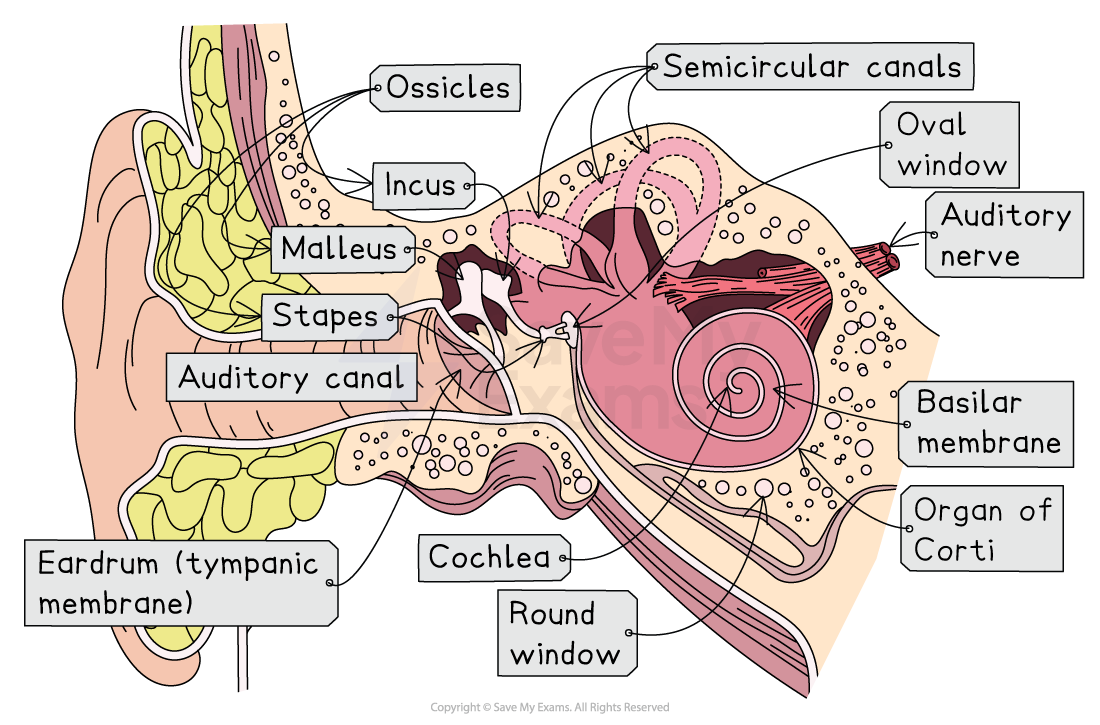
Tympanic Membrane
Eardrum
Cone shaped membrane that separates external ear from middle ear
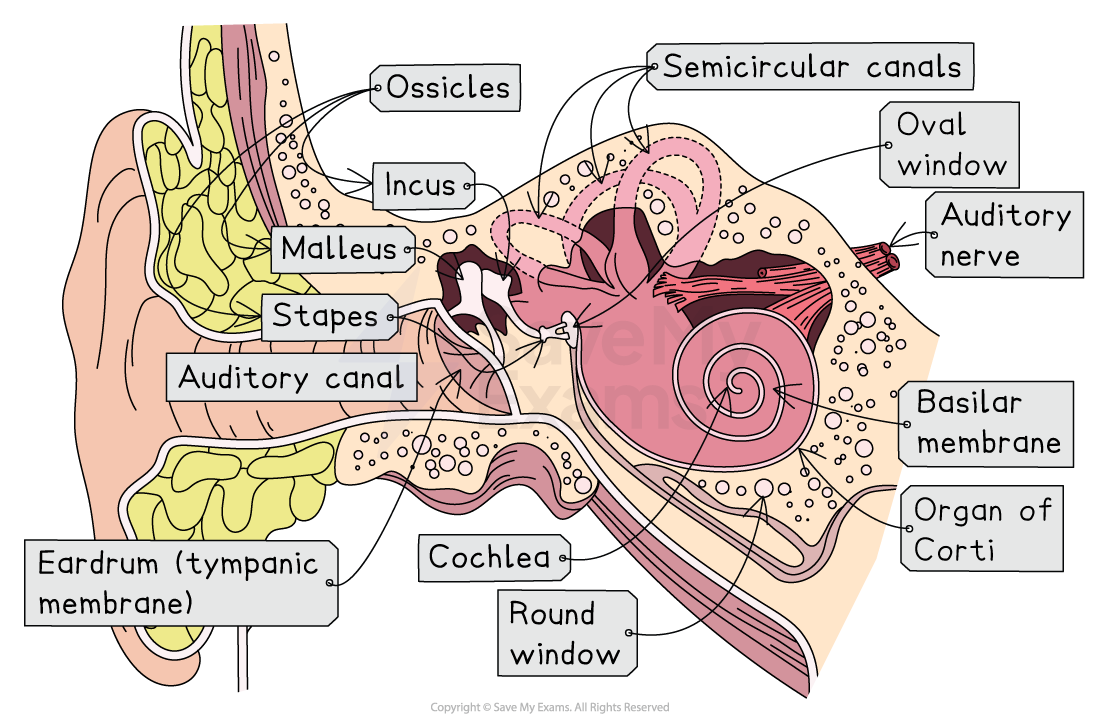
Malleus
Hammer
First middle ear ossicle ( bone)

Malleus
Hammer
First middle ear ossicle ( bone)

Stapes
stirrup
3rd middle ear bone

Cochlea
a coiled, bony, fluid filled tube in the inner ear , sound waves travel trough cochlear field

Basilar membraine
Membrane full of hair cells lining its surface
Bends hairs in the cochlea causing transduction
Frequency of Sound
Frequency determines pitch
Higher frequency= higher pitch
Amplitude relates to loudness
Greater amp= louder sound
High freq= shorter wavelength
Frequency of light waves
Différent Colors visible wavelengths correspond to different perceived colors
High freq= visible light has shorter wavelength
Amplitude= brightness/ intensity