Hematology I Granulocytes
 Call Kai
 Learn
 Practice Test
 Spaced Repetition
 Match
 Flashcards
 Knowt Play
1/99

Earn XP
Description and Tags
CLS 536 Unit 2 - 9/21/2026
100 Terms
How do we classify leukocytes?
Neutrophils, lymphocytes, monocytes, eosinophils, and basophils
Where do leukocytes mature?
In the bone marrow except T cells in the thymus
How do leukocytes fight infection
Phagocytosis and the adaptive response
What is an increase in WBCs called?
Leukocytosis
What is a decrease in WBCs called?
Leukopenia
What is an increase in eosinophils called?
Eosinophilia
What is an increase in basophils called?
Basophilia
What stains basic with methylene blue?
Basophils
What stains acidic with eosin dye?
Eosinophils
What is an increase in neutrophils called?
Neutrophilia
What is a decrease in neutrophils called?
Neutropenia
What physiologic and pathological events affect the concentration of leukocytes?
Infection, age, activity level, pregnancy, race, time of day, etc
What do we need to do to determine the cause of an increased WBC on a CBC?
WBC diff
What needs to be done to a relative differential to determine if the cell line has increased or decreased?
Calculate the absolutes
Is 85% neutrophil count high or normal?
Outside the relative reference range but the number depends on the WBC count
What are the reference ranges for absolute and relative lymphocytes?
1.0 - 4.8×10³/μL and 24 - 44%
What are the reference ranges for absolute and relative segmented neutrophils?
1.8 - 7.0×10³/μL and 41 - 77%%
What are the reference ranges for leukocytes?
4.5 - 11.0×10³/μL
What are the reference ranges for absolute and relative eosinophils?
0 - 0.45×10³/μL and 0 - 5%
What are the reference ranges for absolute and relative monocytes?
0 - 0.8×10³/μL and 4 - 12%
What are the reference ranges for absolute and relative basophils?
Term
0 - 0.2×10³/μL and 0 - 2%
What gives rise to precursor cells in neutrophils?
CMP
How does maturation being in neutrophils?
Upon stimulation by specific cytokines
What cytokines regulate neutrophil production?
IL-3, GM-CSF, and G-CSF
What stages of life for a neutrophil occur in the bone marrow?
Differentiation, proliferation, and maturation
What is the lifespan of a neutrophil in the peripheral blood?
Circulation for a few hours
What purpose do neutrophils serve in the tissues?
Perform the function of host defense
What are the six identifiable maturation stages?
Myeloblast, 2. Promyelocyte, 3. Myelocyte, 4. Metamyelocyte, 5. Band, 6. Segmented neutrophil
What happens to the nucleus as maturation progresses?
Nucleoli disappears, chromatin condenses, and round nuclear mass indents and eventually segments
What happens to the cytoplasm as maturation progresses?
Agranular, basophilic cytoplasm in the myeloblast gradually changes to pink cytoplasm
What do primary granules look like?
Large reddish-purple azurophilic granules
What do secondary granules look like?
Small pinkish specific granules
What do primary granules contain, and what are they primarily found in?
Myeloperoxidase and are very prominent in pros
What do secondary granules contain, and what are they primarily found in?
Lactoerferriln and production begins in the myelo stage
What do tertiary granules contain, and what are they primarily found in?
Gelatinase and found in metas, bands, and segs
What do secretory granules contain, and what are they primarily found in?
CR1, CR3, CD14 and CD16 and are found in myelos, metas, bands, and segs
What is the first identifiable neutrophil?
Myeloblast
As maturation increases, what occurs?
Decrease in cell size, nuclear volume, and N:C ratio, and nucleus goes from fine chromatin to segmented,
What cells are in the proliferating pool?
Mitotic cells - myleloblast, promyelocyte, and myelocyte
What cells are in the maturation storage pool?
Post-mitotic cells - metamylelocyte, band, and seg

What cell is this?
Myeloblast
What are the markers for myeloblast?
CD33, CD13, CD13, and CD45RA
What does the nucleus appear like in a myeloblast?
Round, evenly stained chromatin with a few nucleoli visible
What does the cytoplasm appear like in a myeloblast?
Blue agranular cytoplasm with a distinct unstained area adjacent to the nucleus (golgi apparatus)
What is the range of myeloblasts in the bone marrow?
0 - 1.5%
What are Auer rods?
Fusion of primary granules

What is this abnormality?
Auer rods
What does the nucleus appear like in a promyelocyte?
Chromatin coarser than blast, still open with several nucleoli
What does the cytoplasm appear like in a promyelocyte?
Basophilic, prominent reddish-purple primary granules
What do the granules in promyelocytes contain?
Peroxidase

What cell is this?
Promyelocyte
What is the range of promyelocytes in the bone marrow?
1 - 4%
What does the nucleus appear like in a myelocyte?
Chromatin condensation, nucleoli indistinct, and size is reduced
What are the myelocyte development characteristics?
Goes through 2-3 cell divisions and late stage is capable of mitosis
What does the cytoplasm appear like in a myelocyte?
Early myelocyte is more basophilic and late myelocyte is more pink
What is the hallmark feature of myelocytes?
Secondary granules
What is the range of myelocytes in the bone marrow?
8 - 16%

What is this cell?
Myelocyte
What does the cytoplasm appear like in a metamyelocyte?
Pink color with predominance of secondary and secretory granules
What does the nucleus appear like in a metamyelocyte?
Nuclear chromatin coarse and clumped, nucleoli not visible, nuclear indentation
What is the range of metamyelocytes in the bone marrow?
9-25%

What is this cell?
Metamyelocyte
What does the nucleus appear like in a band neutrophil?
Indentation to an extreme extent, making a horseshoe shape
What does the cytoplasm appear like in a band neutrophil?
Pink with all granules present
What is the range of band neutrophils in the bone marrow?
9 - 15%
What is the range of band neutrophils in the peripheral blood?
<10%
What does the cytoplasm appear like in a segmented neutrophil?
Pink with all granules present
What does the nucleus appear like in a segmented neutrophil?
Condensed chromatin and segmented with two or more lobes
connected by a thin nuclear filament
What is considered hyposegmented?
< 3 lobes
What is considered hypersegmented?
3 neutrophils >5 lobes
What are the markers for segmented neutrophils?
CD15, CD16, and CCD11b/18
What is a barr body?
Inactive X chromosome
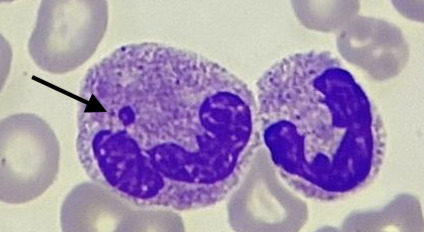
What is this anomaly?
Barr body
What is agranulocytosis?
No granulocytes (no netus, eos, or basos)
What is the difference between agranulocytosis and granulocytopenia?
Granulocytopenia is a decrease in all granulocytes (<2.0×10³/uL) and ususaly agranulocytosis is none
What is the value for neutrophilia and what causes it?
>7.0×10³/uL and bacterial infection, metabolic/drug intoxication, and tissue necrosis
Can there be neutrophilia without leukocytosis?
Yes
What are the 4 steps of neutrophils in the innate immune response?
Adherence, 2. chemotaxis, 5. phagocytosis, and 4. bacterial killing
What is chemotaxis and what is it guided by?
Neutrophils migrating in the tissues guided by chemoattractant gradients
What are the 4 stages of neutrophil leukocyte adhesion?
Leukocyte “rolling” (selectin-mediated), 2. chemoattractants, 3. firm adhesion (integrins), and 4. Diapedesis
What is degranulation?
Fusion of neutrophil granules with phagosome
What are the 2 main mechanisms for killing bacteria in a neutrophil?
Oxygen dependent and oxygen independent
What are the 2 oxygen-dependent mechanisms for bacterial killing in a neutrophil?
Myeloperoxidase (MPO) and respiratory burst
What are some oxygen-independent mechanisms for bacterial killing in neutrophil?
pH, defensins, and lysozymes
What is the eosinophil's morphological maturation and what is the first recognizable stage?
Same 6 stages as neutrophil and the eosinophilic myelocyte is the first rocgonizable

What is this cell?
Eosinophilic myelocyte
What is the major cytokine for eosinophil development?
IL-5
What are the 3 types of granules in mature eosinophils?
Primary, small, and specific granules
What does major basic protein do?
Stimulates release of histamine from mast cells and basophils
What is the range of concentrations of mature eosinophils in peripheral blood?
≤ 0.40 × 10³ /μL
What conditions are associated with eosinophilia?
Allergic diseases, parasitic infections, toxic reactions, GI disease, RT disease, and neoplastic disorders
What is the basophil’s morphological maturation?
Similar to a neutrophil with gradual indentation and segmentation of the nucleus
What are characteristics of granules in mature basophils?
Contains peroxidase and granules are water soluble
What markers are in basophils?
CD9, CD11a, and CD13

What cell is this?
Basophil
Where is the mast cell found?
The bone marrow and the tissues
What does the nucleus appear like in a mast cell?
Round and surrounded by a dense population of granules
What do the granules contain in mast cells?
Phosphatase, protease, and alkaline phosphatase
What does the cytoplasm appear like in a mast cell?
Large granules and purple in color
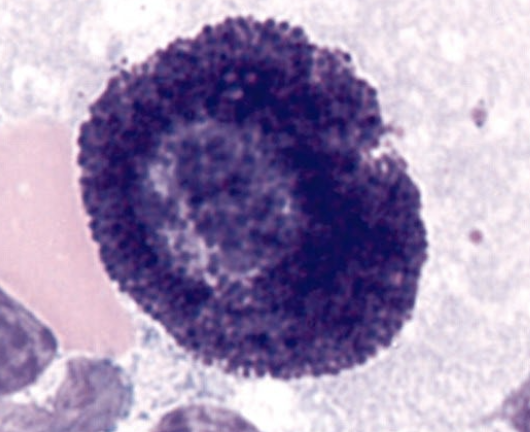
What cell is this?
Mast cell