E4 PEDS: Genetic Disorders PLUS Learning Checks
 Call Kai
 Learn
 Practice Test
 Spaced Repetition
 Match
 Flashcards
 Knowt Play
1/105

There's no tags or description
Looks like no tags are added yet.
106 Terms
What is down syndrome
Aneuploidy condition that results in the 21st chromosome which has 3 copies (Trisomy) instead of 2
Most common type of down syndrome
Trisomy 21.2 - all cells in the body contain the extra 21st chromosome
Describe translocation trisomy 21
The 21st chromosome attaches to other chromosomes, causing material to swap over during cell division
What does balanced translocation in Translocation trisomy 21 cause
No visible effects of down syndrome in the parents, but can cause an increased risk of the parents having a child with down syndrome if both are carriers
What are the two types of translocation down syndrome
Balanced translocation where the individual parents have no issues
Interstitial translocation where the 21st chromosome breaks off and attaches to other chromosomes
What is mosaic down syndrome
only some of the cells have the extra 21st chromosome
Patient may have some visible physical attributes but not all the associated conditions
Inheritence pattern of trisomy 21?
Not usually inherited, except for if one or both parents are carriers of balanced translocation
Most common chromosomal disorder
Trisomy 21
List the MC clinical manifestations of down syndrome (5)
- flat facial profile
- Epicanthal eye folds
- upward slanting palpebral fissures
- small ears
- flat nasal bridge
down syndrome MSK findings (5)
- hypotonia
- joint hypermobility
- single palmar crease
- sandal gap toes
- atlantoaxial instability
down syndrome developmental and cognitive features (4)
- mild-mod intellectual disability
- speech delay
- motor delays
- visual learning strengths
Heart problems for down syndrome patients? (4)
- AV septal defects
- PDA
- VSD
- ASD
Endocrine diagnoses down syndrome patients higher risk for? (3)
- hypothyroidism (mc)
- obesity risk
- DM risk
ENT problems in down syndrome (6)
- conductive hearing loss (mc)
- SNHL
- recurrent otitis media
- strabismus
- cataracts
- hypermetropia (far sighted) (mc)
- myopia
down syndrome respiratory and sleep (3)
- OSA
- airway obstruction
- recurrent respiratory infections
down syndrome GI and hematologic disorders (6)
- duodenal atresia
- hirschsprung dz
- celiac
- chronic constipation
- GERD
- leukemia
down syndrome Screening and Preventive care (4)
- echo at dx, en utero or past partum
- hearing and vision screening
- thyroid surveillance
- growth monitoring
How many chromosomes do humans have
23 pairs; 22 autosomes and 23rd pair is the sex chromosomes
What increases the risk of AD and X-linked disorders?
Increased paternal age
What increases the risk of chromosomal disorders?
Increased maternal age
the MC skeletal dysplasia in humans
Autosomal dom or recessive
Achondroplasia; autosomal dominant
Clin fts of achondroplasia
Short stature
Macrocephaly
Flat midface with a prominent forehead
Rhizometic (root of limb) shortening of hte limb
Bowing of legs
How do you confirm achondroplasia
Molecular testing and XR abnormalities
How can you diagnose achondroplasia prenatally?
through amniocentesis or chroionic villus sampling
achondroplasia life span and intelligence
Normal life span and normal intelligence
Neurofibromatosis type 1 (NF-1) gene
NF1 gene
Is NF-1 auto dom or rec
dominant, but can be a spontaneous mutation
Clin fts of NF-1 (6)
- Café-au lait spots- 6 or more
- Axillary or inguinal freckling
- Cutaneous neurofibromas
- Lisch nodules (iris hamartomas)
- CNS tumor - Optic nerve gliomas
- HTN

Dx of NF-1
Clin findings
Refer to genetics, neuro, and ophthal
What is marfan syndrome
an autosomal dominant mutation in a single gene causing abnormalities in multiple organ systems (FBN-1)
Clin fts of marfan (3 features)
Involves 3:
- Skeletal: a tall, thin body habitus, arachnodactyly, pectus excavatum/carinatum, scoliosis, pes planus and joint laxity
- Ophthalmological: myopia, ectopia lentis, and cataracts
- Cardiac: aortic root dilation, aortic insufficiency, mitral valve prolapse and regurgitation, aortic dissection
- Life exp ~70
Key about genetic testing with marfan
First-degree relatives of patients with Marfan Syndrome should undergo counseling and genetic testing
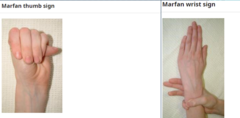
Marfan Signs
- marfan thumb sign
- marfan wrist sign

SCD is a mutation in the hemoglobin beta gene found on chromosome ___
Auto dom or recessive
11
Auto recessive
SCD clinical features (5)
- chronic anemia
- jaundice, pallor
- splenomegaly
- cardiac flow murmur
- delayed growth and sexual maturation
Dx of SCD
- Part of routine screening for newborn
- Checks for hemoglobin S - the defective form of hemoglobin
- Hemoglobin electrophoresis, isoelectric focusing, or high-performance liquid chromatography
SCD refer
- hematology
- opthalmology
Tay-Sachs Disease
- autosomal recessive
- HEXA gene
Tay-Sachs Disease ethnic background RF
Ashkenazi Jewish background
Tay-Sachs Disease sx onset
5-6mo old
Tay-Sachs Disease sx (5)
- incoordination
- exaggerated startle response
- loss of muscle tone
- loss of previously-attained developmental milestones
- retinal cherry red spot
Phenylketonuria (PKU)
autosomal recessive disease that primarily affects the brain
PKU sx (6)
- severe intellectual disability develops in the 1st year of life
- seizures
- microcephaly
- behavioral abnormalities
- abnormalities in gait
- mousy urine and body odor
PKU dx
If newborn screen positive, follow with quantitative amino acid analysis
PKU refer to
nutrition, psychology, metabolic specialists
PKU tx
- Diet specifically restricted in phenylalanine for life
- most infants treated in first 10 days of life will have normal intelligence
What's the most common muscular dystrophy disorder?
Duchenne Muscular Dystrophy
Duchenne Muscular Dystrophy
- X-linked recessive disorder
- mutation in the dystrophin gene
Duchenne Muscular Dystrophy sx (4)
- progressive difficulty running and an awkward, waddling gait
- calf pseudohypertrophy
- hyperlordosis
- difficulty rising from the floor
Duchenne Muscular Dystrophy sx by age 6
arm weakness develops
Duchenne Muscular Dystrophy sx by age 12
wheelchair dependent
Hemophilia A
- X linked recessive disorder
- factor VIII deficiency
Hemophilia A sx
- mild: significant trauma necessary to induce bleeding
- moderate: moderate trauma to induce bleeding
- severe: spontaneous bleeding in muscles or joints or bleeding with minor trauma
Hemophilia A dx
- prenatal and carrier dx possible with molecular techniques
- low factor VIII activity levels or genetic testing
What is the most common inherited cause of intellectual disability
Fragile X Syndrome
Fragile X Syndrome genetic
x linked recessive
Fragile X Syndrome sx (6)
- global developmental delay
- relative macrocephaly
- strabismus
- pale blue irises
- midface hypoplasia with sunken eyes, arched palate
- mitral valve prolapse
Fragile X Syndrome adolescent sx (3)
- long and narrow face with prominent forehead and chin
- large ears
- testicular enlargement with normal testicular function
Fragile X Syndrome dx
- confirmed by molecular testing
- refer to genetics
Trisomy conditions (4)
- T21
- T13
- T18
- Klinefelter syndrome
Monosomies condition
Turner syndrome
Deletions of genetic sequences conditions (3)
- cri du chat syndrome
- prader-willi syndrome
- angelman syndrome
Duplication of genetic sequences condition
Huntington disease
20% of congenital malformations are due to what?
Multifactorial inheritance
Multifactorial inheritance
Asthma, atherosclerosis, DM, and cancer
Trisomy 18 also known as
edwards syndrome
clin fts of trisomy 18 (9)
- SGA
- Hypertonia
- Prominent occiput
- small lower jaw low set and malformed ears
- Short sternum
- Rocker bottom feet
- Hypoplastic nails
- Characteristic clenching of fists - second and 5th digits overlap the 3rd and 4th
- Congenital HD

life exp for trisomy 18
poor - rarely make it to one year
Refer to genetics and palliative care
Trisomy 13 also known as
Patau syndrome
Clin fts of trisomy 13 (6)
- SGA and microcephaly
- Midline facial defects: cyclopia (single orbit), cebocephaly (single nostril), and cleft lip and palate are common, as are midline central nervous system anomalies
- Sloped forehead, small and malformed ears, and microphthalmia or anophthalmia
- Polydactyly of the hands and club feet
- Hypospadias and cryptorchidism are common in boys, whereas girls generally have hypoplasia of the labia minora
- Pathognomonic= Aplasia cutis congenita- punched out scalp lesion over the occiput

The MCC of primary hypogonadism and infertility in men
klinefelter syndrome
Klinefelter syndrome caused by
presence of an extra chromosome (47,XXY)
Clin fts of klinefelter syndrome
- No testicular growth in puberty - hypergonadotropic hypogonadism and failure to produce viable sperm
- Tall w/ long limbs
- Often have behavioral abn, language delay, and learning disabilities
Dx klinefelter
karyotyping
The only condition where a monosomic fetus comes to term
turner syndrome
turner syndrome caused by
the absence of a second X chromosome (45, X)
Clin fts of turner syndrome (9)
- Short stature
- Wide-set nipples and lack of breast development
- Webbed neck
- Puffy hands and feet
- Low set, mildly malformed ears, triangular face, flattened nasal bridge and epicanthal folds
- Congenital heart defects (coarctation of the aorta), prolonged QT syndrome
- Horseshoe kidney (get a renal US)
- Acquired hypothyroidism
- Hearing loss
cri du chat is a de novo deletion on chromosome ___
5
Clin fts of cri du chat (6)
Severity depends on the size of deletion
- Catlike cry in infancy from tracheal hypoplasia
- Low birth weight and FTT
- Hypotonia, developmental disability, microcephaly
- Craniofacial dysmorphism: ocular hypertelorism (wide set eyes), epicanthal folds, downward slanting eyes, and low-set malformed ears
- Clefts of the lip and palate
- Congenital heart disease

Dx of cri du chat
FISH testing (fluorescence in situ hybdridization)
Life expectency cri du chat
Most fatal complications occur before the child's first birthday.
Children with cri-du-chat who reach age 1 generally will have a normal life expectancy
MC syndromic form of obesity
D/t?
prader willi
MC d/t a small deletion on chromosome 15
Clin fts of prader wili (4)
- Neonatal hypotonia, postnatal growth delay
- Developmental disability
- Hypogonadotropic hypogonadism
- Characteristic appearance - almond shaped eyes, small hands and feet, obesity after infancy

Dx of prader wili
Methylation studies, followed by chromosomal microarray
life exp of prader wili
30 yrs
angelman syndrome
- small deletion on chromosome 15
- derives form mother = AS
clin fts of angelman syndrome (8)
- Moderate to severe intellectual disability
- Postnatal microcephaly
- Absence of speech
- Movement or balance disorder (ataxia or tremulous movement of limbs)
- Frequent laughter or smiling
- Happy with emotional lability
- Hand flapping
- Seizures

Life exp of angelman syndrome
almost normal
Fetal alc spectrum disorder flin fts
- Prenatal and postnatal growth deficiency
- Developmental disabilities
- Microcephaly
- Characteristic facial appearance -> short palpebral fissures, thin vermillion border and smooth philtrum
A 17-year-old female presents to the clinic for a WCC. On exam, there is no breast development and wide-set nipples. What condition do these findings suggest?
Turner
You see a child in clinic for a sports physical and family history is remarkable for his dad passing away at age 30 from an aortic dissection. On exam, The tip of the thumb covers the entire fingernail of the 5th digits when wrapped around the other wrist. What condition do you suspect in this patient?
marfan
Which of the following is an autosomal recessive disorder?
A.Fragile X Syndrome
B.Hemophilia A
C.Sickle cell disease
D.Achondroplasia
C.Sickle cell disease
A 12 mo old present for their 12 mo WCC. They have been healthy, with no recent illness or underlying chronic medical conditions. Growth and development have been normal as well. Mom states she has switched the child to whole milk from formula. He drinks a cup at every meal time and with his two snacks (5 cups total) and eats a well-rounded diet. His PE is unremarkable. The finger stick Hgb is 10.7. What is the next step?
A.Trial of iron
B.CBC, +/- ferritin
C.Referral to hematology
D.Dietary counseling only
B.CBC, +/- ferritin
Which of the following is an actionable lead level?
A.≥2.5 mcg/dL
B.≥ 3 mcg/dL
C.≥ 3.25 mcg/dL
D.≥ 3.5 mcg/dL
D.≥ 3.5 mcg/dL
What is the most common cancer in children?
A.Sarcomas
B.Leukemia
C.Retinoblastoma
D.Neuroblastoma
B.Leukemia
MC childhood cancer - ALL
Which malignancy is (almost) exclusive to children?
A.Neuroblastoma
B.Sarcoma
C.Hodgkin lymphoma
D.Non-Hodgkin lymphoma
A.Neuroblastoma
You have a patient with type 1 DM who presents for their 12 y/o WCC. They have had this diagnosis since age 2. The patient was screening for celiac disease at dx and it was negative. At your last WCC you checked lipids and it was WNL. When is this pt due for a BP check?
A.Every 3 months
B.Every 6 months
C.Yearly
D.Every 2 years
A.Every 3 months
Who needs a w/u for precocious puberty?
A.Secondary sexual development in a 6 year old girl
B.Secondary sexual development in a 9 year old boy
C.Secondary sexual development in a 9 year old girl
D.Secondary sexual development in a 10 year old boy
A.Secondary sexual development in a 6 year old girl
If less than 9 in boys and 8 in girls
MC form of primary nephrotic syndrome
Minimal change nephrotic syndrome
You diagnose a newborn with hypospadias. Can a circumcision be performed if the parents elect to have the procedure done?
NO - foreskin used for repair