AP Psych unit 1
 Call Kai
 Learn
Learn Practice Test
 Spaced Repetition
 Match
Match Flashcards
 Knowt Play
 Podcast
1/53

There's no tags or description
Looks like no tags are added yet.
Name | Mastery | Learn | Test | Matching | Spaced | Call with Kai | Chat |
|---|
No analytics yet
Send a link to your students to track their progress
54 Terms
How do excitatory and inhibitory neurotransmitters differ?
excitatory- increases the likelihood of an action potential
inhibitory- decrease likelihood of neural firing
When positively charged ions enter the action potential, making the membrane less negative
depolarization
What is repolarization?
restores the neuron’s original charge before firing
Nervous system that is your brain and spinal cord
Central nervous system
Nervous system that consists of your sensory and motor neurons that connect to your brain and spinal cord
peripheral nervous system
part of your PNS that controls voluntary movement
somatic
part of your PNS that controls involuntary movement (heart beating, lungs pumping)
autonomic
part of your NS that is fight or flight
sympathetic
part of your NS that is rest and digest
parasympathetic
Part of the neuron that contains the nucleus and DNA
cell body
Part of the neuron that receives signals from other neurons
dendrites
Part of the neuron that carries signals from one end to the other
axon
Part of the neuron that sends signals to next neuron
axon terminal
Part of the neuron that insulates the axon and speeds up iimpulses
myelin sheath
Part of the neuron that produces myelin for the myelin sheaths
Schwann cells
spaces between Schwann cells
Nodes of Ranvier
Part of the neuron that provides extra protection and nourishment to neurons
glia
Type of neuron:
carry information from the senses to the brain and spinal cord
sensory neurons
Type of neuron:
carry information from the CNS to the muscles and glands
motor neurons
Type of neuron:
relay information within the brain and spinal cord
interneurons
Name the reflex arc
receptors, sensory neuron, spinal cord, motor neuron, muscles
A neurotransmitter involved in muscle activation, memory, and learning
acetylcholine
A neurotransmitter involved in reward, motivation, and motor control.
dopamine
A neurotransmitter that affects mood, appetite, and sleep.
serotonin
A neurotransmitter and hormone involved in arousal and alertness.
nonrepinephrine
The main inhibitory neurotransmitter in the brain, involved in sleep
GABA
The main excitatory neurotransmitter in the brain; involved in memory and learning, comes from food
glutamate
Neurotransmitters involved in pain relief and pleasure. Body’s natural painkillers
endorphins
A neurotransmitter involved in the transmission of pain signals.
substance P
The base of the brain stem that controls breathing and heartbeat
Medulla
a nerve network that travels through the brainstem into the thalamus and plays an important role in controlling arousal
reticular formation
involved in respiration and REM sleep, also serves as coordination center between the two hemispheres of the brain
pons
coordinates movement and balance, processes sensory input, judgement of time, and enables nonverbal learning and memory; known as “little brain”
cerebellum
serves as the sensory “switchboard”, directing messages to the sensory receiving areas in the cortex and transmitting replies to the cerebellum and medulla
thalamus
A set of structures in the brain, including the amygdala, hypothalamus, and hippocampus, involved in emotion, motivation, and memory.
limbic system
responsible for survival emotions of fear and aggression
amygdala
responsible for processing and storing explicit memories of facts and events
hippocampus
A neural structure lying below the thalamus, regulating bodily functions such as hunger, thirst, body temperature, and sexual behavior, and controlling the pituitary gland.
hypothalamus
Areas of the cerebral cortex that are not involved in primary motor or sensory functions but are involved in higher mental functions such as learning, remembering, thinking, and speaking.
Association areas
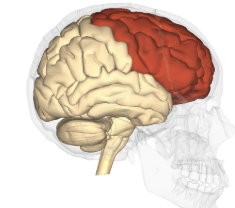
What lobe is this?
frontal

What lobe is this?
parietal

What lobe is this?
occipital
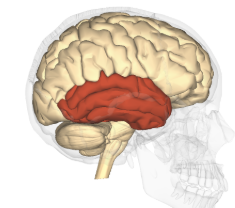
What lobe is this?
temporal
The lobe of the brain that is involved in making judgements, planning & making decisions, abstract thought, and personality
Frontal lobe
What lobe receives sensory input for touch sensations (pain, pressure, temperature) and body position
parietal
What lobe includes auditory areas, each receiving input from the opposite ear
temporal
What lobe receives information from the eyes
occipital
Cortex that executes planning, personality, and executive functioning
prefrontal
Cortex that controls skeletal movments
motor
Cortex that registers touch sensations
somatosensory cortex
Cortex in the temporal lobe
auditory
Cortex in the occipital lobe
visual
Area of the brain that controls speech production
Broca’s area
Area of the brain that controls understanding of language
Wernicke’s area