CliPsy Lec13 CH13+CH15
 Call Kai
 Learn
Learn Practice Test
 Spaced Repetition
 Match
Match Flashcards
 Knowt Play
1/75

Earn XP
Description and Tags
Personality disorders + CH13 p. 373-379 ( Conduct Disorder).
Name | Mastery | Learn | Test | Matching | Spaced | Call with Kai | Chat |
|---|
No analytics yet
Send a link to your students to track their progress
76 Terms
What is intermittent explosive disorder?
Recurrent verbal or physical aggressive outbursts that are far out of proportion to the circumstances.
Difference with conduct disorder: Impulsive, not preplanned behaviour.
What is oppositional defiant disorder (ODD)? | Co-occurence? | Prevalence rate (boys/girls)
Diagnosed if a child does not meet the criteria for conduct disorde - most especially, extreme physical aggressiveness
But exhibits such behaviors as:
losing his or her temper, arguing with adults, repeatedly refusing to comply with requests from adults, deliberately doing things to annoy others, and being angry, spiteful, touchy, or vindictive.
Often co-occurs with ADHD
Difference; Defiant behavior is not thought to arise from attentional deficits or impulsiveness
Prevalence = 8%, no difference in boys vs girls! (different from conduct disorder)
Defining symptoms of conduct disorder?
Conduct disorder involves a pattern of repeated destructive and harmful behavior that can take different forms, including:
A. Aggressive behavior (e.g., bullying, physically hurting animals or people)
B. Destroying property (e.g., vandalizing a building, setting a fire)
C. Lying or stealing (e.g., shoplifting, breaking into a house and stealing items, lying about behavior)
D. Breaking rules (e.g., skipping school, missing curfew)
Clinical description of Conduct disorder
The behavior is often marked by callousness, viciousness, and lack of remorse
Diagnostic specifier: callous and unemotional traits
Shallow emotions and a lack of feelings of remorse, empathy, and guilt.
If present → more problems.
Comorbidities of conduct disorder?
Substance abuse and internalizing disorders
(preceded by conduct disorder) → Anxiety and depression.
specific phobias and social anxiety → precede conduct disorder
Course(s) of conduct disorder? (Moffitt, 1993)
life-course-persistent pattern of antisocial behavior
(most severe problems)
Adolescence-limited. (normal child- and adulthood)
Caused by maturity gap (Between the adolescent’s physical maturation and their opportunity to assume adult responsibilities and obtain the rewards usually accorded such behavior).
Continued to have troubles with substance use, impulsivity, crime, and overall mental health in their mid-20s
30’s → Men still violence problems, women didn’t. Other problems still present in both.
Culturally stable!
Prevalence of conduct disorder? Boys/girls?
5-6%.
Like ADHD, more common in boys than girls
Adolescence-limited more common than Lifelong
Prognosis of conduct disorder
Life-course persistent:
About half develop Antisocial disorder
Almost all keep having problems
Causes of conduct disorder: genetic influences?
Heritability is relevant, but some overlap with ADHD and depression and some specific to CD
Gene-enviornment interaction
Different types of CD have different heritability.
combination of conduct problems and callous and unemotional traits is more highly heritable than conduct problems alone
Onset; Early onset is more heritable.
Causes of conduct disorder: Neurobiological influences?
Deficits in regions of the brain that support emotion, particularly empathetic responses.
Difficulty perceiving distress and happiness, but not anger on others faces.
Reduced activation in brain regions associated with emotion and reward
Amygdala, ventral striatum, and PFC
Causes of conduct disorder: Psychological influences?
Children with conduct disorder, particularly (callous and unemotional traits) → deficient in moral awareness, lacking remorse for their wrongdoing.
Risk factor APD and Psychopathy
callous and unemotional traits may develop, in part, from nonshared environmental factors (like parenting).
Also: C&UE traits → decrease in parental warmth.
Dodge’s cognitive theory of aggression?
these children interpreted ambiguous acts, such as being bumped in line, as evidence of hostile intent
Theory can be extended to conduct disorder.

Causes of conduct disorder: Peer influences?
acceptance or rejection by peers:
→ increase in aggression (which leads to more rejection)
affiliation with delinquent peers
→ more delinquent behaviour due to modelling or coercion
both Social selection and social influence views are correct on this!
Treatment of conduct disorder: Family interventions?
The family checkup (FCU)
3 meetings to get to know, assess, and provide feedback to parents regarding their children and parenting practices.
Parent management training (PMT). → Most effective.
Parents are taught to modify their responses to their children so that prosocial rather than antisocial behavior is consistently rewarded.
How is the treatment of conduct disorder most effective?
when it addresses the multiple systems involved in the life of a child (family, peers, school, and neighborhood).
Treatment of conduct disorder: Multi-systemic treatment?
Based on the view that conduct problems are influenced by multiple factors within the family as well as interactions between the family and other social systems.
uniqueness lies in:
emphasizing individual and family strengths,
identifying the social context for the conduct problems,
using present-focused and action-oriented interventions
using interventions that require daily or weekly efforts by family members.
Treatment of conduct disorder: Prevention programs?
Fast track program:
impressive reductions in later psychopathology
Help children academically, socially, and behaviorally (peer relationships, aggressive/disruptive behavior, social information processing, and parent–child relationships)
In part due to: decrease in the hostile attribution bias.
Prevalence of personality disorders? (difference high and low income countries?)
±7,5%
Higher in high-income countries.
PD Cluster co-occurence with psychological disorders?
Cluster C → high levels of distress → high comorbidity rates with mood and anxiety disorders.
Cluster B → Also show high rates of comorbidity with mood disorders
Antisocial personality disorder is highly comorbid with substance use disorders
General diagnostic criteria for PD?
An inflexible pattern of behaviour and inner experience that is distinct from cultural expectations and influences at least two of the following:
cognition about the self, others, and events
affect
interpersonal functioning
impulse control
The pattern (3 P’s):
Pathological: Causes significant distress or impairment
Persistent: is inflexible
Pervasive across situations
Onset by early adulthood
Symptoms are stable and persistent
Not explained by another psychological disorder, by a substance, or by a medical condition
For what PD is interrater-reliability a problem? Why?
Schizoid personality disorder
Unfortunately, most clinicians do not use structured interviews to assess personality.
DSM-Approach to diagnosing PD?
10 different personality disorders are classified in three clusters, reflecting the idea that these disorders are characterized by:
Odd or eccentric behavior (cluster A)
Dramatic or erratic behavior (cluster B)
Anxious or fearful behavior (cluster C).
What disorders are in the Clusters A, B and C?

Problems with DSM approach to PD diagnosis?
PD are not stable over time
Poor test-retest reliability → In conflict with definition of PD.
Personality Disorders Are Highly Comorbid
More than have with 1 PD, classify for another
Thresholds for Diagnosing Personality Disorders Are Arbitrary
With the exception of schizotypal personality disorder, personality symptoms vary along a continuum. So dimensional approach might be better than arbitrary cut-off points.
Alternative DSM-5 model for PD? (closely related to 5-factor model
Includes only 6 of the 10 DSM-5-TR personality disorders.
If the following are present long tern, after early adulthood:
Persistent, stable, and pervasive impairments in personality functioning.
Then psychologist considersthe personality traits that explain those difficulties in functioning using two types of dimensional personality scores:
5 personality trait domains,
25 more personality facets
What 5 personality traits are evaluated in the alternative approach to PD diagnosis?
Negative Affectivity (vs. Emotional Stability)
Detachment (vs. Extraversion)
Antagonism (vs. Agreeableness)
Disinhibition (vs. Conscientiousness)
Psychoticism
Strengths of the alternative approach to PD diagnosis?
Personality trait ratings are more stable over time than are personality disorder diagnoses
Twenty-five dimensional scores provide richer detail than do the categorical personality disorder diagnoses.
Personality traits are related to many psychological disorders:
Personality traits robustly predict important outcomes such as happiness, relationship quality, stress, occupational outcomes, physical health, and even life expectancy.
Clinicians rate dimensional personality approaches as more useful in communicating with clients and in planning treatment than the traditional categorical diagnostic system
Common Risk Factors Across the Personality Disorders? (stress diathesis model)
Personality traits → heritability at least moderate (genes)
Childhood adversity
Parental abuse might be bc parents have PD disorder (symptoms) themselves → still gene influence.
Neurotransmitter problems:
Dopamine (cognitive problems, cluster A)
Serotonin (Anger, impulse control)
Mono-amine oxidase (Agression)
Brain area’s:
Lack of frontal cortical control: impulses and emotions (mid brain)
Dysfunction amygdala: (hyper-/hypo-emotionality)
Defining Symptoms of Paranoid Personality Disorder
Presence of four or more of the following signs of distrust and suspiciousness from early adulthood across many contexts:

Defining Symptoms of Schizoid Personality Disorder
Presence of four or more of the following signs of aloofness and flat affect from early adulthood across many contexts:

Defining Symptoms of Histrionic Personality Disorder
Presence of five or more of the following signs of excessive emotionality and attention seeking from early adulthood across many contexts:

Defining Symptoms of Dependent Personality Disorder
An excessive need to be taken care of, as shown by the presence of at least five of the following from early adulthood across many contexts:

Defining Symptoms of Schizotypal Personality Disorder
Presence of five or more of the following signs of unusual thinking, eccentric behavior, and interpersonal deficits from early adulthood across many contexts:

Difference schizotypal and SZ
the bizarre thinking and functional impairments are less severe than they are in schizophrenia, and neither hallucinations or full-blown delusions are present.
Schizotypal often develops into schizophrenia (genetic vulnerability overlap
Brains of people with schizotypal Personality disorder?
enlarged ventricles, less temporal lobe gray matter, and neurotransmitter dysregulation similar to but less severe than what is observed in schizophrenia
Differences antisocial personality disorder and psychopathy?
Affective symptoms. The PCL-R (Psychopathy Checklist-Revised) overlaps with much of the APD criteria, but it adds emotional features such as shallow affect and lack of empathy. APD in the DSM-5 is defined mostly by behavior.
Age of onset. The DSM-5-TR requires that symptoms (conduct disorder) begin before age 15 for an APD diagnosis. Psychopathy has no such requirement.
Categorical vs. dimensional. APD is a yes/no diagnosis, while psychopathy is scored along a continuum on the PCL-R.
Comorbidities with antisocial PD?
About three-quarters of people with APD meet the diagnostic criteria for
another disorder, with substance abuse being very common
Defining Symptoms of Antisocial Personality Disorder
Age at least 18
Evidence of conduct disorder before age 15
Pervasive pattern of disregard for the rights of others since the age of 15, as shown by at least three of the following:

Prevalence men/women antisocial PD?
5x more in men
triarchic model of psychopathy?
Three core traits underpin the symptoms of psychopathy
Boldness (fearlessness)
Meanness (aggression and lack of remorse)
Disinhibition (impulsivity)
Meanness and disinhibition → negative outcomes of psychopathy
Boldness → social poise and calm demeanor of some psychopaths
Defining symptoms of Psychopathy (non DSM)
lack of emotions, both positive and negative:
no sense of shame, anxiety or remorse
Their seemingly positive feelings for others are merely an act.
They are superficially charming
Use that charm to manipulate
Genetic vulnerability of APD?
Overlaps with substance use disorder.
Causes of antisocial PD: Social influences?
Parenting qualities (child antisocial behaviour and parent lack of warmth → vicious cycle)
Poverty (Low SES) and exposure to violence
Childhood adversity
Risk for psychopathology, Following triarchic model?
Boldness → Les threat sensitivity → Less amygdala activation→ unable to learn form experience (classical conditioning deficits)
Meanness → lack of empathy
Disinhibition → poor executive control
Defining Symptoms of Borderline Personality Disorder
Presence of five or more of the following signs of instability in relationships, self-image, and impulsivity from early adulthood across many contexts:
(Also related to interpersonal hypersensitivity)

Why is borderline PD a major focus of research interest?
It is very common in clinical settings
Very hard to treat
associated with recurrent self-harm behavior and suicidality.
Borderline PD Psychological comorbidities?
anxiety and depression diagnoses
Causes of Borderline PD: Neurobiological factors?
Diminished connectivity of brain regions involved in emotion experience and those involved in regulatory control.
rTMS can provide short term improvement.
Causes of Borderline PD: Linehan’s biosocial theory?
2 Main influences: emotional dysregulation and invalidation (by family)

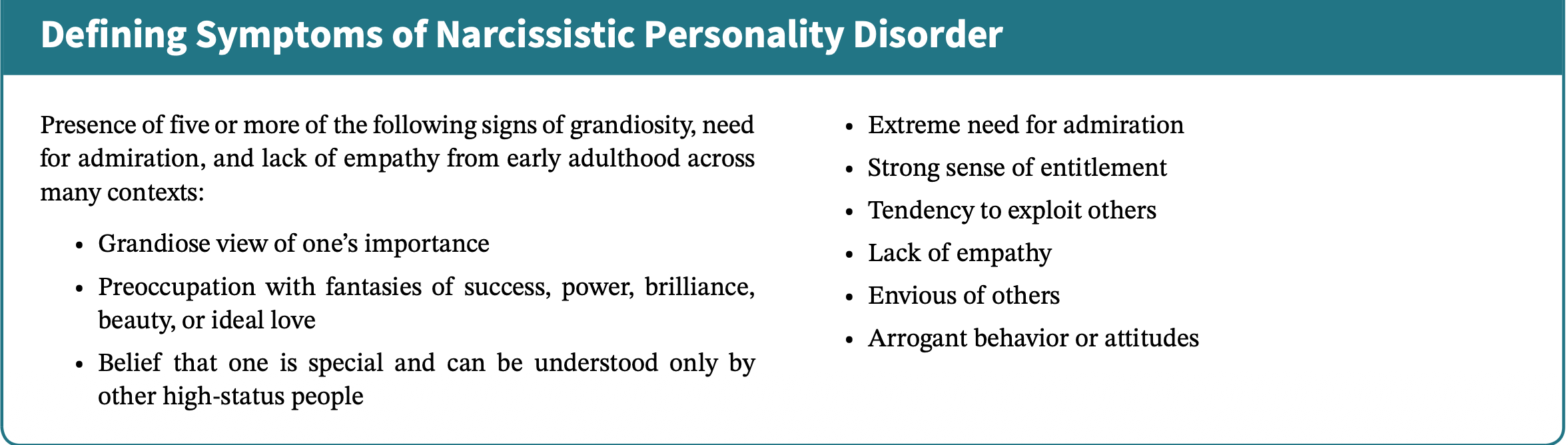
Defining Symptoms of Narcissistic Personality Disorder
Presence of five or more of the following signs of grandiosity, need for admiration, and lack of empathy from early adulthood across many contexts:
Others facts of representation of Narcissistic PD?
highly likely to be vindictive and aggressive when faced with a competitive threat or a put-down
likely to seek out high-status partners whom they idealize and proudly show off, only to change partners if given an opportunity to be with a person of higher status.
Causes of narcissistic PD?
Parenting:
Parents who are overly indulgent promote children’s beliefs that they are special, and that behavioral expressions of their specialness will be tolerated by others.
Fragile self-esteem (model Heinz Kohut)
Narcissistic characteristics mask a very fragile self-esteem.
People with NPD experience more shame than non-NDP.
Social exclusion activated neural regions associated with processing social (pain ) (anterior insula and ACC). Narcissistic traits were tied to more activation of those pain-relevant neural regions.
Comorbiities of Avoidant PD?
social anxiety disorder
Genetic vulnerability and diagnostic criteria overlap
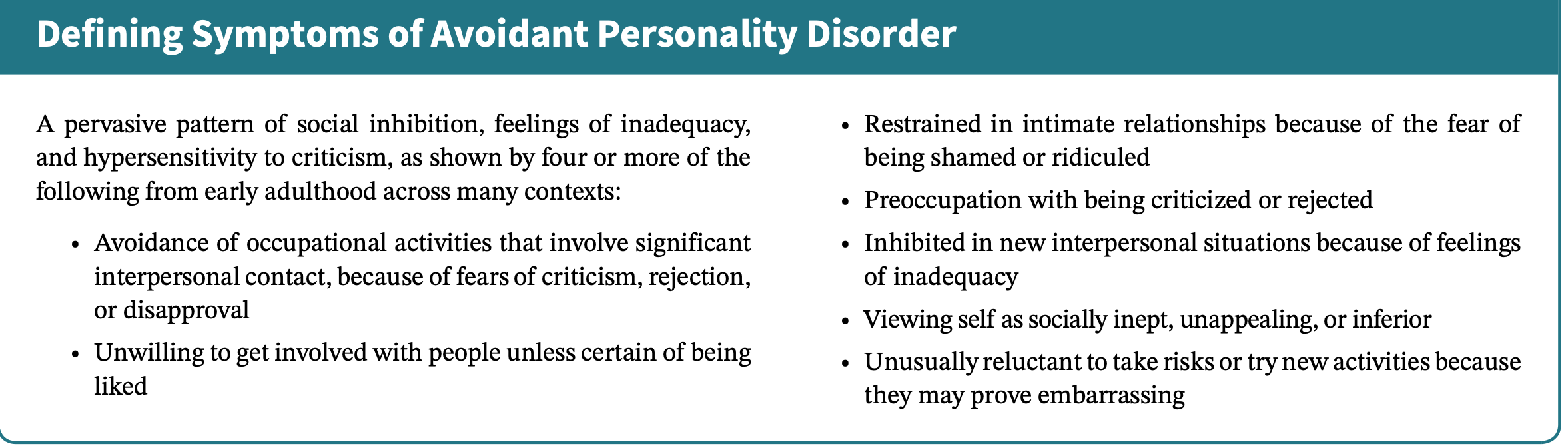
Defining Symptoms of Avoidant Personality Disorder
A pervasive pattern of social inhibition, feelings of inadequacy, and hypersensitivity to criticism, as shown by four or more of the following from early adulthood across many contexts:
Defining Symptoms of Obsessive-Compulsive Personality Disorder
Intense need for order, perfection, and control, as shown by thepresence of at least four of the following from early adulthood across many contexts:

Obsessive-compulsive PD and Social problems?
Less interpersonal difficulty than do those with other personality disorders.
Not tied to major problems in friendships, family relationships, or romantic relationships
Difference Obsessive-compulsive PD and -disorder?
PD variant does not nclude the obsessions and compulsions
Attough people with OCD and their family show higher rates of OCPD.
Treatment of general PD: General facts?
Many people with personality disorders enter treatment for a condition other than their personality disorder
Treatment of general PD: Psychotherapy?
Personality traits can change in psychotherapy.
preferred treatment method
Treatment of general PD: Medication?
Psychotherapy is often supplemented with medications to treat the accompanying depression, anxiety, or cognitive symptoms that can be present
Treatment of general PD: Psychodynamic theory?
→ Childhood problems are at the root of personality disorders
Aim of psychodynamic therapy:
Help patients reconsider those early experiences
Become more aware of how those experiences drive their current behaviors
And than reconsider their beliefs and responses to those early events.
Treatment of general PD: Cognitive theory?
Suggests that negative cognitive beliefs are at the heart of the personality disorders
Aim of therapy (CBT):
help a person become more aware of those beliefs → challenge maladaptive cognitions.
Treatment of Borderline PD: Facts?
People with BPD seek treatment more than those with mood, anxiety, or substance use disorders
The treatment process can be challenging, because they tend to show their interpersonal problems in the therapeutic relationship as much as they do in other relationships.
Demanding special attention and consideration at certain times (e.g.) therapy sessions at odd hours and countless phone calls during crisis periods)
Treatment of Borderline PD: Suicide risk?
It is a serious risk, but difficult for the therapist to judge whether a frantic phone call at 2:00 a.m. from a BPD patient is a call for help or a manipulative gesture designed to test how special the patient is to the therapist
Sometimes hospitalisation is necessary
Treatment of Borderline PD: Dialectical behavior therapy (DBT)?
Combines: Empathy & acceptance, cognitive behavioral problem solving, emotion-regulation techniques, and social skills training
The concept of dialectics refers to the constant tension between any phenomenon (e.g., an idea or event, called the thesis) and its opposite (the antithesis), which is resolved by creating a new phenomenon (the synthesis).
4 Stages:
Dangerously impulsive behaviors (e.g. suicidal actions)
Modulating the extreme emotionality and coaching the client to tolerate emotional distress
Improving relationships and self- esteem
Promote connectedness and happiness
Treatment of Borderline PD: Mentalization-based therapy?
Integration of Psychodynamic and CB approaches.
Focuses on helping clients to be more reflective about their own feelings and those of other people
Avoid automatic reactions
Treatment of Borderline PD: transference-focused therapy
Form of psychodynamic therapy
Less effective than M-BT and DBT
Treatment of Borderline PD: M-BT and DBT, general facts?
Both:
Reduce borderline symptoms,suicidality, and the risk of self-harm,
The benefits have been sustained at follow-up assessments
But:
Small/moderate effect sizes
High drop-out rates
Longer term outcomes are varied
Possible publication bias
Beck’s cognitive model of PD?
Your schema’s that are most active shape the way you interpret the environment and events.
Schema theory of young
Extension of beck’s cognitive theory.
Basic needs not met → early maladaptive schema’s (which used to be adaptive!!) → coping with schema’s → lead to personality characteristics.
Mentalization theory in PD?
Mentalisation = understanding the behaviour of the other (and yourself) in terms of their mental state (desires etc)
Hypothesis; Mentalisation is learned as primary caretaker mirrors the emotions of the child
Poor mentalizaiton leads to bad responses
Object relations theory in PD? (e.g.) Kernberg
Internalised representations of the self in relation to the subject (another person)
In PD: immature defence mechanisms (E.g. splitting → all good or all bad.
What are the roadblock and things you need for PD treatment?
Roadblocks:
Life threatening behaviour
therapy damaging behaviour
motivation
requirements:
Safety/safe environment
Incentive/invitation to revise coping
possibility of new (positive) experiences
Treatment of PD: Schema therapy?
Very integrative: Attachment theory, experiental therapy, cognitive therapy, imagery rescripting.
Treatment of BPD: The big 4? Different client experiences?
Dialectical Behavioral Therapy (DBT; Linehan)
Schema (focused) therapy (ST; Young)
Mentalization Based Treatment (MBT; Bateman & Fonagy)
Transference Focused Psychotherapy (TFP; o.a. Kernberg)

What can happen when you just do catharsis/chair dialoge as treatment
In can be harmful!