Chemistry Electron Geometry, Molecular Geometry, and Bond Angles
 Call Kai
 Learn
 Practice Test
 Spaced Repetition
 Match
 Flashcards
 Knowt Play
1/24

There's no tags or description
Looks like no tags are added yet.
25 Terms
2 electron groups; 2 bonding groups; 0 lone pairs
linear; linear; 180 degrees

3 electron; 3 bonding; 0 lone pairs
trigonal planar; trigonal planar; 120 degrees

3 electron; 2 bonding; 1 lone pair
trigonal planar; bent;

4 electron; 4 bonding; 0 lone pairs
tetrahedral; tetrahedral; 109.5 degrees

4 electron; 3 bonding; 1 lone pair
tetrahedral; trigonal pyramidal;

4 electron; 2 bonding; 2 lone pairs
tetrahedral; bent;

5 electron, 5 bonding; 0 lone pairs
trigonal bipyramidal; trigonal bipyramidal; 120 degrees (equatorial) and 90 degrees (axial)

5 electron; 4 bonding; 1 lone pair
trigonal bipyramidal; seesaw;

5 electron; 3 bonding; 2 lone pairs
trigonal bipyramidal; T-shaped;

5 electron; 2 bonding; 3 lone pairs
trigonal bipyramidal; linear; 180 degrees

6 electron; 6 bonding; 0 lone pairs
octahedral; octahedral; 90 degrees

6 electron; 5 bonding; 1 lone pair
octahedral; square pyramidal;

6 electron, 4 bonding, 2 lone pairs
octahedral; square planar; 90 degrees

aufbau principle
fill the lowest available energy levels before filling higher levels
Pauli exclusion principle
no two same set of numbers
hund's rule
every orbital in a subshell is singly occupied with one electron before any one orbital is doubly occupied, and all electrons in singly occupied orbitals have the same spin.
Magnetic quantum number
Specifies the orientation in space of an orbital of a given energy (n)
Principal quantum number
one of four quantum numbers which are assigned to each electron in an atom to describe that electron's state
Angular momentum quantum number
The angular momentum quantum number, l, (also referred to as the secondary quantum number or azimuthal quantum number) describes the shape of the orbital that an electron occupies. The lowest possible value of l is 0, and its highest possible value, depending on the principal quantum number, is n - 1
Spin quantum number
The Spin Quantum Number (s) is a value (of 1/2) that describes the angular momentum of an electron.
Schrödinger quantum number
?
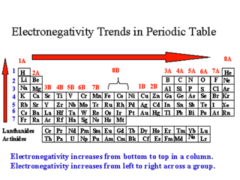
electronegativity
Electronegativity is a measure of the tendency of an atom to attract a bonding pair of electrons
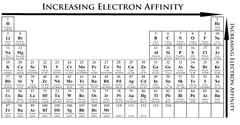
electron affinity
Electron affinity is defined as the change in energy (in kJ/mole) of a neutral atom (in the gaseous phase) when an electron is added to the atom to form a negative ion
ionization energy
The ionization energy (IE) is qualitatively defined as the amount of energy required to remove the most loosely bound electron, the valence electron, of an isolated gaseous atom to form a cation.

atomic radii trend
