w7 l2 - common ground 2
 Call Kai
 Learn
 Practice Test
 Spaced Repetition
 Match
 Flashcards
 Knowt Play
1/22

There's no tags or description
Looks like no tags are added yet.
23 Terms
2 types of ambiguity
syntactic
lexical
Syntactic ambiguity
Keysar & Henly (2002)
the same string of words can have different interpretations, depending on how you analyse them syntactickly
"Angela sprayed the child with a water pistol"
Angela sprayed [the child [with a water pistol]] - referring to a child carrying a water pistol
Angela sprayed [the child] [with a water pistol] - refers to an action being performed by angela (spraying the child)
Lexical ambiguity
"Currency is no longer exchanged by the banks." the word banks can have two different meanings
Currency primes us to think about money so we assume banks refers to the financial institution
Banks could also be referring to the banks of a river
Keysar & Henly (2002) - Method
Researchers use ambiguity to help understand how speakers make sense of their communicative success
Two different phases:
Phase 1
Speaker and addressee are sat facing opposite each other
Speaker reads something silently off a screen, only read the final sentence of the passage out loud
Final sentence is a syntactically ambiguous sentence
Speaker knows which interpretation is correct as they have the additional context
Phase 2
Speaker and addressee turn to face a screen
See images that correspond to the two possible interpretations
Addressee chooses the one they think is correct
Speaker decides how likely it is that the addressee chooses the correct interpretation
Results
Index for Speaker's overestimation of effectiveness:
Probability of the speaker predicting successful communication, given that Addressee did not get the message. 46%
Index of Speaker's underestimation:
Probability of speaker predicting failed communication, given that Addressee got the message. 12%
Overestimation > Underestimation - speaker was much more likely to think that they had done a good job
Speakers prediction on the y axis, listeners actual accuracy on the x axis
If the speaker was predicting the listeners choice accurately, would follow they straight line, this is not the case. Suggests speakers expected listeners to be accurate on a greater proportion of cases than they actually were
Researchers wanted to find out why speakers get this so wrong
do they overestimate because they know the intended message?
How
Contrasting speakers and overhearers (someone who witnesses the exchange between the speaker and the addressee, but is not involved in it)
example of overhearer
Assign roles: SPEAKER, LISTENER, OVERHEARER
Speaker task 1: Choose one of these two pictures and tell the overhearer, BUT NOT the listener about your choice
Speaker task 2: Read out the sentence to the listener and overhearer
Speaker and overhearer task 3: Will the listener pick the right picture? Post your answer on Vevox
Listener task 4: pick a picture, ask for feedback from the speaker and report whether you were right or wrong on vevox
Results (Keysar & Henley, 2002)
Reported results as a proportion of overestimation vs underestimation
The two bars on the left show the findings from the og experiment - speakers overestimate their effectiveness
For the overhearers, there wasn't much difference in overestimation vs underestimation of the listener
So phenomenon of overestimating how effective you are is something that is specific to speakers
We know it cant be because the speaker knows what the context is as the overhearer also knows the context but does not overestimate the listeners

Why do speakers overestimate?
"Illusion of transparency" - psychological states (private information) leaking out to the public, have an illusion that other people would have access to the content of your inner state. Especially because they are the ones reading out the sentence and trying to communicate what the meaning is
Cognitive demands - failure to assess how successful you are at communicating is because the speaker is speaking which is a cog demanding process
Speaker's privileged knowledge about prosodic (intonational) cues. - "Angela sprayed the child...with the water pistol." can emphasise meaning by pausing in a certain place. So speaker might be using this tool to try and convey meaning and make the message clear, but the listener might not pick up on this, ie pause is not long enough
Do speakers modify their linguistic expressions, depending on what information the addressee needs?
Speakers "attenuate" their linguistic expressions when telling the same content for the second time
Shorter, simpler formulations
Full noun phrases - pronouns
Articulation - becomes less clear with repetition
Is attenuation for-the-speaker adjustment or for-the-addressee adjustment? - is this for the benefit of the speaker, addressee or both
For-the-addressee
Speakers produces less elaborate expressions when the information need for the addressee is smaller - addressee already knows a lot about the figure, so speaker can reduce the amount of detail needed to convey the message
For-the-speaker
Speakers produce less elaborate expressions when they have already practiced producing the message - want to try and be more efficient for themself, reduce their own effort
Galati & Brennan (2010)
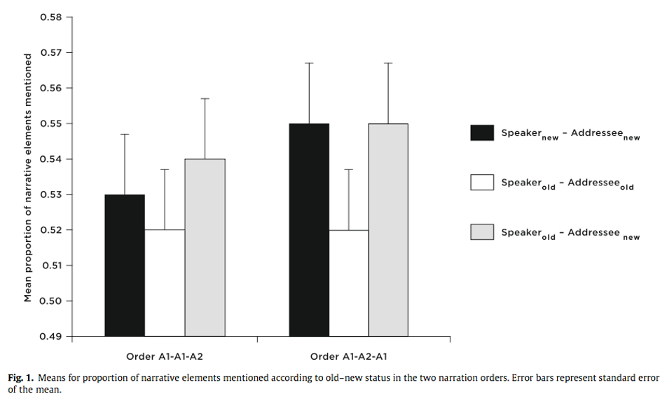
The speaker retells a cartoon story three times to Addressee 1 and Addressee 2.
A1 - A2 - A1
A1 - A1 - A2
Once the speaker has told the story once, they either tell the story to a new listener, or to the same listener
Three conditions:
Speaker(new) - Addressee(new)
Speaker(old) - Addressee(new)
Speaker(old) - Addressee(old)
For-the-addressee attenuation: Predictions
Speaker(new) - Addressee(new) = Speaker(old) - Addressee(new)
vs.
Speaker(old) - Addressee(old)
If this explanation is correct, the amount of shortening of the expression will be greater when the addressee is old compared to when they are new (addressee has already heard it once so they dont need as much detail)
For-the-speaker attenuation: Predictions
Speaker(new) - Addressee(new)
vs.
Speaker(old) - Addressee(new) = Speaker(old) - Addressee(old)
Two speaker old conditions should be similar as the speaker is becoming more efficient
Analysis
Stories are divided into 108 narrative elements (possible events that could be mentioned by speaker)
Counted the number of elements the speaker referred to as well as the number of words in each element
Road Runner is being chased by Coyote
Freeze shot: camera slows down on Road Runner then on Coyote.
Road Runner's Latin name, "Accelerati Incredibulus", is presented.
Results: Proportion of narrative elements mentioned
Proportion of narrative elements mentioned is lower, when the addressee is old compared to when the addressee is new
So speaker is adjusting to the need of the addressee - tailoring to what they already know
The development of interactive communication - Matthews et al., 2010
Did a version of the director task with children
Are children sensitive to referential pacts with their partner?
Method
- Had grids with different toys on them
- Didnt occlude toys to vary the knowledge the speaker and addressee had access to, instead they changed the way the experimenter was referring to some of the objects
- Played game with exp1, would refer to the toys as on the left, then would play the game with exp1 again or exp 2
- now use dif words to refer to the same object, regardless of exp
- will the child be surprised by this switch and take longer to respond
- also will the amount of surprise differ depending on whether it is the same person that previously said car or a dif person
- if a child is sensitive to the fact that they established a referential pact with the first exp, then they should be very surprised when they change the word used
Hypotheses
If children keep track of the conventions established with their conversation partners:
they should be surprised when their original partner switches words but not when a new partner uses a different expression.
If they are surprised, they should take longer to respond
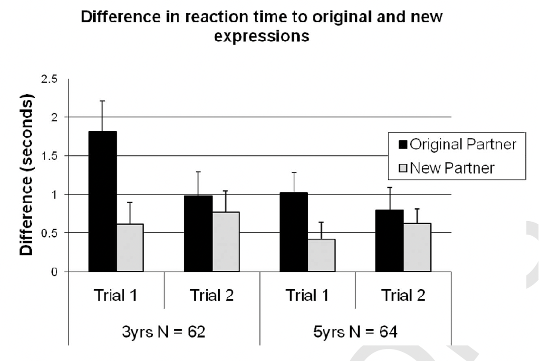
response time should be higher with old than new partner
Results
- y-axis is the difference between the time it took the child to pick the correct option in response to hearing the og expressions, compared to hearing a new expression
- higher the bar, greater level of surprise
- children are more surprised when the exp switches the way of referring to an object, compared to a new exp referring to it with a word dif to the other exp
- so children have some awareness that when we talk to someone, we establish referential pacts that are unique to that speaker
further results
Children were equally likely to explicitly protest when a new name was introduced by E1 or E2
Suggests they have a preference for old names (hyper-conventionalism)
Their ability to reason about other people’s preferences and how they may differ from their own is still limited.
So dif aspects of the exp point to dif conclusions
The child seems to be sensitive to the difference to speaking to the same vs dif person but they also seem to have an overall preference to keep referring to the same thing with the same name
Conclusion
Young children are sensitive to referential pacts from a young age - they have some understanding of common ground.
Their interactive communication abilities are not fully adult-like