Lecture 1 - Time Value of Money
 Call Kai
 Learn
 Practice Test
 Spaced Repetition
 Match
 Flashcards
 Knowt Play
1/24

There's no tags or description
Looks like no tags are added yet.
25 Terms
Why do we need the time value of money?
Financial decisions often require comparing cash flows that occur at different times.
Rule 1 - Comparing and Combining values
You can only compare or combine (add/subtract ) cash flows that occur at the same point in time.
What are the two ways to compare £100 today with £133.10 in 3 years?
Move them to the same point in time
Case 1 – Future Value (FV): what £100 today is worth in 3 years
Case 2 - Present Value (PV): what £133.10 is worth today
Rule 2 - Moving cash flows forward in time
To move a cash flow forward – compound it at the appropriate interest rate for the proper number of periods
Compounding – increasing the value as you move forward, by multiplying it by (1+r) each period.
Rule 3 - Moving cash flows back in time
To move a cash flow back in time, discount it at the appropriate discount rate for the proper number of periods
Discounting – decreasing the value as you move back, by dividing it by (1+r) each period
Formula - future value after one period
FV1=C0(1+r)
£100 at 10%: FV1=100×1.10=£110
Interest in year 1 = £100 × 10% = £10
£100 at 10% — what is it worth at t = 2, and why is year-2 interest £11 not £10?
FV2=FV1(1+r)=C0(1+r)2=100×1.12=£121
Year-2 interest = £110 × 10% = £11
= £10 on the original £100 + £1 interest on interest (on year 1's £10 interest)
£100 at 10% — what is it worth at t = 3? What is the interest in year 3?
FV3=FV2(1+r)=C0(1+r)3=100×1.13=£133.10
Year-3 interest = £121 × 10% = £12.10
General formula: future value of a single cash flow after N periods
FVN=C0(1+r)(1+r)⋯(1+r)=C0(1+r)N
C0 = cash flow today, r = interest rate per period, N = number of periods
Multiply by (1+r)N
How do you find the combined FV of a stream of cash flows?
Compound each cash flow to the same date by its own number of periods, then add them (Rule 1 - theyre noe all at the same time)
Example: £1,000 received at t = 0, 1 and 2. Interest 10%. Total FV at t = 3?
Compound each by 3, 2 and 1 periods respectively:
1000(1.1)3+1000(1.1)2+1000(1.1)1=1331+1210+1100=£3,641
£133.10 at t = 3, discount rate 10%. Walk it back step by step to t = 0.
PV2=133.10/1.1=£121
PV1=121/1.1=C3(1+r)2=£110
PV0=110/1.1=C3(1+r)3=£100
General formula: present the value of a single future cash flow at time N
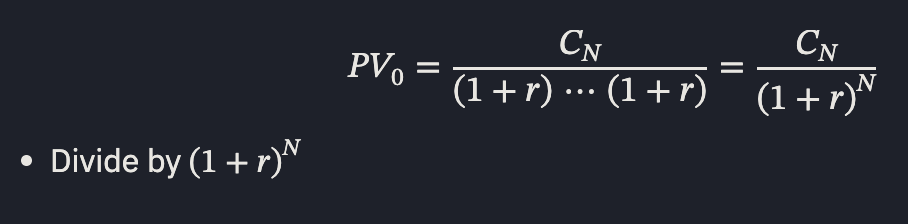
What is the discount factor
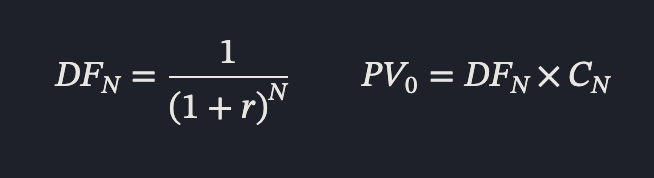
What range does the discount factor take
If r > 0, then 0 < DFN < 1
If r < 0, then DFN > 1 (very rare)
How do you find the combined PV of a stream of future cash flows
Discount each cash flow back to t = 0 by its own number of periods, then add the PVs
Example: $3,000 at t = 1, $2,000 at t = 2, $1,000 at t = 3. Discount rate 7%. Total PV?

General formula: PV of a stream of cash flows C0,C1,…,CN

What is the Net Present Value (NPV) and what problem does it solve
NPV = the sum of all PVs of all inflows and outflows.
NPV = PV0 (inflows) - PV0 (outflows)
Values projects/instruments whose cash in- and outflows happen at different times, accounting for the time value of money
NPV decision rule
NPV > 0 → good: investment is profitable → accept
NPV < 0 → not good: investment is not profitable → reject
Example: pay $5,000 today; receive $3k (t=1), $2k (t=2), $1k (t=3). Discount rate 7% p.a. Should you buy?

Define a perpetuity
A stream of equal cash flows at regular intervals that lasts forever
First cash flow is at t=1, not t=0 (no cash flow at t=0)
Formula: PV of a perpetuity

Define a growing perpetuity
A stream of cash flows at regular intervals that grows at a constant rate g forever
Starts at t=1: C, C(1+g), C(1+g)2
Cash flow at time t = C(1+g)t-1