physics term 1
 Call Kai
 Learn
Learn Practice Test
 Spaced Repetition
 Match
Match Flashcards
 Knowt Play
1/21

There's no tags or description
Looks like no tags are added yet.
Name | Mastery | Learn | Test | Matching | Spaced | Call with Kai | Chat |
|---|
No analytics yet
Send a link to your students to track their progress
22 Terms
Time
s, scalar
Distance
m, scalar
Displacement
m, vector
Speed
m/s, scalar
Velocity
m/s, vector
Acceleration
m/s², vector
Force
N, vector
Volume
L, scalar
km/h → m/s
divide by 3.6
m/s → km/h
multiply by 3.6
Newton’s First Law
Object stays at rest or constant motion unless acted on by an external force (inertia)
Inertia
Resistance to change in motion (more mass = more inertia)
Balanced forces
Equal forces → no change in motion
Unbalanced forces
Unequal forces → causes acceleration (speed up, slow down, change direction)
Newton’s Second Law
F = ma (greater force = more acceleration, less mass = more acceleration)
Newton’s Third Law
For every action force there is an equal and opposite reaction force (on different objects)
Kinetic energy examples
motion
light
heat
sound
Potential energy examples
elastic
gravitational
chemical
static
Law of Conservation of Energy
energy can’t be created or destroyed; only transformed or transferred
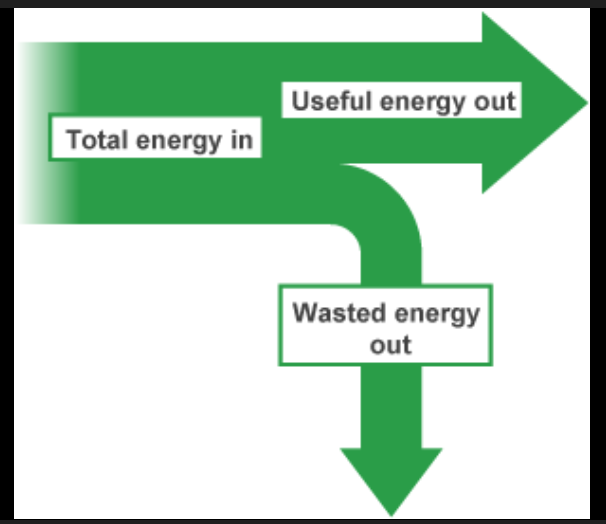
Wasted energy
(mainly) friction
air resistance
Efficiency formula
efficiency = (useful energy / wasted energy) x 100
Sankey diagram