L5 - Knowledge representation and reasoning
 Call Kai
 Learn
 Practice Test
 Spaced Repetition
 Match
 Flashcards
 Knowt Play
1/46

47 Terms
What are the general four knowledge representations?
Logical
Rule-based
Graphical
Structured
How does logical representation work?
Uses formal logic to ensure precision and support interference
What are some examples of logical representations?
Propositional and First-Order
How does propositional logic work?
Basic true or false statements
True or False: First-Order logic extends propositional logic with objects, relations and quantifiers
True. It extends for more expressive power
How does rule-based representation work?
Uses condition-action rules to encode knowledge for decision-making
What are some examples of rule-based representations?
Production rules and Constraint Satisfaction Problems
How do production rules work?
‘If-then‘ rules trigger actions based on conditions
How do Constraint Satisfaction Problems work?
For valid solutions, variables and constraints must be satisfied
How does graphical representation work?
Uses graphs or nodes to represent concepts and their relationships
What some examples of graphical representations?
Semantic, Bayesian and Markov networks
How does a semantic network work?
Concepts are nodes and relationships are edges
How does a Bayesian network work?
Probability relationships modelled with directed graphs for reasoning under uncertainty
How does a Markov network work?
Undirected graphs that capture local dependencies among variables
How does structured representation work?
Represents knowledge using structured data formats
What are some examples of structured representations?
Frames and ontologies
What are frames in a structured representation?
Data structures with slots and values that represent stereotypical situations
True or False: Ontologies in a structured representation, are informal definitions of concepts and relationships outside of a domain
False. Ontologies are formal definitions of concepts and relationships within a domain
What is meant by logic, in general?
Formal languages for representing information, so conclusions can be drawn
True or False: Syntax is the meaning of logical statements and semantics is the rules for how to write those statements
False. They are swapped. Syntax = Rules, semantics = Meaning
What is meant by entailment?
One thing follows from another

Diagram: Knowledge base KB entails sentence a, only if a is true in all worlds where KB is true
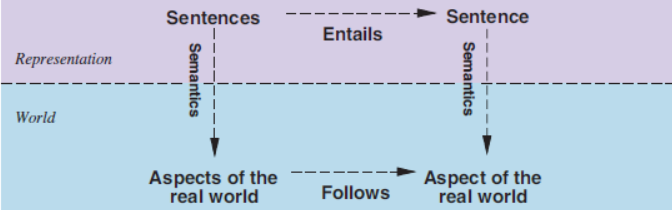
Examples of entailment, involving KB and a

Diagram: Propositional logic syntax

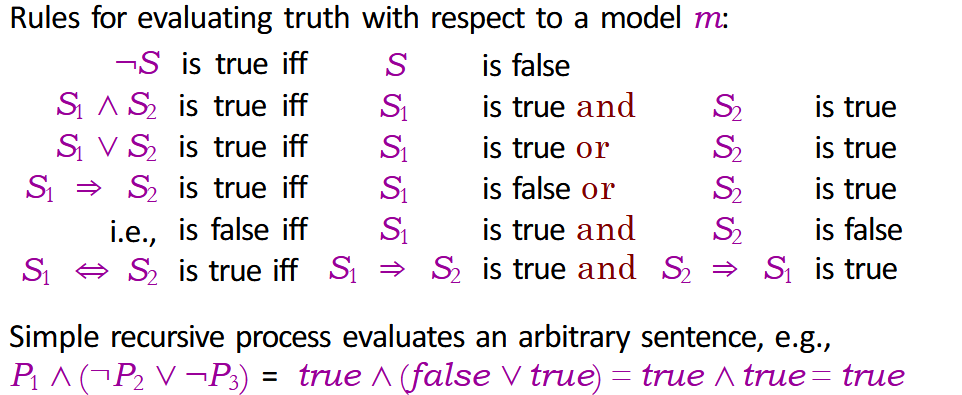
What is meant by a model in propositional logic?
A specific interpretation that makes the sentence true.
Each specifies true/false for each proposition symbol
Diagram: Propositional logic semantics
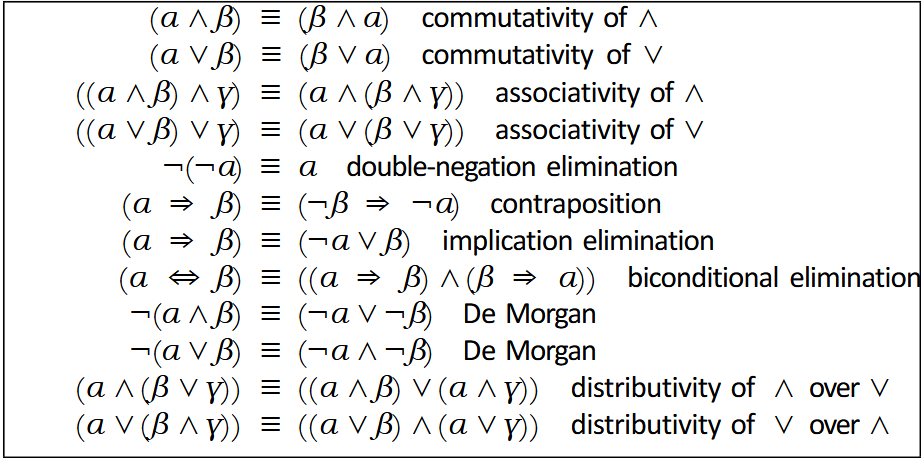
True or False: Two statements are logically equivalent, if they always have the same truth value
True. No matter the situation, they always have the same truth value
Diagram: Logical equivalence laws
True or False: A sentence is valid, if it is true in all models
True.

Diagram: Validity is connected to interference via the Deduction Theorem

True or False: A sentence is satisfiable, if it is true in ALL models
False. A sentence is satisfiable, if it is true in SOME models
True or False: A sentence is unsatisfiable, if it is true in NO models
True
Diagram: Satisfiability is connected to inference via the following

Example of inference

What are the two kinds of proof methods?
Application of inference rules
Model checking
What are some examples of applications of inference rules as a proof method?
Forward and Backward chaining
What is an example of model checking as a proof method?
Truth tables
What are the steps for forward chaining?
Use any rules that would be satisfied in the KB
Add the conclusion to the KB, until query is found
Diagram of example of forward chaining

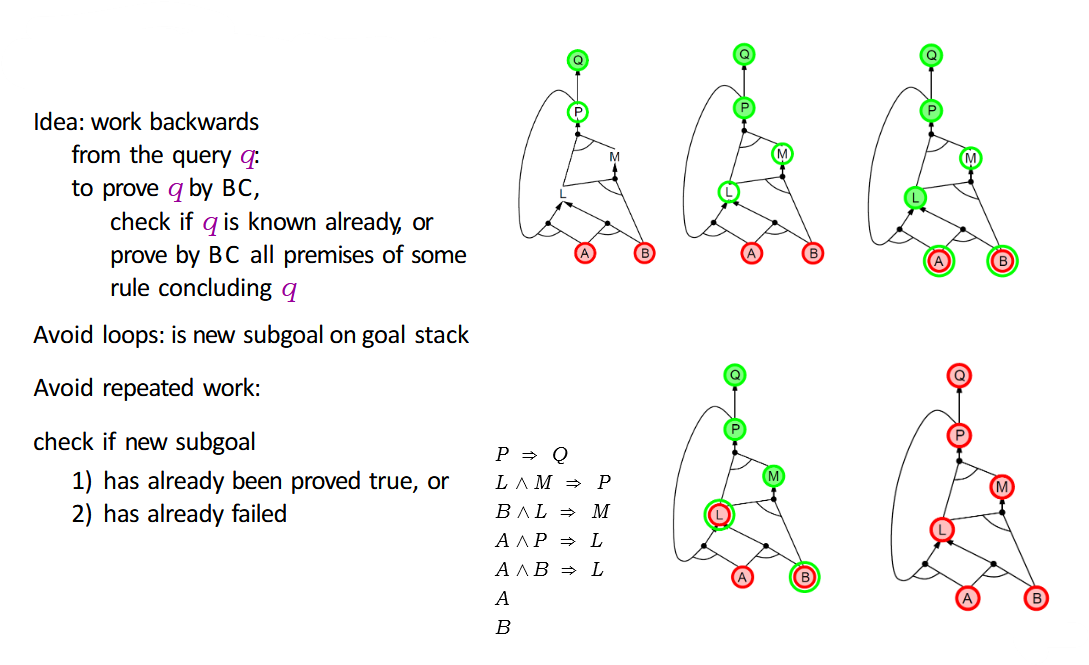
True or False: In backwards chaining, you work back from the query
True. You work back from what you want to prove
Diagram: Example of backward chaining

True or False: FC is goal-driven and appropriate for problem solving, whereas BC is data-driven, automatic and processed unconsciously
False. They are swapped. FC is data-driven while BC is goal-driven.
True or False: Complexity of BC can be much less than linear in size of KB
True.
What is Conjunctive Normal Form?
OR and NOT statements ANDED together
Diagram: CNF example

What is a resolution?
Rule for cancelling out opposites, one at a time
Diagram: Resolution rule
