Verifying Safe Dose
 Call Kai
 Learn
 Practice Test
 Spaced Repetition
 Match
 Flashcards
 Knowt Play
1/32

There's no tags or description
Looks like no tags are added yet.
33 Terms
Patient data correlated with drug references to evaluate medication safety
Key factors evaluated alongside dose verification:
Diagnosis and presenting symptoms
Route of administration
Age of the patient
Relevant laboratory test results influencing dose
Dosing calculated by body weight or body surface area (BSA)
Initial dose versus maintenance dose
What should the nurse always check regarding an ordered drug dose before administration?
always check ordered dose against recommended dose.
Take into account there are reasons sometimes medications do not follow norms and it is important to collaborate with the medical provider
What must the nurse verify before administering medication?
The nurse must verify that the ordered dose of a medication is a safe dose for the individual patient.
How does the nurse determine if the ordered dose is safe?
By comparing the ordered dose with the recommended dose, which is the typical dose given to achieve a therapeutic effect.
What factors determine the recommended dose of a medication?
The drug manufacturer determines the recommended dose based on intended therapeutic effect and potential adverse effects.
What does it mean for a dose to be considered safe?
A dose is considered safe if it does not exceed the recommended dose.
In what circumstances might a physician order a dose different from the recommended dose?
Patients with liver disease may require a lower dose to prevent toxicity. Patients with a serious infection may need a higher dose to combat the infection.
What is the nurse's responsibility regarding medication dosages?
It is not within the nurse’s scope of practice to determine the medication dose; however, safe practice requires consulting with the physician to clarify any order differing from the recommended dose.
Where can recommended doses be found?
Recommended doses are provided on package inserts, labels, or detailed in drug references.
What is a standard dose?
A standard dose or dosage range is a recommended amount, such as 40 milligrams twice daily or a range of 200,000 to 400,000 units, typically for all adult patients.
What is a weight-based dose?
A weight-based dose varies by the patient’s weight and is determined by the manufacturer; for example, 10 micrograms per kilogram for granisetron hydrochloride.
weight-based dosing practices
weight-based dosing is standard practice with pediatric and oncology medications
frequently used with older or critically ill patients adults
recommended doses always vary depending on weight of the patient
The recommended dose is stated as an amount of drug per kilogram or pound of body weight (for example, 1 mg/kg).
How is a dose based on body surface area calculated?
considers both the height and weight of the patient and is
expressed in meters squared, (ex. 60 to 75 milligrams per meter squared)
can be given as a dose or dosage range
What must the nurse always do regarding dosing?
The nurse must always compare the ordered dose against the recommended dose, regardless of the format of the recommended dose.
Types of Recommended Doses
Standard Dose:
A fixed amount (e.g., 40 milligrams twice daily) or a dosage range (e.g., 200,000 to 400,000 units) applicable to all adult patients.
Weight-Based Dose:
A dose determined based on the patient's weight (e.g., 10 micrograms per kilogram).
Body Surface Area Dose:
A dose calculated considering the patient’s height and weight, measured in meters squared (e.g., doxorubicin at 60 to 75 milligrams per meter squared).
Difference between safe dose and effective doses
A dose is considered safe when the amount of drug is equal to or less than the dose recommended in the drug reference. A dose is considered effective when the amount of drug is enough to produce the desired therapeutic effect. Safe doses are not always effective doses
Single dose
Dose of medication administered at one time
Total daily dose
Total amount of medication to be given in 24 hours
Divided Dose
Fractional portions of a total daily dose given at specific intervals
Initial Dose
First dose of a drug given to a patient
Loading dose
Initial large dose administered to quickly achieve therapeutic drug levels
This is a pharmacologic concept where an initial, larger-than-normal dose of a medication given to rapidly reach therapeutic levels in the body before switching to smaller, regular maintenance doses
Maintenance dose
Dose required to sustain therapeutic effect
Bolus
This is a delivery method of a relatively large amount of a substance (medication, fluid, or enteral formula) administered all at once or over a short, defined period (ranging from a few seconds to a couple of minutes)

The ordered dose is safe because it is less than the recommended dose.


how many lbs is one kg
2.2 lbs
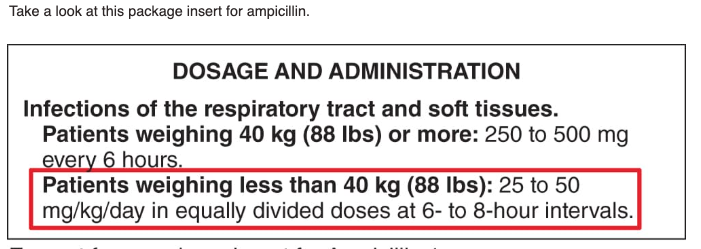
The weight-based recommended dosage range on the ampicillin package insert is a total daily dose. Notice how for patients weighing less than 40 kg the total daily dose must be divided into 3 or 4 equal individual doses, given either every 6 hours (if the total dose is divided into 4 individual doses) or every 8 hours (if the total dose is divided into 3 individual doses).
Calculating safe dose when the weight-based recommended dose is written as a total daily dose requires one extra step:
dividing the total daily dose into individual doses. This is done by dividing the total daily dose by the number of individual doses to be administered in 24 hours.
The two common methods that can be used to calculate a patient’s BSA
use of a standard BSA formula
use of a nomogram
BSA formulas
To calculate BSA using a formula, you will need:
Recommended doses based on BSA are common for pediatric doses and oncology drugs.
BSA must be based on current height and weight measurements.
An individual’s BSA can be determined by use of a formula or a nomogram.
There are two standard formulas for calculating BSA

Using a Nomogram
You may also determine BSA by using a nomogram, which is a graph or chart that shows the relationship between different numerical variables, such as height and weight.
To read the West Nomogram, a straight line is drawn from the child’s height, in the left-hand column, to the child’s weight, in the right-hand column. The intersecting line on the surface area (SA) column provides an estimate of the child’s BSA.
A RULER MUST BE USED TO ENSURE ACCURATE DATA
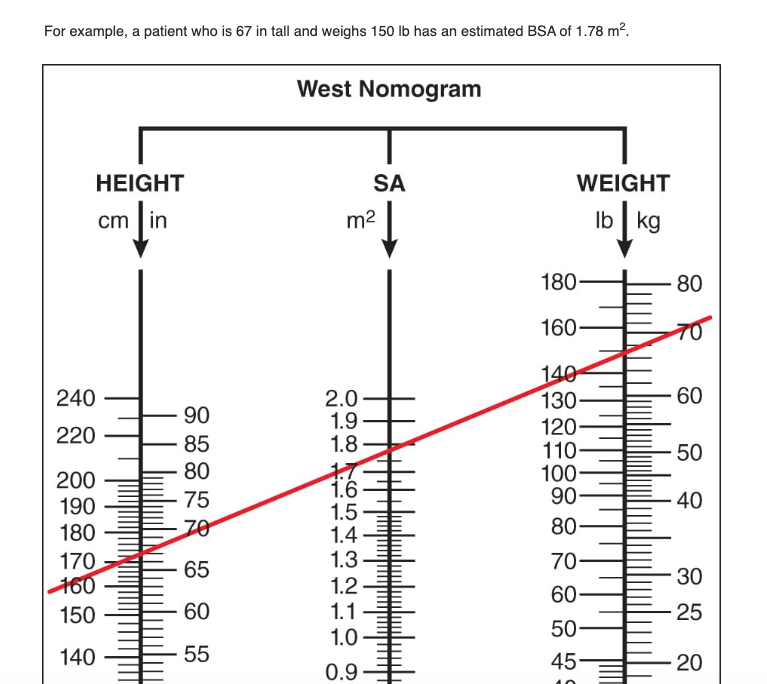
Nomogram for children of normal height and weight

How many oz in one lb
There are 16 ounces in one pound.