Proteins
 Call Kai
 Learn
 Practice Test
 Spaced Repetition
 Match
 Flashcards
 Knowt Play
1/39

There's no tags or description
Looks like no tags are added yet.
40 Terms
Give the general structure of an amino acid and what each respresents
NH2 - Amine
COOH- Carboxyl
R - Side chain

What are proteins?
They are polymers made up of amino acid monomers
How many amino acids are common in all organisms and how do they differ?
20 amino acids
They differ only in their side group
What is a peptide bond?
A bond formed between 2 amino acids through a condensation reaction, where water is removed
How are dipeptides formed?
A condensation reaction between 2 amino acids
How are polypeptides formed?
Through the condensation of three or more amino acids
How many polypeptides are needed for a functional protein?
One or more polypeptides
Draw a peptide bond
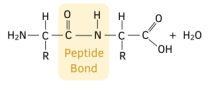
What happens during hydrolysis of a protein? (3)
Addition of water
Breaks the peptide bonds
Resulting in polypeptides being broken down into amino acids
Which levels of protein structure relate to a single polypeptide chain?
The primary, secondary and tertiary stages
Describe the primary structure of all proteins and what is the name given to this structure?
It is a sequence of amino acids linked together by peptide bonds through condensation reactions
(always mention these when asked about primary structure in any form)
A polypeptide.
How is the primary structure of a protein determined?
It is determined by DNA.
By instructing the cell to add certain amino acids in specific quantities in a certain sequence, during translation.
This affects the shape and, therefore, the function of the protein
Describe the secondary structure of a protein
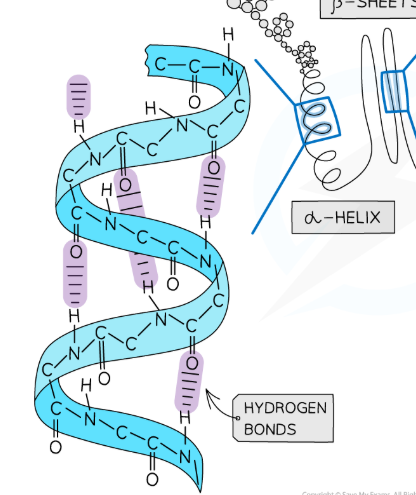
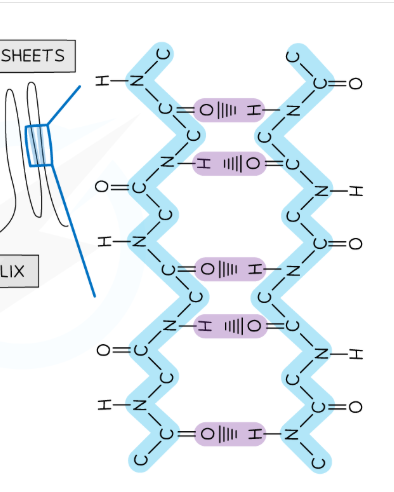
The local coiling or folding of the polypeptide chain occurring as a result of the hydrogen bonding between amino acids in the peptide backbone which does not involve r groups
What bonding is the secondary structure of a protein held by, which groups form this bond and what are the charges?
Hydrogen bonding.
This hydrogen bond forms between the H in the -NH- region and the oxygen in the -C=O region of another amino acid
The hydrogen in the -NH- region has a partially positive charge while the oxygen in the -C=O- group has a partially negative charge
Which 2 factors can easily break this secondary structure and why?
High Temperature and high pH
This is because of the hydrogen bonds which hold the secondary structure together which are easily broken by high heat and pH changes
Which 2 types of shape can be formed due to these hydrogen bonds?
α-helix
β-pleated sheet
When does the alpha helix shape occur?
The α-helix shape occurs when the hydrogen bonds form between every fourth peptide bond.
When does the beta sheet shape occur?
The β-pleated sheet shape forms when the protein folds so that two parts of the polypeptide chain are parallel to each other
This enables hydrogen bonds to form between the folded layers
For which type of proteins is the secondary structure the highest folding level for?
Fibrous proteins
What is the tertiary structure of a protein?
Unique 3D structure where bonds which form between the side chains (r-group) of the protein due to the twisting and folding of the secondary structure.
What are the 4 types of additional bonds which can form in the tertiary structure of proteins?
Hydrogen bonds
Disulfide bridges
Ionic bonds
Hydrophobic interactions
List the the additional bonds in order of strongest to weakest
Disulfide bonds
Ionic Bonds
Hydrogen bonds
Hydrophobic interactions
Features of disulfide bonds (3)
Forms between 2 cysteine R groups and helps to stabilise proteins
Broken by reduction
Common in proteins secreted from cells (eg insulin)
Features of ionic bonds (3)
Forms between positively charged amine group and negatively charged COO- groups
Stronger than hydrogen bonds but not common
Broken by pH changes
Features of hydrogen bonding(2)
Forms between strongly polar r groups
Weakest bonds that form
Define quaternary structure of a protein
When there is more than 1 polypeptide chain working together as a functional macromolecule
List 6 functions of protein (THEACS)
Enzymes: biological catalysts to speed up metabolic reactions
Transport proteins (eg. Channel and carrier proteins/haemoglobin)
Structural proteins: provide support (collagen in connective tissue, keratin in hair and nails)
Hormones: Regulate processes (eg insulin)
Antibodies: Part of the immune response
Contractile proteins: Enable movement (actin and myosin in muscle)
Biochemical test for protein
Biuret reagent
Colour change for biochemical test for protein
Blue to purple
What must be present for the biochemical test to work?
There must be at least 2 peptide bonds present
There will be a negative result if there is only amino acids or dipeptides
What are prosthetic groups?
Non-protein structure that is permanently integrated into an enzyme or protein's structure
What is an example of a prosthetic group?
Heme
What are conjugated proteins?
A complex protein consisting of a simple amino acid shell bound to a non-protein chemical component.
What are examples of conjugate proteins? (3)
Glycoproteins
Lipoproteins
Haemoglobin
What is a globular protein?
A protein that folds into a compact, roughly spherical 3D shape, which is soluble in water
What are features of a globular protein? (3)
Compact and spherical (describes the 3D tertiary structure).
Hydrophilic R-groups on the outside (to form hydrogen bonds with water).
Globular proteins carry out functional or metabolic roles due to highly specific shapes
Examples of globular proteins
Haemoglobin
Enzymes
Antibodies
What are fibrous proteins?
Proteins which are in long, parallel strands and insoluble in water
What are features of a fibrous protein? (3)
No tertiary folding
Insoluble in Water: Because hydrophobic R-groups face outwards, they are completely insoluble.
Structural Role: They provide mechanical strength, elasticity, and protection to structural tissues.
Examples of fibrous proteins and where they are found(3)
Collagen: Found in tendons, bones, cartilage, and walls of blood vessels.
Keratin: Found in hair, nails, and the outer layer of skin.
Elastin: Found in elastic connective tissue (like the lungs, large arteries like the aorta, and skin