BSC1010 Final (CH. 1-5)
 Call Kai
 Learn
 Practice Test
 Spaced Repetition
 Match
 Flashcards
 Knowt Play
1/134

There's no tags or description
Looks like no tags are added yet.
135 Terms
what are the 7 characteristics of life
order
energy processing
growth & development
evolutionary adaptation
response to the environment
regulation
reproduction
5 unifying themes of biology
organization
information
energy & matter
interactions
evolution
3 things that help organize biology
emergent properties
reduction properties
system
system
combination of components that work together
levels of life
atom
molecule
organelle
cell
tissue
organ
organism
population
community
ecosystem
biosphere
energy
the capacity to cause change particularly in the context of doing work
2 dynamic processes of ecosystems
cycling of nutrients (recycled = food cycle)
flow of energy (transferred in & out)
DNA
stores genetic information and is responsible for the inheritance of traits through replication and transcription processes
gene
the basic physical and functional unit of hereditary made up of DNA
prokaryotic cells
single celled organisms
bacteria and archaea
smaller
lacks nucleus or membrane bound organelles
eukaryotic cells
multicellular organisms
membrane bound organelles
larger
make up plants and animals
types of regulation
negative and positive feedback
negative feedback
the response reduces the initial stimulus (most common insulin lowering blood sugar)
positive feedback
an end product speeds up its own production (blood clotting)
how do taxonomies work
they organize all living and extinct organisms into a nested hierarchy of groups based on shared characteristics and evolutionary history
how many domains and list the names
3 Bacteria, Archaea, Eukarya
Bacteria
most diverse and widespread prokaryotes and are now classified into multiple kingdoms
Archaea
live in Earth’s extreme environments such as salty lakes and boiling hot springs ex: halophiles
Eukarya
all eukaryotes: plants, animals, fungi, humans
evolution
a process of biological change in which species accumulate differences from their ancestors as they adapt to different environments over time
natural selection must have…
inheritance
individual variation
unequal reproduction
overpopulation
what is science
set of logical and empirical methods which provide for the systematic observation
of empirical phenomena in order to understand them)
inductive reasoning
a logical process that uses related specific observations to arrive at a broad general conclusion
deductive reasoning
a logical process that uses general principles, laws, or theories to predict specific, measurable results
empirical evidence
verifiable information gathered through sensory observation, field research, or laboratory testing
scientific hypothesis
a tentative answer to a question or a proposed explanation for a set of observations
scientific theory
a comprehensive explanation supported by abundant evidence and is general enough to spin off many new testable hypotheses
element
a substance that cannot be broken down to other substances by chemicals
compound
substance consisting of two or more different elements combined in a fixed ratio
identify the four elements that make up 96% of living matter
carbon (C), hydrogen (H), oxygen (O), nitrogen (N)
what is a trace element
required by an organism in only small amounts
examples of trace elements
iron (Fe), iodine (I), and fluoride (F)
structure of an atom (subatomic particles)
protons & neutrons form the nucleus and electrons sit on the outside in the shells of cloud
how many elements are in the human body
around 60 with 11 of those making up majority of the mass
atomic number
the total number of protons found in the nucleus
mass number
the total number of protons and neutrons in the nucleus of an atom
atomic weight
weighted average that accounts for the different isotopes of an element
elements are identified by what 3 things
atomic number
chemical symbol
name
how are elements arranged on the periodic table
in order of increasing atomic number (# of protons) running from left to right and top to bottom
electronegativity increases from bottom to top and left to right
function of protons
(+) determine the element
function of neutrons
(neutral) determines isotope
function of electrons
(-) determine chemical behavior
what differentiates carbon 12,13, and 14
the number of neutrons
isotope
elements whose atoms vary in neutron number and mass number (# of protons does NOT change)
stable isotopes
have nuclei that do not undergo radioactive decay or emit radiation over time (carbon-12 & carbon-13)
unstable (radioactive) isotopes
have an imbalance of protons and neutrons that causes the nucleus to decay spontaneously and releases radiation (carbon-14)
ion
an atom or molecule that carries a positive or negative electrical charge because it gained or lost electrons
ionic bond
an atom transfers electrons to another creating oppositely charged ions that attract each other
covalent bond
atoms share pairs of electrons
nonpolar covalent bond
electrons are shared equally between atoms with similar or identical electronegativity creating no partial charges across the bond (H2, Cl2, CH4)
polar covalent bond
electrons are shared unequally because one atom has a higher electronegativity giving one end a partial negative and the other a partial positive charge (H2O, HF, HCl)
van der waals bond
a weak short-range electrostatic attraction between nearby atoms or molecules caused by temporary or permanent shifts in electron density
valence electrons
the electrons located in the outermost shell of an atom
where do the properties of water arise from?
attractions between oppositely charged atoms of different water molecules (hydrogen bonds)
cohesion
the natural attraction that water molecules have for each other
adhesion
the attraction between water molecules and molecules of different substances causing water to stick to other surfaces
surface tension
a measure of how difficult it is to stretch or break the surface of a liquid
evaporative cooling
the process where liquid water turns into gas on a surface absorbing the heat and lowering its temperature
when water absorbs heat which bond is broken first and why?
hydrogen bonds because they’re weaker and require less energy to break
heat
the total amount of kinetic energy due to molecular motion in a body of matter
temperature
a measure of intensity reflecting the average kinetic energy of molecules in a body of matter
solvent
dissolving agent of a solution
solute
substance that is dissolved
aqueous solution
water is the solvent
solution
a homogeneous liquid mixture of two or more substances
what are substances called when they can dissolve in water
hydrophilic
amphipathic molecules
chemical compounds that contain both polar (hydrophilic) and nonpolar (hydrophobic) regions within the same structure
how do you calculate concentration (morality)
moles of solution divided by liters of solution
what do we call substances that can release their H+ into the surrounding solution
acids
acid
a substance that increases the hydrogen ion concentration of a solution
base
substance that reduces the hydrogen ion concentration of a solution
how do you know how many hydrogen ions is in a solution
pH
concentration to be classified as an acid
H+ concentration is greater than its hydroxide ion (OH-) concentration
buffer
a substance that minimizes changes in the concentrations of H+ and OH- in a solution
function of buffers
allows biological fluids to maintain a relatively constant pH despite the addition of acids or bases
what is meaning of valance
electrons in outer most shell
how many more electrons are needed to complete the outer most shell
why is carbon versatile
processed into sugars throughout photosynthesis
ultimately derived from carbon dioxide
incorporated into organic molecules by plants
what are the behaviors and characteristics of hydrocarbons
only made up of hydrogen and carbon atoms
nonpolar covalent
hydrophobic
major component of petroleum
release large amounts of energy
examples of a hydrocarbons
methane, propane, butane
why are hydrocarbons hydrophobic
great majority of their bonds are nonpolar carbon-to-hydrogen linkages
definition of isomer
compounds that have the same numbers of atoms of the same elements but different structures and hence different properties
structural isomer
differ in the covalent arrangements of their atoms (butane)

geometric isomer
carbons have covalent bonds to the same atoms, but these atoms differ in their spatial arrangements due to the inflexibility of double bonds (2-butene)

cis isomer
the arrangement with both Xs on the same side of the double bond (cis-but-2-ene)
trans isomer
the arrangement with the Xs on opposite sides (trans-but-2-ene)
enantiomers
are mirror images of each other and that differ in shape due to the presence of an asymmetric carbon (ibuprofen)

what type of isomer is glucose and fructose
structural isomers
functional group
attachments that replace one or more hydrogen atoms to the carbon skeletons of the hydrocarbon
types of functional groups
hydroxyl group
carbonyl group
carboxyl group
amino group
sulfhydryl group
phosphate group
methyl group
hydroxyl group
a hydrogen atom forms a polar covalent bond with an oxygen which forms a polar covalent bond to the carbon skeleton (alcohols)
example of hydroxyl group
ethanol

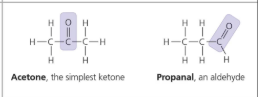
carbonyl group
consists of an oxygen atom joined to the carbon skeleton by a double bond (within=ketone end=aldehyde)
polar (dissolve in water)
examples of carbonyl group
acetone and propanal
carboxyl group
consists of a carbon atom with a double bond with an oxygen atom and a single bond to a hydroxyl group (carboxylic acids)
example of carboxyl group
acetic acid (gives vinegar its sour taste)

amino group
consists of a nitrogen atom attached to two hydrogen atoms and the carbon skeleton; acts a base (amines)
example of amino group
glycine (an amino acid)

sulfhydryl group
consists of a sulfur atom bonded to a hydrogen atom and to the backbone (thiols)
example of sulfhydryl group
cysteine and ethanethiol

phosphate group
consists of phosphorus bound to four oxygen atoms (three with single bonds and one with a double bond) (organic phosphate) gives energy