2.18 Light Reactions
 Note
Note Call Kai
 Learn
Learn Practice Test
 Spaced Repetition
 Match
Match Flashcards
 Knowt Play
1/4

Earn XP
Description and Tags
Name | Mastery | Learn | Test | Matching | Spaced | Call with Kai | Chat |
|---|
No analytics yet
Send a link to your students to track their progress
5 Terms
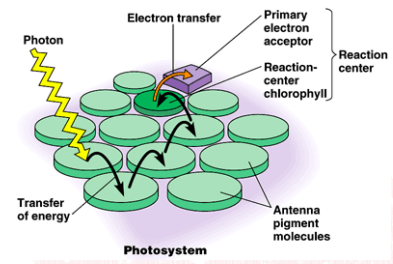
What is a photosystem?
Collection of photosynthetic pigments linked together to funnel light energy
What are the 3 steps light reactions occur?
Pigments embedded in thylakoid membrane absorb energy from light and release high energy electrons (ionized). Antenna pigments transfer electrons to reaction center. Electrons passed to acceptor molecule in ETC
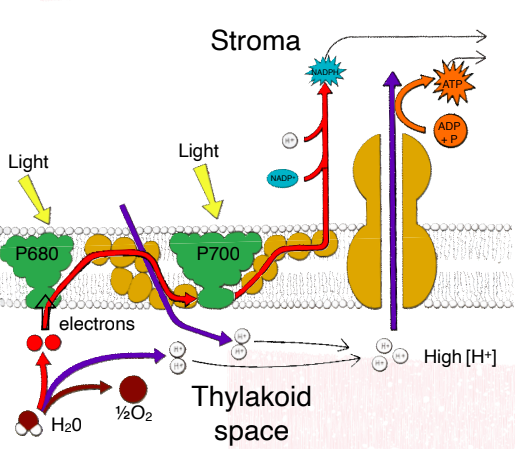
Movement of electrons and H+ ions leads to production of NADPH and ATP via chemiosmosis
Electrons released by pigments are replaced by splitting of H2O (photolysis) producing O2
Specify Step 1
Light energy of a certain wavelength (680nm) excites chlorophyll a in photosystem II causing release of electrons.
Excited electrons are transferred to carrier molecules within the thylakoid membrane
Electrons released by photosystem II are transferred through series of proteins in thylakoid membrane (ETC) to photosystem I
As electrons move they loose energy and H+ ions move from stroma to thylakoid space
H+ gradient creates proton motive force
Chemiosmosis through ATP Synthase creates ATP via phosphorylation
Light energy (700nm) excites chlorophyll a in photosystem I causing electrons to move into second series of membrane proteins
Specify Step 2
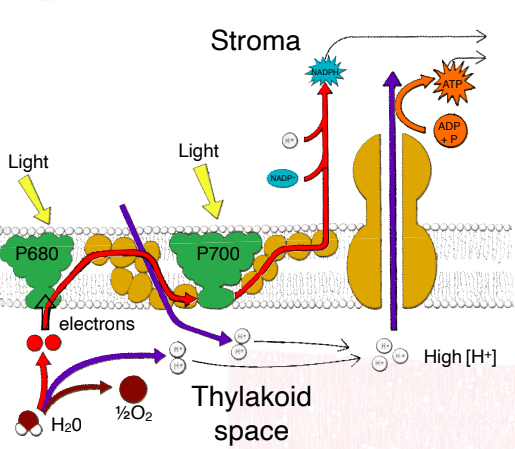
NADP+ is final electron acceptor. It is reduced to NADPH.
Specify Step 3
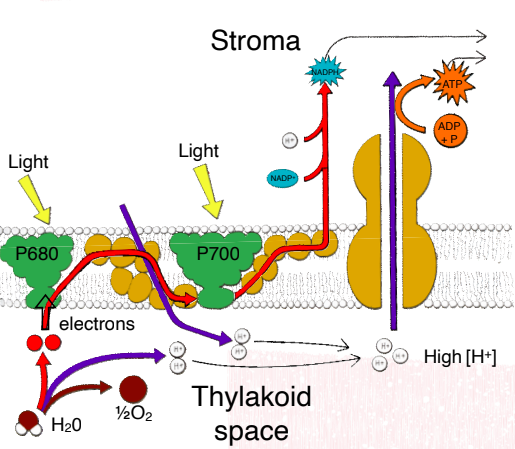
Photolysis (splitting of water by light) provides electrons to replace ones lost by P680, oxygen gas, and H+ ions