Advanced Organometallic and Coordination Chemistry
 Call Kai
 Learn
Learn Practice Test
 Spaced Repetition
 Match
Match Flashcards
 Knowt Play
1/16

There's no tags or description
Looks like no tags are added yet.
Name | Mastery | Learn | Test | Matching | Spaced | Call with Kai | Chat |
|---|
No analytics yet
Send a link to your students to track their progress
17 Terms
What is the UV-vis reigons?
10 000 - 50 000 cm-1
→ Reigon where electronic excitations usually occur
Why is UV-vis wavelength reigon the reigon where electronic excitations occur?
Ligand spectra
Counter-ion spectra
Charge-transfer spectra
Ligand-field spectra → (d-d transitions)
What are the selection rules?
Δ S = 0
Δ L = ± 1
Laporte rule - In a centrosymmetric system, transitions are forbidden ( g → g or u → u)
→ e.g = s → p and p → d aren’t allowed
Why is it complicated to use electronic spectra to determine the number of transitions for more than one electrons?
Ignores the effect that other electrons have
What do you use Russell-Saunders coupling for?
Derive terms arising from dn configurations → Ground state term (and maybe first excited state term)
How do you work out Russell-Saunders coupling to work out ground state terms?
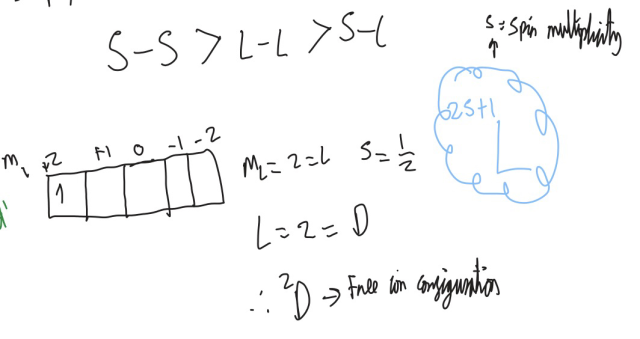
How do you draw out orgel diagrams to determine the number of transitions (use d1 as an example)

What is hole formalism?
Figuration with one hole = Opposite to configuration with one electron
→ Or d1 is the opposite to d9
dn = dn+5

How and why does energy level diagram for a d2,d3,d7,d8? configuration lead to a semiquantitative Tanabe Sugano diagram?
Energy now depends on:
Crystal field splitting parameter (Δ)
Separation between 3F and 3P (and how they can vary with Δ
Magnitude of interaction between 3T1g(F) and 3T1g(P)
What are the energies of the 4 levels for d2,d3,d7,d8? (DONT NEED TO REMEMBER)

What are Racah Parameters?
In the free ion, they are parameters that describes electron-electron repulsion
How do you work out the energy gaps between states for d electrons?
Use sums of multiples of B and C parameters
How do you work out the energy gap between states of the same multiplicity?
Only use multiple of B
What is the Nephelauxetic effect?
Greater the reduction in the Racah B parameter, the greater the covalency in the M-L bond
How do you calculate the Nephelauxetic ratio?

What is the order of the Nephelauxetic series?

Very different to the spectrochemical series
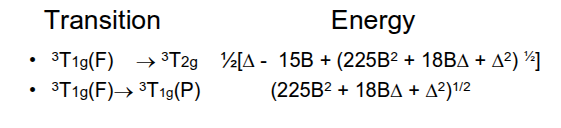
How do you calculate the Racah B parameter and crystal field splitting parameter (Δ) starting from transition energy formulas using d2 and d7 as an example?
