BENG 186A Lecture 2: Mechanical Properties
 Call Kai
 Learn
 Practice Test
 Spaced Repetition
 Match
 Flashcards
 Knowt Play
1/47

There's no tags or description
Looks like no tags are added yet.
48 Terms
What are the mechanical properties of materials?
Tensile/compressive
Torsion/shear
Strength
Hardness
Resilience/toughness
What is the formula for stress?
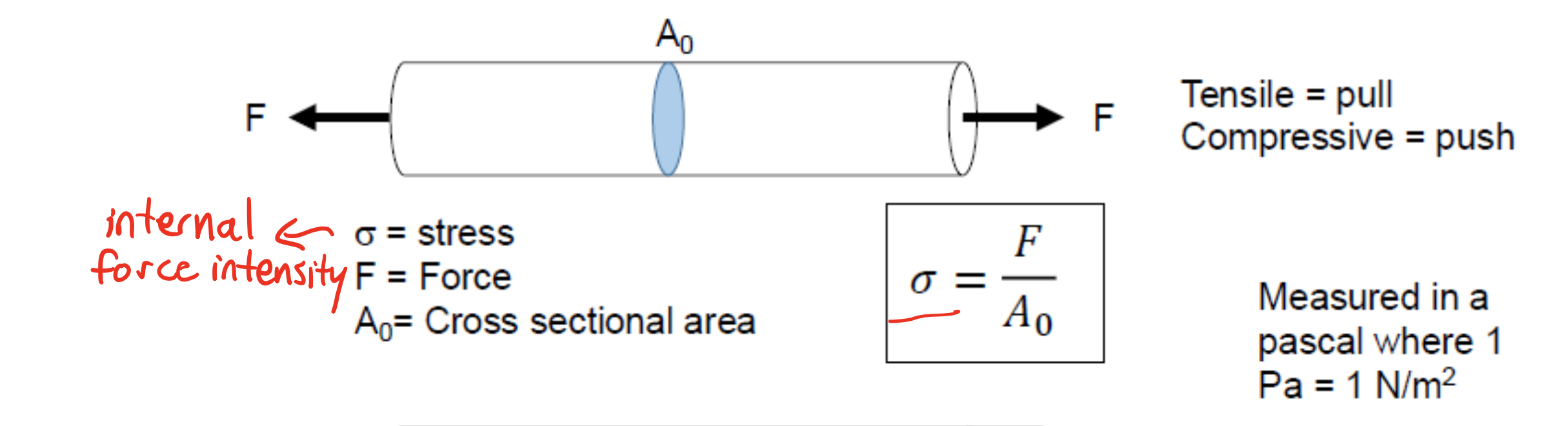
What is the formula for strain?

What is the difference in direction of force for tensile or normal stress, and shear stress?
Tensile is when force is perpendicular and shear stress is when force is parallel.
What is the formula for shear stress?
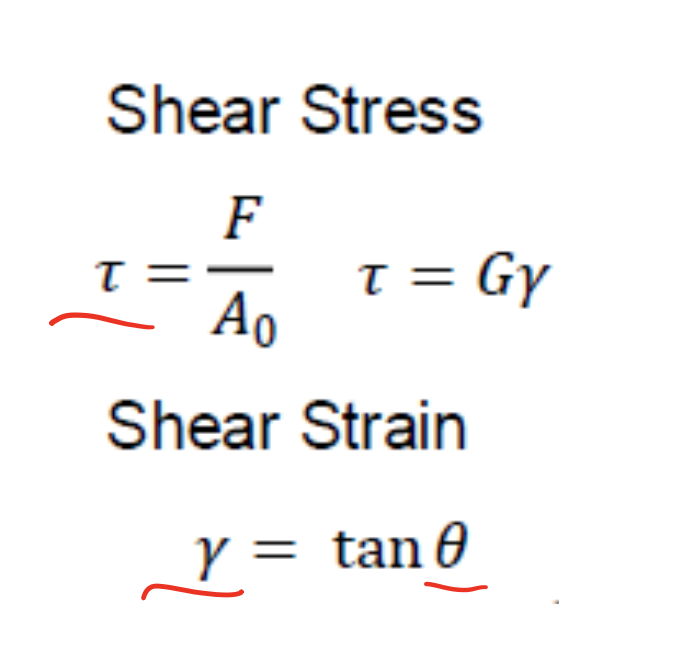
How to convert between nominal strain and true strain?

When would you expect the nominal strain to be very different than the true strain?
When the material undergoes large deformations.
What are the equations for Young’s modulus, Shear modulus, and Bulk Modulus?

What is the equation for Poissons ratio?

What is the difference between positive and negative Poisson’s ratio?
Most materials have a positive Poisson ratio and contract perpendicular to stress, while materials with a negative Poisson ratio stretch perpendicular to stress.
How does directionality of a material change its properties of deformation?
Anisotropic materials vary with orientation while isotropic materials deform the same way in all directions.
What is a property of the constants for isotropic materials?

What are the properties of elastic deformation?
Elasticity or Young’s Modulus E is resistance by interatomic forces
Stronger bonds are less easily deformed, and have a higher Young’s modulus
E is typically larger for ceramics and metals compared to polymers
Ceramics and metals are typically isotropic
Many polymers are anisotropic
What is the “yield strength” point of a stress strain curve?
The point at which the response is no longer linear
What is plastic deformation?
Plastic deformation is irreversible deformation, rearrangement of atoms and molecules. It commonly occurs in metals and polymers and only rarely in ceramics.
Plastic deformation is permanent
It is a non-linear response of stress-strain
Sample never returns to original shape
What does a stress- strain curve graph look like?

What is plastic deformation in metals?
Deformation is due to dislocation motion along a slip plane
Single crystal: when enough stress is applied in an orientation that coincides with a slip plane (high atomic density)
Most metals are polycrystalline with many grains
Deformation of individual grains rather than alterations or opening of grain boundaries
Deformation occurs when a high enough stress is applied to deform the less favorably arranged grains
Polycrystalline materials usually stronger due to constraints by neighboring grains
What is plastic deformation in polymers?
A neck forms after passing yield strength, where polymer chains become oriented with the direction of the load
Increased strain with increased growth in neck
Before fracture, increase in stress required
What is hardness?
Hardness is a measure of how much a material is resistant to plastic deformation
It is characterized by both yield strength and ultimate tensile strength
Hardness measurements are frequently used to estimate strength because it is a cheap and simple test
How to measure hardness?
Apply a known load to a small indenter, either a pyramid or sphere shape, to a surface for a known time and the size of the impression indicates the hardness
Can create calibration curves to convert hardness to yield strength and ultimate tensile strength
What is resilience?
Resilience is elastic energy that can be stored in the material, springiness
What is toughness?
Toughness is energy required to break a material. Toughness is total amount of energy a material can absorb before fracture
What is strength?
Strength is the maximum amount of stress a material can withstand to stay in the elastic region
What is stiffness?
Stiffness is described by Young’s modulus, stress/strain
What is failure?
Point where there is plastic deformation, certain amount of plastic deformation, or material fractures
What are the three main modes of failure?
Fracture, fatigue, and creep
What is ductile fracture?
Ductile fracture is when material undergoes plastic deformation before breaking
Crack propagation occurs fairly slowly
No further elongation unless stress is applied
Occurs in metals and some ductile polymers
What is brittle fracture?
Little evidence of plastic deformation
Proceeds quickly
Can lead to catastrophic failure
More common in ceramics and certain types of polymers
What is ductility?
Amount of plastic strain required to break the material
Low ductility materials, or brittle materials, fracture with very little plastic deformation
What is the stability level of cracks for brittle materials and ductile materials?
Cracks are unstable in brittle materials and can propagate without increase in stress
Cracks in ductile materials are stable and can resist crack propagation with applied stress
What mode of fracture is preferred, ductile or brittle?
Ductile, as there is warning
What is fatigue?
Mechanical materials that are used in the body will have some sort of lifetime and therefore will be under repeated loading
Failure that occurs in structures with cyclic stresses
Failure can occur at stress levels much lower than the tensile or yield strength
Responsible for 90% metallic failures, but can also occur in polymers and ceramics
Dangerous as it can occur suddenly, caused by crack propagation
What is fatigue failure?
Crack initiation, crack propagation, and then final failure
How is fatigue graphically represented?
S-N curve, maximum stress v. Log number of cycles N
Fatigue life is estimated as the number of cycles for crack initiation plus the number of cycles for propagation to the critical size that leads to failure
Fatigue failure is a stochastic process
A high cycle fatigue life is considered as greater than 10^4 cycles
What are some designs to avoid fatigue?
Avoid notches and sharp discontinuities and treat surfaces to have added hardness since fatigue propagates as cracks
How does the environment affect fatigue?
Thermal fatigue and corrosion fatigue
What is creep?
Time dependent plastic deformation that occurs when sample is under constant load for along period of time. A certain amount of plastic deformation can occur and will not return to 0
What are some characteristics of creep? What materials does it occur in? What temperatures does it occur at? How is it tested?
Can occur in all materials
Usually only a concern for > 0.4Tm for metals, and even higher for ceramics
Can occur around room temperature with polymers
Tested by exerting a constant load at a fixed temperature and measuring strains as a function of time
Creep in polymers: What temperature does it occur at? What does it depend on?
Can occur at low temperature and stress
For biomaterials, need to know if it demonstrates creep at body temperature
Depends on the movement of polymer chains in the amorphous regions via viscous flow
Increased crystallinity usually means less creep
Creep increases with temperature above the glass transition temperature
What is stress relaxation?
Decrease in stress over time with constant strain
Often found in polymeric materials
Related to reordering of molecular bonds, also related to sample crystallinity and temperature
Measured by loading a material with enough stress to create a small strain, and then monitoring the stress to maintain constant strain over time
How does temperature influence elastic modulus?
As temperature decreases, elastic modulus increases and material becomes more brittle
What is an application where you may want an anisotropic material? Why?
Tissue engineering, cardiac patches, and bone implants. Useful when the goal is to replicate directional structure and function of native tissues, improve mechanical properties and mimic natural cell behavior.
The cup of a hip implant can be lined with plastic, ceramic, or metal. Which
material has the largest Young’s modulus?
Ceramic
What mode of fracture is preferable – ductile or brittle fracture? Why?
Most biomaterial applications – ductile fracture generally preferred over brittle
fracture. Ductile fracture provides warning before failure undergoing significant plastic
deformation and absorb more energy prior to fracture, safer for implants to avoid
catastrophic failure
For increasing strain rates, would the curve shift 1 to 3 or 3 to 1?
3 to 1 – Curve 3 represents a material deformed at a low strain rate meaning lower
stiffness. Curve 1 represents a high strain rate with a steeper initial slope
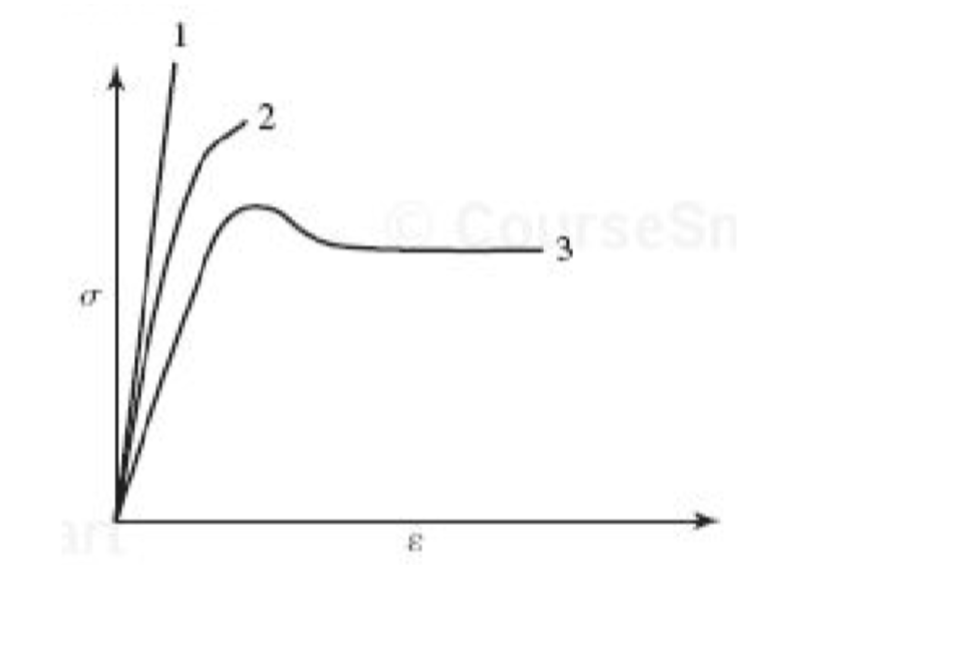
How would the curve shift if the temperature was lowered?
The curve shifts in the same direction as increasing strain rate to Curve 1. As temperature decreases elastic modulus increases (steeper initial slope),
ductility decreases (lower strain before failure), and the material becomes
more brittle
Which sample would likely undergo the most creep?
3 – would likely exhibit the most creep behavior. Undergoes the largest strain and has a long plastic deformation region –behaving like a ductile or polymer material which is material type most prone to
creep under a sustained load
Which sample is an example of brittle fracture?
Sample 1 – fractures after very little strain, steep nearly linear stress-strain curve
and fails suddenly, almost no plastic deformation before breaking