Chapter 10 - Nucleus
 Call Kai
 Learn
Learn Practice Test
 Spaced Repetition
 Match
Match Flashcards
 Knowt Play
1/78

There's no tags or description
Looks like no tags are added yet.
Name | Mastery | Learn | Test | Matching | Spaced | Call with Kai | Chat |
|---|
No analytics yet
Send a link to your students to track their progress
79 Terms
nuclear envelope function
separates the nucleus from the cytoplasm and controls protein and RNS traffic
how does the nuclear envelope control traffic
nuclear pore complexes
what are the components of the nuclear membrane
inner and outer membrane
what is the nuclear lamina made of
type 5 intermediate filaments
perinuclear space
fluid filled gap in between the inner and outer membranes; directly connected to the lumen of the ER
outer membrane
continuous with the endoplasmic reticulum (ER)
inner membrane
has integral proteins that bind to the nuclear lamina
what are the nuclear membranes made up of
phospholipid bilayer
what kind of molecules can passively go through nuclear membrane
nonpolar molecules
what molecules have to go through the nuclear pore complex
small polar molecules, ions, and macromolecules
how do lamins interacts with each other
lamins form a dimer through coiled-coil interactions between their α-helical region
how is the nuclear lamina formed
lamin dimers associate with each other to form higher order structures.
what is LINC
LInker of Nucleoskeleton and Cytoskeleton
where do lamins bind
inner membrane
what makes up the LINC comlpex
KASH and SUN
what are KASH and SUN
transmembrane proteins
two ways molecules move through NPCs
passive and selective transport
how many subunits do NPCs have
8
what is needed for selective transport
larger molecules such as proteins and RNAs, requires transport proteins and energy GTP
what is located in the NPCs to help move things through
FG repeats, glycine and phenylalanine
what must proteins have in order to enter the nucleus
nuclear localization signals
what recognizes nuclear localization signals
nuclear transport receptors
what are nuclear localization signals (NLS) rich in
K and R (lysine and arginine)
what two types of NLS are there
t antigen nls and bipartite nls
what is a bipartite nls
nls made of two amino acid sequences separated by another amino acid sequence

what is a t antigen NLS
an NLS that is one continuous stretch of amino acids
exportins and importins are part of what family
karyopherins
exportins
direct protein transport to the cytoplasm
nuclear export signals (NES)
an amino acid sequence that targets proteins for transport from the nucleus to the cytosol
importins
specialized transport proteins that carry specific molecules from the cytosol into the nucleus
know the import/export pathway

know exportin/cargo pathway
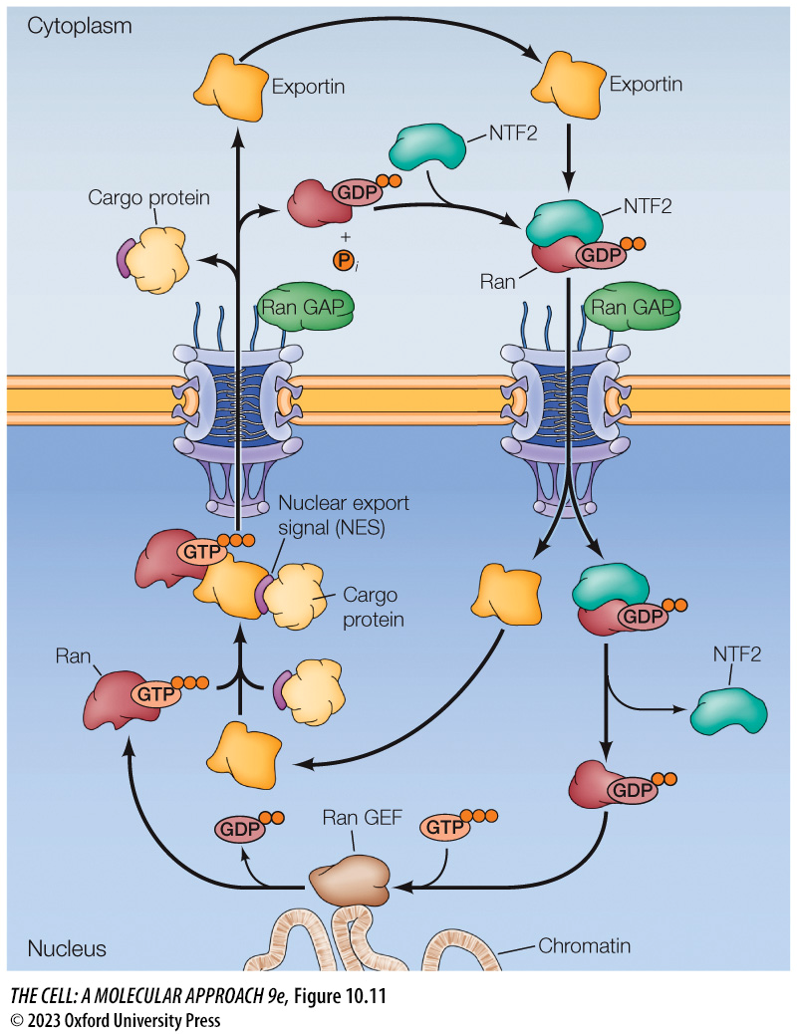
what does the karyopherin system transport
tRNA, rRNA, miRNA
how does mRNA get exported from the nucleus
uses an exporter complex to be brought through the NPC and once in the cytoplasm, helicase interacts with the export complex and removes it
what does the helicase ensure happens during mRNA transport
that helicase is removed, making transport unidirectional (makes sure the mRNA doesn't just go back through the NPC)
what does snRNA stand for
small nuclear RNA
what does snoRNA stand for
small nucleolar RNA
function of snRNAs
removes introns by splicing activity
what exports snRNA out of the nucleus
Crm1 is an exportin and complexes with snRNA
how is snRNP transported into the nucleus
snRNAs are exported by Crm1, once in the cytoplasm they disassociate. Crm1 binds to proteins in the cytoplasm to form snRNPs. snRNPs are imported by snurportin (importin) to the nucleus

what happens during mitosis
chromatin is highly condensed
what happens during interphase
chromatin decondenses and distributes
what happens during interphase
chromosomes occupy distinct regions, clustering
chromosome territory
each chromosome occupies a discrete region of the nucleus
when was chromosome territory official
1984 in drosophila salivary glands
what is fluorescence in situ hybridization (FISH)
a method for detection of rna or dna molecules within cells by hybridization with fluorescent probes
what is chromosome confirmation capture (3C)
a method where adjacent regions of chromosomes are identified by cross-linking
in what mitosis phase will there be euchromatin
interphase
in what mitosis phase will there be heterochromatin
interphase
characteristics of euchromatin
the chromosomes that are being expressed and transcribed, decondensed, dispersed throughout nucleus
characteristics of heterochromatin
highly condensed, not expressed/transcribed, located on the periphery of nucleolus clustered
what are LADs
lamina associated domains that associate with the nuclear lamina
what are NADs
nucleolus associated domain associated with the nucleolus
replication factories
a large complex containing clustered sites of DNA replication in eukaryotic cells
transcription hubs
a clustered site in the nucleus where transcription of multiple genes occurs
nuclear bodies
distinct, membraneless structures inside the nucleus made of rna and protein interactions
membrane-less regions of the nucleus where specific proteins and RNAs are concentrated to carry out particular functions
examples of nuclear bodies
nucleolus, cajal body, speckle, polycomb body
function of nucleolus
rRNA synthesis and ribosome production
what transcribes the 5.8, 18, and 28 subunits
rna polymerase l INSIDE the nucleolus
How are the major rRNAs (18S, 5.8S, and 28S) produced?
RNA Pol I transcribes them as one 45S pre-rRNA in the nucleolus, which is then processed into the three rRNAs
the 45S pre-rRNA is chopped into what three pieces
18, 5.8, and 28 subunits
how is 5S rRNA different
5S rRNA is transcribed separately by RNA Pol III outside the nucleolus
three regions of the nucleoli
fibrillar center
dense fibrillar component
granular component
what do the nucleoli regions represent
represents progressive stages of rRNA transcription, processing, and ribosome assembly
What chemical modifications occur during pre-rRNA processing?
methyl groups are added to bases and ribose residues
urine is converted to pseudourine
What is the role of snoRNAs in the nucleolus?
snoRNPs complex proteins, which then helps process and modify pre-rRNA into mature rRNAs.
What are snoRNPs?
snoRNA complexed with a protein
what is the function of snoRNAs
help with pre-rRNA processing and modification (processing of 45S pre-rRNA)
How do snoRNAs direct modifications of pre-rRNA?
snoRNAs base-pair with complementary rRNA sequences, guiding enzymes to specific sites for methylation or pseudouridine formation
How are ribosomal subunits assembled?
ribosomal proteins and rRNAs assemble in the nucleolus into pre-ribosomal particles, which are exported to the cytoplasm and mature into 40S and 60S subunits.
polycomb bodies
a complex of repressor proteins that methylate histone H3 lysine 27
what do polycomb proteins do
repress transcription by promoting methylation of lysine 27 on histone H3
what is used to visualized polycomb bodies
immunofluorescence
polycomb bodies
nuclear domains where polycomb proteins are concentrated
cajal bodies
a nuclear body involved in assembly of snRNPs and other RNA protein complexes
what is scaRNA
small Cajal body specific RNAs
function of scaRNA
guides ribose methylation and pseudo uridylation of snRNAs (like snoRNAs do)
what is another role of cajal bodies
used to make telomeres, which help lengthen and protect
speckle
a nuclear body that contains components of the mRNA splicing machinery