W5: Depression
 Call Kai
 Learn
 Practice Test
 Spaced Repetition
 Match
 Flashcards
 Knowt Play
1/25

There's no tags or description
Looks like no tags are added yet.
26 Terms
What is the criteria for Major Depressive Disorder (MDD)
Five or more of the following symptoms within a two-week period, representing a change from previous functioning, and at least one of the symptoms must be either:
1. Depressed mood most of the day, nearly every day
Markedly decreased interest or pleasure in all, or almost all activities

Which two groups of people is depression prevalence higher in?
Women
First-degree biological relatives (more likely if you have parents, siblings who have depression)
What is early onset of MDD associated with?
Greater frequency of depressive episodes
What is a strong predictor of initial depressive episodes, but not so much for subsequent episodes?
Major life events e.g. divorce, loss of loved ones
What does incomplete inter-episodic recovery increase the likelihood of?
Subsequent episodes
What is the criteria for Persistent Depressive Disorder (Dysthymia)?
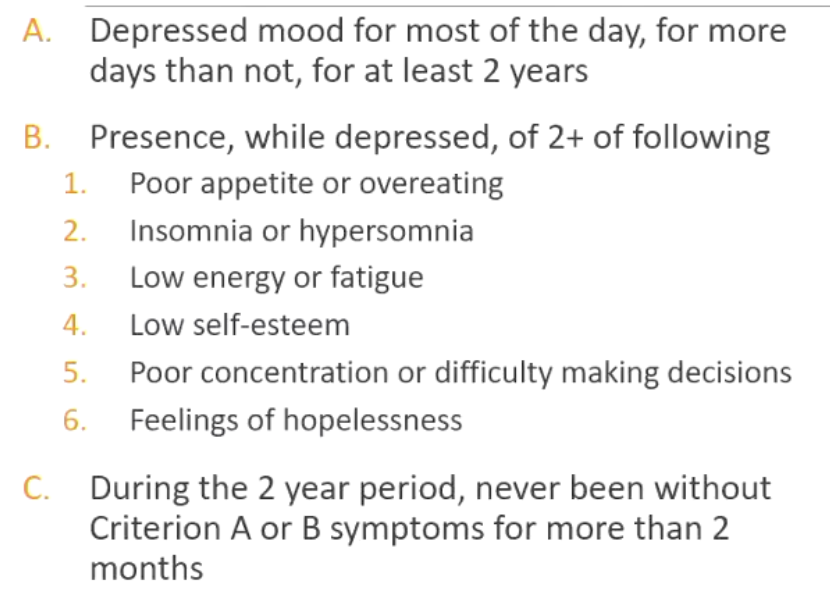
What are 2 differences between MDD and PDD
MDD | PDD |
More severe | Less severe |
More prone to relapse and remission over time | Stable over time |
What is it called when a patient has both MDD and PDD?
Double depression (due to incomplete recovery of MDE)
What does the early onset of PDD increase the likelihood of?
Comorbid personality disorders and substance use disorders
What are the 3 groups of causes of depression?
Biological factors (familial and genetic factors)
Psychological factors
What do family studies show about how patients with mood disorder affect their relatives?
Relatives show lower age of onset and more likely to have recurrent depressive episodes
How do twin studies support the genetic factor in MDD?
Given that one twin has MDD, there is a higher % of an identical twin developing MDD as well compared to a fraternal twin
What is one genetic explanation as to why women are more vulnerable than men?
Heritability estimates are higher in women than men
What is one psychological concept to explain why people develop depression?
Learned helplessness
What does that mean?
When humans learn they have no control over reinforcements in life, they develop depression
According to the attribution helplessness theory, what do depressed individuals attribute lack of control to?
Internal, global and stable causes
What does the response style theory of depression claim?
How a person responds to a negative or depressed mood (rumination) determines how long, how severely, and how often that depression continues
According to Beck, what are the 3 types of thoughts implicated in depression
Negative schemas (from childhood events)
Negative beliefs
Negative automatic thoughts
What are 4 cognitive errors common among depressed individuals?
Overgeneralisation
All-or-nothing thinking
Filtering
Emotional reasoning

Pharmacology intervention: What is the main antidepressant medication?
SSRIs (selective serotonin reuptake inhibitors)
What are the 4 major types of psychological treatments for depression?
CBT
Interpersonal psychotherapy
Behavioural activation
Problem-solving therapy
What are the treatment guidelines based on the severity of depression?
Mild to moderate: evidence-based psychotherapy
Moderate to severe: combined pharmacotherapy & psychotherapy
Chronic: combined
What is the rationale behind Behavioural Activation?
Life events → less positive reinforcements and more punishment → secondary problems (avoidance, escape, rumination) → lethargy → depression
What does treatment focus on?
Increasing activity (pleasure & mastery, scheduling, problem-solving)
What is the goal of cognitive therapy?
Reduce distress by helping patients think in a way that is more realistic and helpful
What model is used in cognitive therapy and what does it show?
The ABC model
Show the role of thoughts (B) in the relationship between events (A) and emotions (C)
