Chem 17 Midterm 1
 Call Kai
 Learn
Learn Practice Test
 Spaced Repetition
 Match
Match Flashcards
 Knowt Play
1/84

There's no tags or description
Looks like no tags are added yet.
Name | Mastery | Learn | Test | Matching | Spaced | Call with Kai | Chat |
|---|
No analytics yet
Send a link to your students to track their progress
85 Terms

Remember H in top left
Then remember the four below it (LiBe, NaMg: sound it out)
Then, first row is BCNOF
Then, second row is AlSiPSCl
Below that is Br, I
Remember the table for electronegativities.
the tendency of an atom or functional group to attract electrons towards itself
Electronegativity
the electrons in the orbitals are held more tightly
its atomic orbitals become more stable (lower in energy)
What happens as electronegativity increases?
resulting purely from electrostatic interactions between a cation (positively charged) and an anion (negatively charged)
ve- localized entirely around anion
ΔEN > 2.0
btwn metals + nonmetals
Ionic bonds
resulting from sharing elecrons between two nuclei
form when ΔEN <= 2.0
nonpolar covalent: form when sharing of electrons is relatively equal (ΔEN < 0.5)
polar covalent: form when sharing of electrons is unequal, such that electron density is distorted towards the more electronegative atom (0.5 <= ΔEN <= 2.0)
Covalent bonds
(#ve- in neutral atom) - (# of dots and lines around atom) = (ve'- in neutral atom) - (unshared e-) - 1/2(shared e-)
Formal charge
each bond is neither a single bond nor a double bond; instead, it has a bond order of 1.5
delocalization of electrons —> stability
do not depict different molecules; instead, depict the electron’s distribution within the SAME molecule
true structure = hybrid of all resonance structures
Resonance structure
same number of bonds btwn the same types of atoms, same number of formal charges on the same types of atoms
Equivalent resonance structure
1) Structures in which all atoms obey the octet rule
2) Minimize charge separation as much as possible (molecules w/ fewer formal charges are more stable)
3) If there are charges present, put negative charge on more electronegative atoms and positive charge on less electronegative atoms
Order of priority for determining relative importance of non-equivalent resonance structures (ie., how much they contribute to the resonance hybrid: major or minor?)
major = contribute more to the resonance hybrid
minor = useful + necessary for explaining chemical reactivity
What are the different usages of major/minor non-equivalent resonance structures?
OK
When arrow pushing to identify resonance structures, try to push no more than two arrows a time!!!
molecules w/ same molecular formula (made up of same atoms) but w/ different connectivity —> ALWAYS different molecules; don’t need to contain the same functional groups
Structural / constitutional isomers
Linear (180 degrees)
VSEPR model for 2 electron domains, 0 lone pairs
trigonal planar (120 degrees)
VSEPR model for 3 electron domains, 0 lone pairs
bent (bond angles w/ lone pairs are more acute than w/ bonds)
VSEPR model for 3 electron domains, 1 lone pair
tetrahedral (109.5 degrees)
VSEPR model for 4 electron domains, 0 lone pairs
trigonal pyramidal (bond angles w/ lone pairs are more acute than w/ bonds)
VSEPR model for 4 electron domains, 1 lone pair
bent (bond angles w/ lone pairs are more acute than w/ bonds)
VSEPR model for 4 electron domains, 2 lone pairs

orbitals with s character are lower in energy bc their electrons stay closer to the nucleus
Draw the relative energies of s, p, sp3, sp2, and sp orbitals
the extent of p character: more p character = higher in energy bc e- are farther away from the nucleus and thus less stabilized (less attraction to nucleus)
What do the relative energies of atomic orbitals and hybrid atomic orbitals depend on?
ex:// (s + px + py + pz) = 4 sp3 orbitals
ex:// (s + px + py) + pz = 3 sp2 orbitals + 1 remaining p orbital
ex:// (s + px) + py + pz = 2 sp orbitals + 2 remaining p orbitals
total number of orbitals remains constant before and after hybridization
any p atomic orbitals that aren’t used to make hybridized orbitals remain as p atomic orbitals
How are hybridized orbitals generated?
If an atom has a lone pair next to a pi bond (meaning the lone pair can be conjugated), then the hybridization is based on the lowest hybridization possible (after conjugation).
Normally, hybridization of an atom depends on the number of electron domains. However, what’s the exception?
Find the longest continuous carbon chain (“main chain). If two or more chains within a structure have the same length, choose the one with the greater number of substituents.
Number the carbons, giving ALL substituents lowest numbers possible.
Name the substituent, using the carbon number on the main chain as the locator. Use hyphens (-) to separate the carbon number from the substituent name.
If more than one type of substituent is present, they appear alphabetically in the name.
Use di-, tri-, etc. for multiples of same substituent. Use commas to separate numbers when multiple of the same substituent are present. ****Caution: Prefixes indicating the number of substituents (e.g. di, tri) as well as sec and tert do NOT count when alphabetizing. However, substituents with the iso prefix are alphabetized by ”i.”
If there are two identical ways to number multiple substituents on the main chain, choose the numbering that gives the lowest number to the substituent that is alphabetically first.
Names for systematic naming of alkanes and cycloalkanes.
defined by the number of bonds carbon has with a heteroatom (any atom other than carbon or hydrogen)
for each bond, 2e- are gained/lost
each C–H bond replaced by a C–heteroatom bond is a two-electron (2e⁻) oxidation of carbon bc the more electronegative heteroatom pulls the bonding e- away from carbon
each C-heteroatom bond replaced by a C—H bond is a 2e- reduction of carbon bc the electron density that the heteroatom had pulled away is returned to carbon
Oxidation Levels (of carbon)
alkane
What is the name of the oxidation level with 0 bonds to heteroatoms (lowest oxidation level)?
alcohol
What is the name of the oxidation level with 1 bond to heteroatoms?
aldehyde
What is the name of the oxidation level with 2 bonds to heteroatoms?
carboxylic acid
What is the name of the oxidation level with 3 bonds to heteroatoms?
carbonate
What is the name of the oxidation level with 4 bonds to heteroatoms?
when two atomic orbitals overlap and combine, two new MOs are formed: an in-phase and an out-of-phase interaction
# AOs = # MOs!!!!! ALWAYS
Molecular Orbital (MO) Theory
bonding MO: the orbital that results when AOs that are in-phase with each other combine; bonding MO is lower in energy than starting AOs
antibonding MO: that results when AOs that are out-of-phase with each other combine; denoted with a *; higher in energy than starting AOs; always contain nodal plane (region of no electron density) and phasing of the orbital changes across the node
non-bonding MO: MO that results when lone pairs or empty p orbitals are present
Different types of MOs

sigma bonds: head-on overlap btwn AOs; pi bonds: side-on overlap btwn p AOs
when an orbital interaction occurs btwn 2 different atoms, the interaction energy is dictated by:
spatial overlap: how similar in shape and size the AOs are (and how well they can overlap in space): similar size → stronger bond
energetic overlap: how similar in energy the AOs are before they interact (determined by electronegativity): smaller difference in electronegativity → stronger bond
formal charge
the relative order of orbital energies can be predicted as follows: all sigma < all pi < all n < all pi * < all sigma *
the relative ordering of energies within an MO:
a lower difference in electronegativity of the atoms will have lower energies (compare atoms in the same row)
a lower difference in size of the atoms will have lower energies (compare atoms in the same column)
bond energy is related to delta E, which is proportional to orbital overlap / (EA - EB)
In a polar bond, the bonding MO is located more on the more EN atom (bc it’s closer to the orbital of the more EN atom), and the antibonding MO is located more on the less EN atom (bc it’s closer to the orbital of the less EN atom).
MO Types and Energies
List all sigma and pi bonds in the molecule. Don’t forget the implicit hydrogens, lone pairs, or empty p orbitals.
List the corresponding MOs.
As a check: Total # of MOs = # of hydrogen atoms + (4 x (# of other atoms))
Draw the MO diagram by ordering the MOs, using the guidelines to determine their relative energies.
Count the number of electrons present in the molecule and fill in the MO diagram accordingly (everything up to the antibonding will be filled in, unless there’s an empty p orbital).
Steps for providing MOs
Positive charge lowers all MOs of a molecule: due to less electron-electron repulsion and stronger pull from the nuclei.
Negative charge raises all MOs of a molecule: due to greater electron-electron repulsion and weaker pull from the nuclei.
How do charges affect the molecular orbitals of an atom?
used for predicting + explaining reactivity of organic molecules by describing rxns in terms of the interaction between the frontier molecular orbitals of the reactive partners
consist of: (1) higher-occupied molecular orbital (HOMO) and (2) lower-unoccupied molecular orbital (LUMO)
The HOMO and LUMO are for ONE reactive partner / molecule
The HOMO-LUMO interaction with the smallest energy difference between the two orbitals will be more favorable!
The reaction is btwn a nucleophile and an electrophile
Frontier Molecular Orbital (FMO) Theory
neutral or negatively charged reactive partners that act as electron donors; better nucleophiles have higher-energy HOMOs; tend to be bases?
Nucleophile; what makes a better nucleophile?
neutral or positively charged reactive partners that act as electron acceptors; better electrophiles have lower-energy LUMOs; tend to be acids?
Electrophile; what makes a better electrophile?
(Lewis) electron acceptor or (Bronsted-Lowry) H+ donor
Acids
(Lewis) electron donor or (Bronsted-Lowry) H+ acceptor
Bases
occurs when a pi bond, a lone pair, or a vacant p-orbital sits directly adjacent to a pi bond, allowing the orbitals to overlap and delocalize over multiple atoms
fully conjugated systems have all atoms participating in the pi system as sp2 hybridized
examples of conjugation:
can be with carbocation
sigma and pi bonds adjacent
cyclic system (benzene ring)
Conjugation (what defines fully conjugated systems?)
only count the ones in the arene ring, none that are attached to substituents!
If you have an arene ring, how do you count the electrons involved in the pi system (for aromaticity)?
its electrons are not counted in the fully conjugated system because the lone pair lies perpendicular to the p orbitals (since sp2 if trigonal planar, so all orbitals lie in the same plane, and then p orbitals lie perpendicular to that plane), so the lone pair can’t contribute its electrons to the p orbitals
If an atom starts off as sp2 hybridized, (as opposed to starting off as sp3 hybridized but then capable of being conjugated to sp2 hybridization), then what is true of its electrons?
everything lies in one plane
What is true of the 3D configuration of an atom that’s trigonal planar (sp2)?
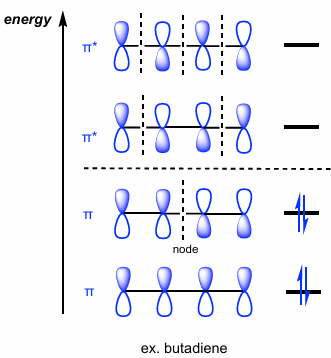
the lowest-energy MO has every p-orbital lobe in phase, and it has one node (through the nucleus, splitting p orbitals in half)
each higher MO adds exactly one more node; more nodes = higher energy. the most antibonding MO (all adjacent lobes out of phase) is highest in energy
fill the MOs from the bottom up with the correct number of pi electrons (electrons participating in the pi system: 2 from each bond, 2 from a lone pair)
if there’s an odd number of p orbitals, then one of the p orbitals will lie on the boundary (neither bonding nor antibonding)
if there’s an even number of p orbitals, then there will be an event number of p orbitals above and below the boundary (so, either bonding or antibonding)
don’t forget to label the bonding / antibonding orbitals!
How to visualize the pi MOs for a linear system?
the HOMO-LUMO gap shrinks, and the system becomes more stable; this is bc very long, conjugated systems are especially low in energy and rigid/planar; e- can be delocalized across ALL of the atoms
the molecule becomes more stable
the difference between the energy levels decreases
fully conjugated pi systems are rigid
What happens as conjugation length increases (greater number of atoms in one continuous chain of parallel p orbitals)?
unusual stabilization in cyclic, fully conjugated molecules containing 4n + 2 pi electrons (where n is an integer)
Aromaticity
certain cyclic, fully-conjugated systems that are destabilized bc it forces unpaired e- into degenerate (MOs with exactly the same energy), half-filled MOs
because they’re so unstable, molecules that would otherwise be antiaromatic pucker out of planarity (e.g., into a boat conformation) to avoid full-conjugation and anti-aromaticity
cyclic, fully-conjugated, contains 4n pi electrons
Anti-Aromaticity

Frost Circle Mnemonic: visualize pi MO energies in aromatic + anti-aromatic compounds
Draw a circle, then inscribe the appropriate regular polygon inside it, with one vertex pointing STRAIGHT DOWN
every point where the polygon touches the circle marks the energy of one MO
a horizontal line through the center marks bonding vs. antibonding; MOs below it are bonding (pi), MOs above it are antibonding (pi*)
fill the resulting energy levels from the bottom up with the ring’s pi electrons, then apply Huckel’s rule to the total count; aromatic compounds will have all bonding MOs filled; anti-aromatic compounds will have two unpaired electrons in degenerate (same energy level) MOs (unstable)
How to visualize the pi MOs for a ring system?
ring more stable if 4n+2 pi electrons (bc aromatic)
chain more stable if 4n pi electrons (bc aromatic)
How do ring and linear chain systems compare in stability for pi MOs?
acids = proton donors; bases = proton acceptors
Bronsted-Lowry acids and bases
![<ul><li><p>used to quantify the acidity of a compound</p></li><li><p>K<sub>a</sub> = ([H<sub>3</sub>O<sup>+</sup>][A<sup>-</sup>]) / [HA]</p></li><li><p>higher K<sub>a</sub> = stronger acid</p></li></ul><p></p>](https://assets.knowt.com/user-attachments/7e39c6c3-d355-4afc-8ebc-53b9c7d79d0f.png)
used to quantify the acidity of a compound
Ka = ([H3O+][A-]) / [HA]
higher Ka = stronger acid
Equilibrium constant (Ka) of the dissociation of a compound in water, assuming an infinitely dilute aqueous solution
pKa = -log[Ka]
Ka = 10-pKa
smaller pKa = stronger acid
pKa
10(pKa acid product - pKa acid reactant) = 10delta pKa)
Keq
non-superimposable on its mirror image; exhibits optical activity by rotating plane-polarized light; lacks plane of symmetry
Chiral
describe a molecule that is superimposable on its mirror image; doesn’t exhibit optical activity; commonly possesses a plane of symmetry
Achiral
a pair of chiral molecules that are non-superimposable mirror images; have the same connectivity and differ only in the spatial arrangement of each stereocenter
if multiple stereocenters present, a pair of enantiomers must have opposite R/S configurations at every stereocenter
have identical physical properties + same energy on a reaction coordinate diagram
differ only in their interactions with a chiral environment (either other chiral molecules or plane-polarized light)
rotate the plane of plane-polarized light equally in opposite directions
Enantiomers
50-50 mixture of two enantiomers; doesn’t exhibit optical activity because no NET rotation of plane-polarized light (the rotation due to each enantiomer cancels out)
Racemate (racemic mixture)
spatial arrangement of atoms or groups around a stereocenter; R/S
Absolute configuration
more stable = weaker
Charge: positive charge = more stable base bc less likely to donate e-, more likely to gain = stronger acid
Atom (look at acidic site):
Electronegativity (across row): more electronegative = better able to stabilize negative charge after loss of H = more stable base = stronger acid
Polarizability (down column): more polarizable = electrons more spread out = less e- repulsion = more stable base = stronger acid
Hybridization: increased s character = e- held closer to nucleus = more stable base = stronger acid
Resonance: delocalized electrons / charge = better able to stabilize negative charge after loss of H = more stable base = stronger acid
if resonance withdraws e- from acidic site = better able to stabilize the negative charge after loss of H = more stable base = stronger acid
Inductive effect: presence of an electronegative atom = shifts e- density through sigma bonds = stabilizes negative charge after loss of H = more stable base = stronger acid
inductive effect stronger the closer it is to acidic site + the greater number of electronegative atoms present
Electrostatic: like charges near each other is destabilizing; opposite charges near each other is stabilizing
Determining acidity / basicity
diastereomeric molecules with multiple stereocenters will have at least one stereocenter of the same configuration and at least one that is different
differ in their physical properties and chemical reactivity
arise from differences in configuration at stereocenters or at alkenes; may be achiral
Diastereomers
isomers = compounds w/ same molecular formula, but different arrangement / connectivity of atoms
structural (constitutional isomers): isomers with different atomic connectivity
stereoisomers: isomers with same atomic connectivity, but different 3D arrangement of atoms in space
enantiomers: two stereoisomers that are non-superimposable mirror images
diastereomers: two stereoisomers that are NOT mirror images
How to identify what different kinds of isomers?
molecule containing two or more stereocenters that also possesses a plane of symmetry, which renders it superimposable on its mirror image
achiral and cannot have enantiomers
will always have a chiral diastereomer
optically inactive
Meso compounds
split the alkene in half (split the double bond)
identify the group with the highest priority among the two groups on each side of the split
if the two higher priority groups lie on opposite sides of the double bond, the configuration is E (entgegen)
if they are on the same side, the configuration is Z (ZIS = CIS = SAME)
How to assign E/Z to alkenes.
2n = max number of stereoisomers (enantiomers + diastereomers), where n is the number of stereocenters
be careful if you’re already given a molecule (that counts as one of the stereoisomers!
this number is reduced in the presence of internal symmetry (e.g., meso compounds)
How to determine number of stereoisomers
stereoisomers that may be interconverted by rotation about one or more single bonds
considered identical molecules
conformational isomers (conformers)
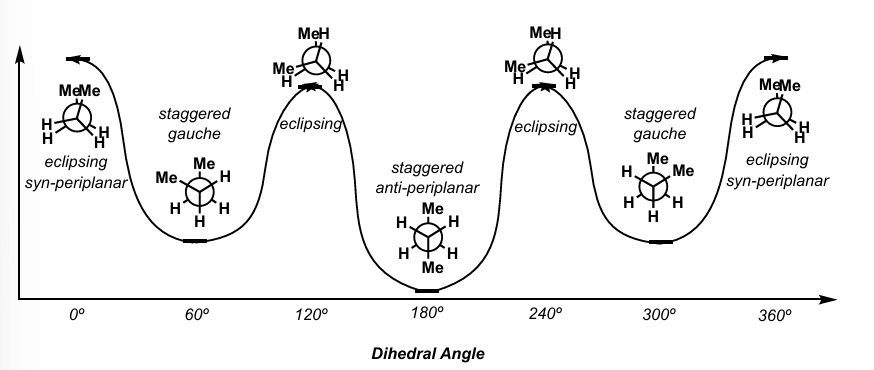
eclipsed interaction: energetic penalty (for steric and stereoelectronic reasons) for orienting groups with a 0 degree dihedral angle
penalty of 1 kcal/m for each H-H eclipsing interaction, 1.4 kcal/m for each C-H, 3 kcal/m for each C-C
gauche interaction (type of staggered): smaller energetic penalty (for steric reasons) for orienting large groups at a 60 degree dihedral angle relative to each other
penalty of 0.9 kcal/m for each C-C
antiperiplanar / anticoplanar: largest groups 180 degrees apart → least steric repulsion → most stable (lowest energy)
want big compounds to be as far away from each other as possible to be lowest in energy
Conformational analysis for acyclic systems (different kinds of interactions)

Electronic argument
staggered: weak overlap between filled and unfilled orbitals (e.g., filled bonding orbital and unfilled antibonding orbital) —> some delocalization of e-
this overlap is lost in eclipsed conformation
Why is eclipsed less favorable than stagged conformation for acyclic systems?
Ring strain:
involves bond-angle strain + energetic penalty for repulsive steric interactions btwn eclipsing and gauche substituents on the ring
bond angles in cyclic all-sp3 molecules won’t be able to reach ideal 109 degrees corresponding to perfectly tetrahedral carbon
deviations from ideal angle —> poor physical overlap between bonding orbitals —> weaker bonds (bond-angle strain)
Small rings (3- and 4- membered rings):
significant ring strain bc of bond-angle strain + repulsive steric interactions btwn eclipsing substituents
very reactive through mechanisms that release that ring strain
Normal rings (5-, 6-, 7-membered rings):
adopt non-planar conformations allowing them to minimize bond-angle strain and eclipsing interactions
cyclohexanes (6-carbon rings) are strain-free (important!)
Medium rings (8- to 14- membered rings:
adopt non-planar conformations
can shift significant bond-angle strain, but repulsive steric interactions remain problematic + destabilize these rings
Ring strain (definition and different types)
strain-free bc can access a chair conformation w/out bond-angle strain + completely staggered arrangement of ring substituents
can access a range of other conformers during chair-flip:
for chair flip: keep the chair the same configuration; just shift substituents on the carbon, one carbon over
Conformations of cyclohexane

axial points up if the carbon is the tip of an N, down if the carbon is the tip of a V
equatorial points opposite direction of axial and parallel to the bond that is one bond over
steps for drawing a chair cyclohexane
energetic difference btwn putting non-hydrogen substituents in an axial position vs. an equatorial position due to the repulsive 1,3-diaxial interactions present in the axial position
as size of substituent increases —> greater preference for remaining in the equatorial position
A-value = Gaxial - Gequatorial = how much a substituent prefers the equatorial position over the axial position
larger A-value = putting substituent in axial is much less favorable
tert-butyl groups = lock substituted cyclohexane rings into single conformation that places the t-butyl equatorial bc they suffer such large steric penalty in the axial position
What can cause certain chair conformations of cyclohexanes to be more favorable than others?
two rings sharing 3 or more atoms
Bredt’s rule: a bridged bicyclic compound cannot have a double bond at a bridgehead position (carbon atom in a bicyclic molecule that is shared by the two rings and acts like an “endpoint” of the different paths connecting the rings), unless one of the rings contains at least 8 carbon atoms
Bridged bicyclic compounds

contain two rings sharing two or more adjacent atoms: two rings are fused together at the bridgehead atoms, and they share a common bond (bond btwn the bridgehead atoms)
decalin = example of fused bicyclic compound; exists as two diastereomers
to draw fused bicyclic compounds:
draw one ring, and add in the hydrogens in the correct position
then draw in the axes not occupied by the hydrogens (but on the same carbon)
that provides the skeleton for the other ring, so just finish drawing it!
Fused bicyclic compounds
delta G = delta H - T delta S
delta G < 0 when a reaction is thermodynamically favorable (possible in the forward direction): can be due to forming more stable bonds / species (enthalpic factors), which decreases enthalpy, or by increasing disorder (entropic factors)
compounds can become more stable, either through sterics (relieving strain) or electronics (charges placed on atoms that can better stabilize them
delta G = -RT ln Keq ←→ Keq = e-delta G / RT
if the forward reaction is favorable: delta G < 0, Keq > 1
if reverse reaction favorable: delta G > 0, Keq < 1
if forward and reverse reactions equally favorable: delta G = 0, Keq = 1
Gibbs free energy
Keq = relative concentrations of starting materials + products at equilibrium = [products] / [reactants]
Equilibrium constant
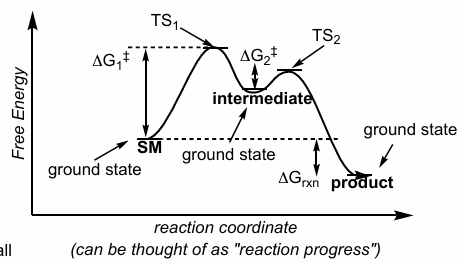
Ground state: relative energy minima on a free energy diagram; includes all starting materials, intermediates, and products
Transition state (TS): relative energy maxima on a free energy diagram; a single transition connects each pair of ground states
Activation energy (delta Gdouble dagger): difference in energy btwn ground state and transition state, or amount of energy needed for a step to occur
overall activation energy = amount of energy needed for overall reaction to occur
transition state theory
Free energy diagram or reaction energy profile diagram
rate = k[SM] = kdouble daggerT e-delta Gdd / RT[SM]
the rate of a reaction is proportional to the concentrations of the reactants that come together in the transition state
the rate constant k is directly related to the activation energy of a process; will be characteristic of a particular reaction mechanism
the larger the rate constant, the faster the reaction
for a reaction to take place at a measurable rate at room temperature (ca 300 K), it must have an activation barrier of delta Gdouble dagger < 25 kcal/m
Transition state theory (for free energy diagram)

a reaction where forward and reverse reactions can both occur to a significant extent under the same conditions → equilibrium btwn reactants + products
occurs when reactants + products have free energies that aren’t too different (delta G < 13 kcal/m)
Reversible reaction

when reverse reaction won’t occur to any significant degree bc:
one or more products are removed from the reaction mixture as they are formed (e.g., gas evolution)
the products are much more stable than the starting materials such that the rate of the reverse reaction is prohibitively slow (delta G <= -13 kcal/m)
Irreversible reaction

(to aldehydes and ketones)
after the nucleophile attacks the aldehyde/ketone, an H+ will be added to the ion, because ions aren’t stable (don’t want ions as a final product)
Possible reagents (nucleophiles):
hydride sources (H:-): NaBH4, LiAlH4
arrow is drawn from the sigma bond between H and heteroatom (which is the HOMO) to the carbon on the ketone/aldehyde
ex:// NaBH4: breaks up into Na and then BH4
carbanion sources (C:-): R3CLi, R3CMgBr
arrow is drawn from sigma bond between C and heteroatom (which is the HOMO) to the carbon on the ketone/aldehyde
yield an irreversible addition a carbonyl bc:
pi C-O bond is replaced with a stronger sigma C-Nu bond (sigma bond is stronger, which is why sigma bond is lower in energy)
charge is stabilized going from reactant (hydride or carbanion) to product (O-)
Electrophiles (aldehyde vs. ketone)
Hyperconjugation: sigma C-H bond (filled, HOMO) on ketone can have weak overlap with the pi* bonding of C=O (unfilled, LUMO), which is stabilizing → donates e- to the carbonyl C (carbon because it has a bigger lobe due to antibonding), making C less electron poor and thus less electrophilic
after hyperconjugation, LUMO is raised (less electrophilic)
Because aldehyde has a hydrogen where ketone has a CH3, there’s no net interaction / overlap of orbitals → no hyperconjugation
Irreversible nucleophilic addition
H+: proton
H-: hydride
H. : hydrogen atom
H2: hydrogen molecule
Different forms of H
(+) and (-) are physical properties, cannot be determined by the structure or by correlation with R/S; properties of the entire molecule
labeled as (R)-(+)-2-butanol
Optical activity (of enantiomers)
diastereomers
What is the stereoisomer relationship between cis and trans-2-butene?
first check: does it have a stereocenter
if a molecule has 0 stereocenters, it is likely achiral
if has only 1 stereocenter, must be chiral
if has >1 stereocenters, check other property!
second check: is there a mirror / internal plane of symmetry
if yes, achiral
if no, chiral
Determining chirality
strong acid: pKa <= 0
strong base = conjugate acid: pKa >= 14
strong acid → weak conjugate base
weak acid → strong conjugate base
Acid / Base Strength