HACCP
 Call Kai
 Learn
 Practice Test
 Spaced Repetition
 Match
 Flashcards
 Knowt Play
1/33

There's no tags or description
Looks like no tags are added yet.
34 Terms
What does HACCP stand for?
H: Hazard
A: Analysis and
C: Critical
C: Control
P: Point
What are the objectives of application of the HACCP system?
More efficient quality assurance system
Prevention of foodborne illness
Reduction of losses due to product recall
Reduction of costs of food analyses
Protection of reputaiton
What is the difference between pre-requisite programmes and HACCP?
Pre requisite programmes are not specific- can't usually quantify
They are a good foundation for the more specific HACCP
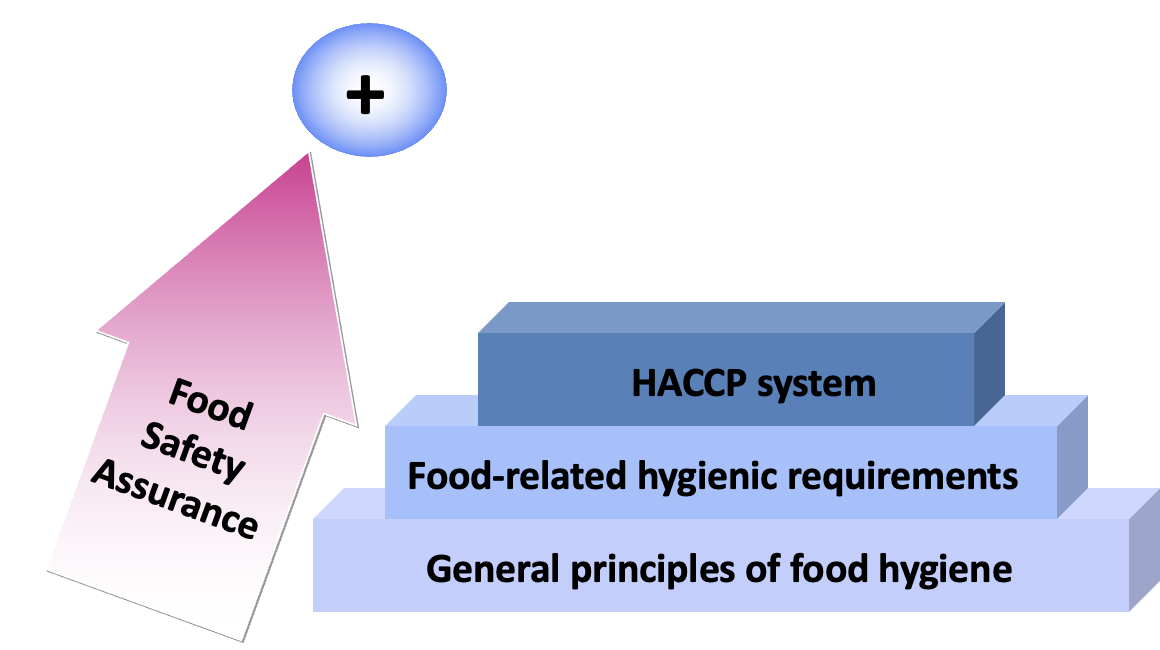
What are the 7 HACCP principles?
Conduct a hazard analysis to identify any hazards that must be prevented, reduced or eliminated;
Identify the critical control points (CCPs) at the steps at which control is essential;
Establish critical limits for CCPs;
Establish procedures to monitor the CCPs;
Establish corrective actions to be taken when monitoring indicates that particular CCP is not under control;
Establish procedures to verify whether the above procedures are working effectively; and
Establish documentation and records to demonstrate the effective application of the above measures.
What are the steps of implenting HACCP?
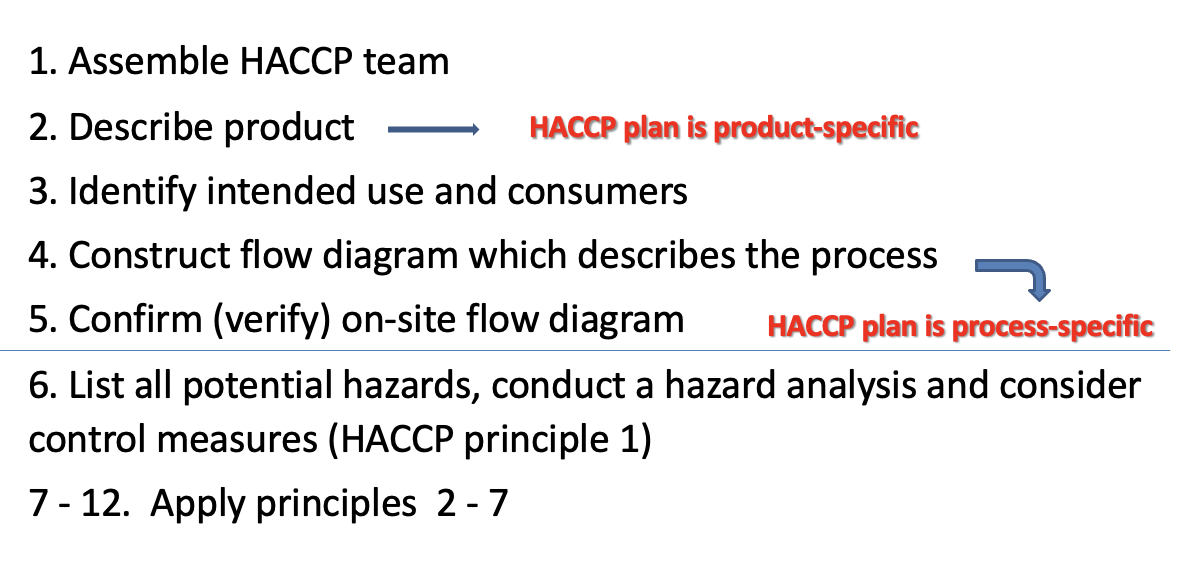
Explain what happens in HACCP Principle 1 'Hazard Analysis'
1- Identification of hazard
2- Basic risk estimation either quantitative and/or qualitative evaluations
E.g.- adverse health effects (qual), probability (quant), consequence
3- List some hazard control options
Example table:
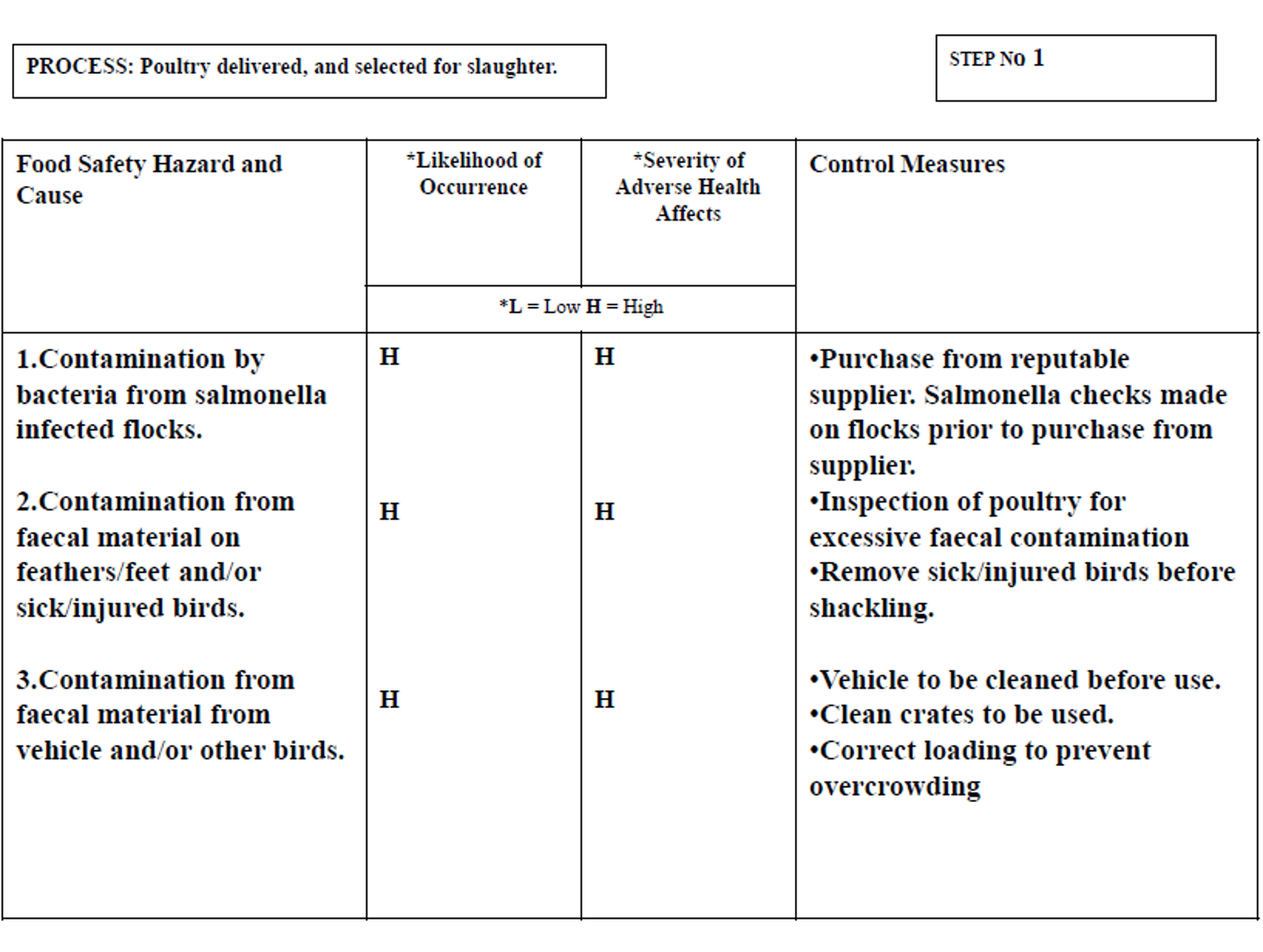
overall risk the likelihood consequences (adverse health effects)
List the principles of hazard control
Prevention of contamination
Prevention of increase in level
Assurance of adequate reduction
Prevention of recontamination
Prevention of dissemination (spread)
Elimination
How can hazards be controlled?
Purchase from a reputable supplier. Use reputable haulier
Visual checks of animals presented for slaughter
Scheduled cleaning
Correct temperature control: Fridges/freezers/chilling hall. Knife/saw sterilisers, scald tank/singe (time)
Use potable (drinking quality) water (water analysis checks)
Minimise time carcases spend at ambient (room) temperature
Staff hygiene training/rules (records)
Staff fitness to work. (medical certificates/screening)
Correct stock rotation
Use food safe packaging
Scheduled maintenance: plant/equipment/buildings
Pest control
When should you perform a hazard analysis?
During product development
During industrialization of new product
When new hazards emerge
When new raw materials are used
When formulation or use is changed
When equipment is changed
With new (layout of) production area
Recall HACCP principle 2
Identify the critical control points (CCPs)
Ex:-
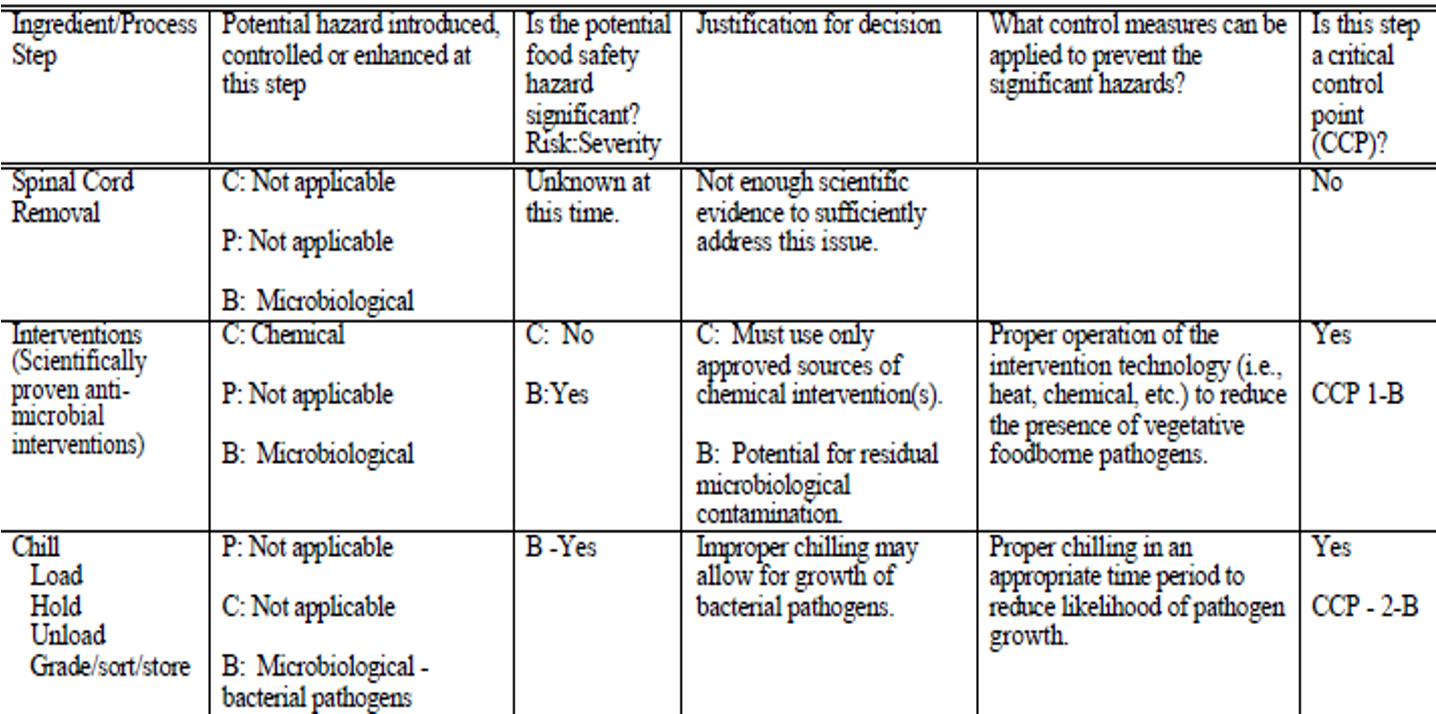
What is a CCP?
A step at which control can be applied and is essential or prevent or eliminate food safety hazard or reduce it to acceptable levels
Applicable to raw processes where there are no steps that can completely prevent or eliminate a biological hazard
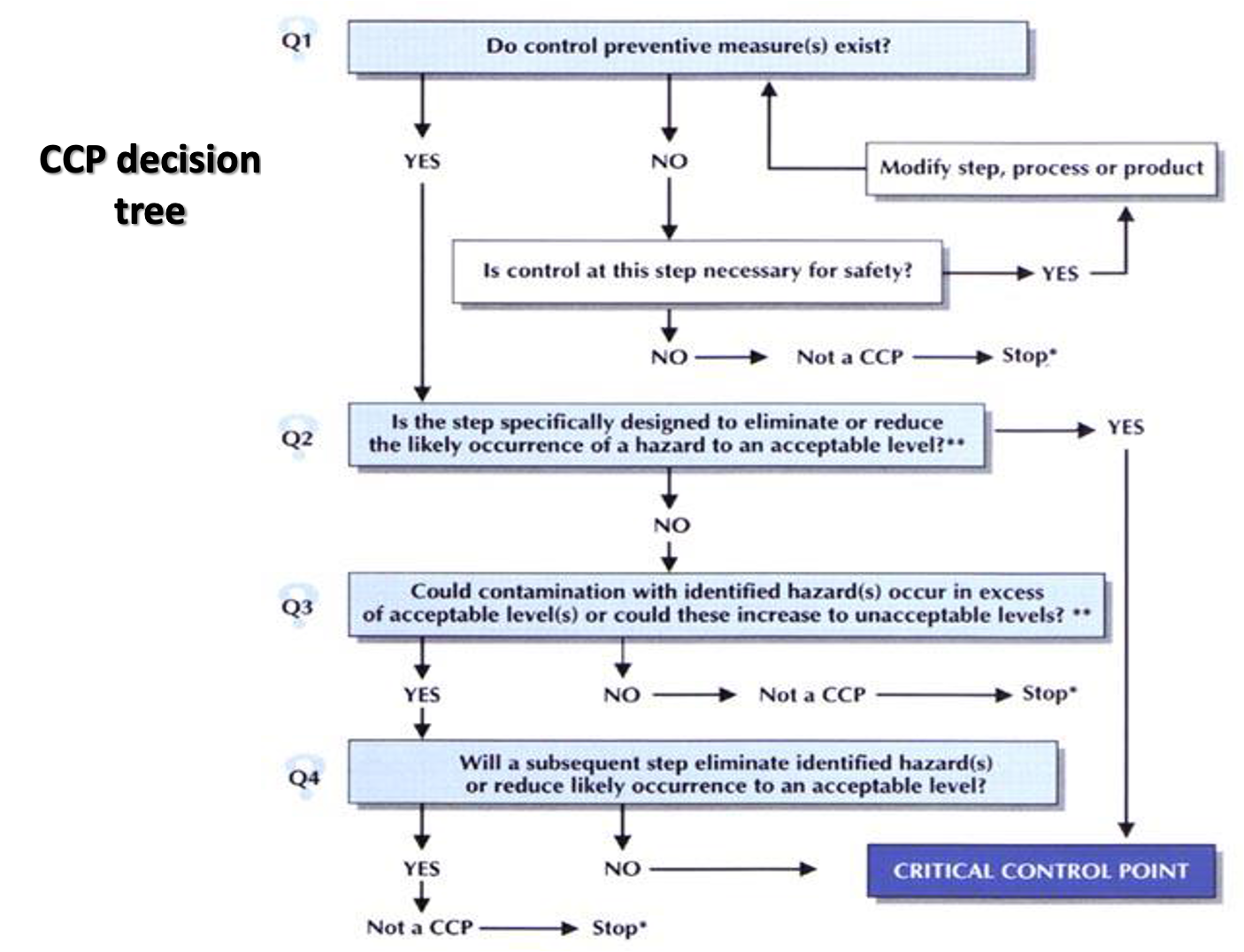
What is used to facilitate the identification and location of each CCP?
CCP decision tree
Ex:
Recall HACCP principle 3
Establish critical limits for CCPs
What is a critical limit? What is it used for?
A maximum and/or minimum value to which a biological, chemical or physical hazard must be controlled at a CCP
Distinguish between safe and unsafe operating conditions at CCP
How many critical limits should each control measure have? Give an example of a critical limit?
One or more
Zero visible faecal material, ingesta and milk on carcasses after slaughter and internal carcass
Temperature within 24 hours of slaughter
Recall HACCP Principle 4
Establish procedures to monitor the CCPs
How are the CCPs monitored in HACCP Principle 4? Give examples
Regular observations/ measurements to assess whether the CCP is under control
Should detect problem before critical limits are reached
Examples:
Visual monitoring of a certain number of carcasses per hour for faecal contamination;
Checking of carcass temperature by the cooler operator every hour
What is the key difference between monitoring (principle 4) and verification (principle 6)?
Monitoring is done in real time whereas verification is an audit and can take place after the process
Recall HACCP Principle 5
Establish corrective actions
What are corrective actions?
Actions to be taken when the monitoring indicates that the process is moving out of control at CCP
To bring the process back under control and prevent a food safety hazard
What should corrective actions include?
Determine and correct the cause of the deviation;
Determine the disposition of the affected product;
Record the corrective actions that have been taken (so can be verified in principle 6)
Recall HACCP principle 6
Establish verification and validation procedures
What are the components of HACCP principle 6
Verification
Validation
Regulatory assessment
What are validation procedures?
Check to confirm that the elements of the HACCP plan are effective in controlling the relevant hazards
Before implentation
It is a subset of verification
What are verification procedures?
Activities, other than monitoring, that determine the validity of the HACCP plan and that the system is operating according to the plan
Primarily the responsibility of the industry, but also during regulatory assessments (further verified by OV)
Give some example of verification activities
Review of monitoring and corrective action records,
Direct observation of the persons responsible for conducting the monitoring and taking the correct actions,
Calibration of any monitoring equipment and
Testing of finished product samples
What is regulatory assessment?
Checking compliance (external check that the FBO is effective and compliant with legislation)
establish whether the food business has the ability to consistently manufacture, and / or distribute safe food
What should be assessed in a regulatory assessment?
HACCP management
HACCP plan development
Hazard Analysis
Control measures
Verification procedures
Documentation
Implementation
Recall HACCP principle 7
Establish documentation and records
What are the types of documentation and records that are established in principle 7 of the HACCP plan?
Details of the HACCP plan
Monitoring records
Corrective actions records
Verification results
What is the responsibility of food industry in HACCP?
To ensure proper application of HACCP principles and implementation of the HACCP plan
To provide evidence of this to government authorities when requested
What is the responsibility of the government in HACCP?
Facilitators- clarifying goals and scope of HACCP
Enforcers- assess correct application and implentation
Trainers- assist in or provide training programmes
List some advantages of HACCP
Proactive and preventative
Owned by the producers and staff
Specific, systematic, scientific and documented
List some of the limitations of HACCP
Expensive in the start
Demanding of staff and time
Difficult for small operators/large number of products