Liquid Chromatography
 Call Kai
 Learn
 Practice Test
 Spaced Repetition
 Match
 Flashcards
 Knowt Play
1/38

There's no tags or description
Looks like no tags are added yet.
39 Terms
Sample Types for LC
must be soluble in an appropriate mobile phase (ideal to use H2O tho)
non-volatile biological molecules (proteins, lipids, etc)
toxicological samples (drug & drug metabolites)
metabolites may be too polar for GC analysis
analyte —(liver)→ metabolites (more polar = ex. urine) → have to be highly soluble in water (why metabolites are more polar)
environmental samples such as pesticides and herbicides
pharmaceuticals
Liquid Chromatography
separation using packed columns containing small (porous Silica) particles that contain stationary phase (separation technique)
packed column = requires high pressures
not an easy travel because liquid will take a while to get through packed column & interact with stationary phase (need pump)
mobile phase = liquid
analytes interact with stationary phase and mobile phase
different from GC (only interacts with stationary phase)
avoids solids (clogs the system)
removes derivization from procedure (p

Mobile Phase
organic/aqueous solvents used to depend on analysis → LIQUID
Degassing Unit
to remove dissolved air from the mobile phase (b)
Solvent Delivery Pump
to deliver the mobile phase at constant flow (a)
helps combine the mobile phases together (if using aqueous and organic mobile phase components)
Sample Vial
to store std solution or sample solution
Injector
introduce standard solution or real sample to the HPLC column ©
autosampler can be kept at cooler temperatures (diff from GC)
avoids degredation over time (want sample to be liquid)
Column Oven
keeps temp constant (d)
Column
to separate each compound contained in the sample
Detector
to detect the eluted compound(s) from the column (e)
Workstation
signal from the detector is processed and the chromatogram is displayed (f)
HPLC
Connecting Tubing = 0.175-0.125 mm ID
Particle Size = 3-5 um
Flow = 1-2 mL/min
Temperature controlled compartment → helps with stable environment and reproducible result → want temp to be slightly higher than ambient because of lower viscosity (easier to move through column)
if not controlled = ambient temp = affects separation
Expensive & can be easily damaged or degraded
stationary phase silica = doesn’t like harsh pH conditions
Additives used in mobile phase:
formic acid (changes pH but protonates ions)
ammonium formate (controls pH → chance of salt formation if washing column with highly organic mobile phase doesn’t happen)

UPLC
Connecting Tubing = 0.125-0.062 mm ID
Particle Size = < 2 um
Flow = 0.2-0.7 mL/min
Guard Column
between injector and analytical column
short column packed with similar stationary phase
GOAL = retain compounds you want & remove particles/unwanted compounds
typically, will replace this more often than analytical column

Typical NON-POLAR stationary phases
C18
C8
Phenyl
Typical POLAR stationary phases
Amino
Cyano
Diol
Normal Phase Chromatography
original form of partition chromatography
mobile phase = non-polar
stationary phase = polar → polar analytes retained more strongly
increasing mobile phase polarity decreases elution time
common SP = cyano, dimethylamine
Reversed Phase Chromatography
more common partition chromatography approach
mobile phase = polar
Polar mobile phase A (MPA) = water
Polar mobile phase B (MPB) = organic solvent (ex. Methanol, Acetonitrile)
**add additives to both of these phases
Stationary phase = non-polar (C18, C8, etc) → non-polar analytes are retained more strongly
increasing the mobile phase polarity increases the elution time
Hydrophilic Interaction Chromatography (HILIC)
used to separate highly polar molecules
useful with polar pharmaceuticals, peptides, and sugars
stationary phase is strongly polar, coated with a layer of water (due to MP)
MP = usually 60-97% ACN or aprotic solvent mixed with aqueous buffer
GRADIENT: increase % of water in MP (force hydrophilic compounds at some pt)
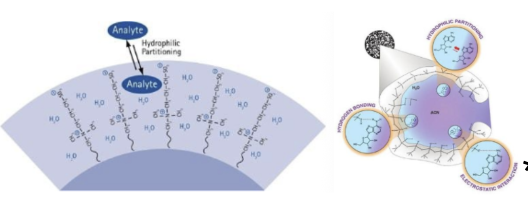
Silica
micron-sized pores with varying internal porosity (can be used for size-exclusion chromatography)
surface silanol groups (active & can interact strongly with polar analytes)
sensitive to pH and temp
How do you select a stationary phase?
depends on what you’re trying to separate => look for similar polarity between stationary phase & analyte

Mobile Phase Resevoirs
solvent containers for mobile phase
if using LC-MS, need to use LC-MS grade solvents
higher purity = avoid possible trace contaminants with spectrometer
General rule for normal phase chromatography
Mobile Phase A = aqueous (brown bottles)
Mobile Phase B = organic (colorless bottles)
always use HPLC grade solvents
no particulate
vacuum filter to remove dissolved gases (reproducability)
irreproducible flow rate & band spreading
avoid chromophores if using UV detection
no solids in mobile phase
What are 2 ways to avoid particles & contamination in LC instrument?
Effective sample preparation = EXTRACTIONS
For LC having contaminants = Guard Column
Solvent Considerations
avoid topping off bottles to reduce contamination
microbial growth could be issue
use sterile solvent resevoirs
change solvent regularly
avoid direct sunlight
use brown glass bottles
keep mobile phase pH less than 3
Polarity Index (P’)
ranks solvents based on ability to displace polar solutes/analytes
the higher the index = more polar the solvent
Why would we decrease the amt of water in mobile phase during run time?
to help push out the late eluting analytes

Selection of Mobile Phase pH
Degree of ionization (protonated or deprotonated)
Weak acids & bases with ionizable centers (can ionize/dissociate in soln)
Balancing hydrophobic & ionic interactions
ionized = more polar/hydrophilic = can interact with other electrostatic compounds/SP
unionized = more hydrophobic/less polar
pH of mobile phase that means 100% neutral or 100% ionized
High concentration of both ionized & unionized = peak broadening & asymmetry
Know analyte’s pKa

Adjusting pH of Mobile Phase
usually add stuff to aq mobile phase A
Using buffer of known pH
Adjusting pH of mobile phase before completing final volume
Add acid or base to mobile phase
Considerations for buffers
Low [Buffer] => concentration, pH, and absorbance might be poorly affected
High [Buffer] => solubility problems with organic solvents
Isocratic Elution
constant mobile phase composition throughout run
keep temp the same in GC
keep MP composition for LC

Gradient Elution
continuous change of mobile phase composition to increase the mobile phase strength (ex. make it more water over time)

Pumping System Requirements
generation of pressures up to 6000 psi (415 bar)
cut-off pressure (~600 bar) & safety procedure to shut down if it hits this and prevent solvent leaks
pulse-free output
flow rates ranging from 0.1 to 10 mL/min
flow reproducibility of 0.5% or better
resistance to corrosion by a variety of solvents
Delay or Dwell Volume
volume from the point of mobile-phase mixing to the column head
has a strong influence on analysis speed
due to this, designs of pump & sampler have substantial influence on speed of analysis
Priming
flush all mobile phases out of system (can have up to 4 set-up in standard LC)
conduct when installing a pump
conduct when you run out of mobile phase & then mobile line was running dry for a bit (BAD) = would help get them wet again
wash syringe with solvents
can be avoided if constant moderate flow => don’t have to do this though (just purge next time you use it)
Purging
done EVERY DAY if pump/mobile phases are sitting idle
conduct if pump has been sitting OR if mobile phase is changed
mobile phase goes through the lines & straight into waste
think back to miscibillity & intermediate solvents
Injection System
introduction of sample without depressurizing the system
AUTOSAMPLERS
high accuracy and precision
no need for analyst intervention

Accuracy of Injection System
achieve absolute preset value for injection volume
Precision of Injection System
injection of same volume over replicate runs
UV-Vis/PhotoDiode Array Detector
Z-shaped flow cell to measure absorption of eluant
keep flow cell as small as possible (1-10 uL & 2-10 mm path length) to avoid band broadening
double beam instruments or chopped beam splitter to compare eluant and reference cells
Chromatogram = absorbance vs. retention time
absorption is proportional to concentration
Scanning or diode array detectors to collect range of absorption wavelengths (operates in 190-900 nm wavelength range)
LC-UV measures few pre-selected wavelengths simultaneously
LC-PDA monitors entire wavelength range in real time
Advantages:
quantitative technique
good sensitivity (~ug) for UV-absorbing compounds
easy to operate
good stability
Limitations:
analyte must contain a chromophore or no detection
UV absorption produces quite broad spectra that limits specificity
Mass Spectrometry Detector
requires gas-phase samples
LC eluant is a liquid
must remove the solvent & vaporize the analytes into gas-phase
occuring at atmospheric pressure
two common approaches
1) Electrospray Ionization (ESI)
2) Atmospheric Pressure Chemical Ionization (APCI)