3.9 & 3.10 Mitosis and Meiosis
 Call Kai
 Learn
 Practice Test
 Spaced Repetition
 Match
 Flashcards
 Knowt Play
1/24

There's no tags or description
Looks like no tags are added yet.
25 Terms
What is mitosis and why is it important for cell?
the process of nuclear division by which two genetically identical daughter nuclei are produced that are also genetically identical to the parent cell nucleus
important for:
it enables the growth of unicellular zygotes into multicellular organisms
for the replacement of cells and repair of tissues
State the three stages of the cell cycle
1- interphase (the longest stage)
2 - Mitosis (has four main stages)
3 - cytokinesis
State and explain the stage of interphase
G1: cell synthesises proteins and organelles such as mitochondria
S phase: DNA is replicated to form 2 chromatids per chromosome (therefore there would be 46 chromosomes but 92 chromatids
State the four stages of mitosis
prophase
metaphase
anaphase
telophase
State and explain what happens in prophase
chromosomes condense and become visible when stained
centrioles move apart and spindle fibres form from centrosomes
the nuclear envelope begins to break down into small vesicles

State and explain what happens in metaphase
Chromosomes line up at the equator of the cell so they are equidistant to the two centrosome poles
chromosomes attach to spindle fibres at centromere

State and explain what happens in anaphase
The sister chromatids separate at the centromere (the centromere divides in two)
The separated sister chromatids are pulled to opposite poles by the spindle fibres

State and explain what happens in telophase
Chromosomes arrive at opposite poles and decondense
Nuclear envelope begins to reform around each set of chromosomes
The spindle fibres break down
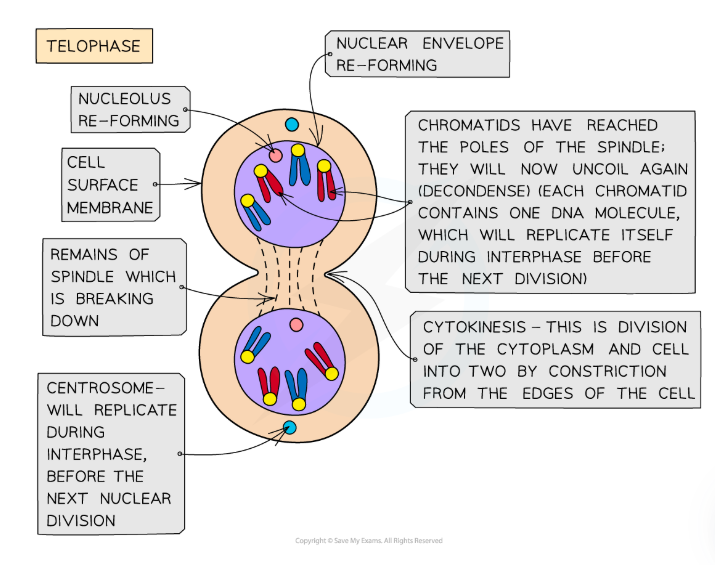
State and explain what happens in cytokinesis
cytoplasm divides
two cell membranes form
forming 2 genetically identical daughter cells
Describe and explain a graph showing the changes in DNA mass during the cell cyle (4)
DNA mass is constant during G1
it increases during S phase because DNA is replicated
it remains doubled during G"2 and early mitosis
it returns to the original amount per cell after nuclear division and cytokinesis
Define meiosis
a type of nuclear cell division that produces 4 genetically different / non-identical daughter cells
the four daughter cells are haploid cells
occurs only in reproductive organs to produce gametes
What is the function of meiosis and where does it take place?
function - to produce gametes
takes place in the testes and ovaries
How many cell division occur in meiosis and describe what happens during interphase?
there are two cell divisions
during interphase each chromosome has replicated to form two sister chromatids
the sister chromatids remain joined at a single centromere
the cell still has two homologous sets of chromosomes, although its DNA content has doubled
How do you count the number of chromsomes during mitosis or meiosis?
chromosomes are counted by the number of centromeres present
so when the 46 chromsomes duplicate during interphase and the amount of DNA double there are still 46 chromosomes
Explain why DNA replication doubles the number of chromatids but not the number of chromosomes
each chromosome is copied to form two gentically identical sister chromatids
chromatids remain joined at one centromere
chromosome number is counted by centromeres, so it does not increase until chromatids separate
Explain why DNA replication and mitosis maintain the chromosome number and genetic information in daughter cell (2)
DNA replication before mitosis copies the homologous chromosomes forming sister chromatids
sister chromatids are separated and each daughter nucleus contains receives one copy of every chromosome and the same chromosome number
Give two reasons as to why meiosis gives rise to genetic variation
independent assortment
crossing-over


crossing over:
the homologous chromosomes join at the chiasmata and swap genetic information as the chromatids are produced with different combinations of alleles
and leads to the formation of recombinant chromatids
e.g Ab/ aB
independent assortment:
different combinations of chromosomes (1 and 2) are prodcued
therefore the alleles for A and B could be in the same gamete as C or c
Explain how crosssing-over may differ in sex chromsomes
crossing-over cannot form between some of the sections of the X and Y chromosomes
as they are not homologous chromsomes
Give the formula to work out the number of possible pair of chromsomes during metaphase as they line up at the equator of the cell
2n
n = number of pairs
Explain the role of meiosis in the production of gametes (3)
produces haploid cells
genetic variation occurs through crossing over
crossing over involves the swapping of sections of chromatids
Explain the role of meiosis in the production of genetically variable sperm cells (5)
meiosis produces 4 haploid cells
genetic variation occurs due to crossing over
whereby the homologous chromosomes join at the chiasmata where tey exchange sections of chromatids
this reults in exchange of alleles between chromatids
and thus the formation of recombinants
genetic variation also occurs due to independent assortment
where homologous chromsoes line up in different combinations
resulting in new combination of alleles in the gametes
Explain why meiosis is needed in a sexually reproducing organism, rather than producing asexually (2)
meiosis halves the number of chromosomes and thus produces haploid gametes
fertilisation causes the fusing of both female and male gametes restoring the diploid number,
preventing chromosome number from doubling each generation
Compare mitosis and meiosis (6)
both forms of nuclear division
both involve the replication of DNA and sub-cellular structures
mitosis produces clones whilst meiosis produces gametes
mitosis occurs in all body cells except cells in reproductive organs, whils meiosis only occurs in he testes and ovaries
mitosis produces diploid cells whereas meiosis produces haploid cells
mitosis produces two genetically identical daughter cells whilst meiosis produces four genetically non-identical daughter cells